

Virtual Assistant Industry Trends 2026: Six Changes Shaping Human VAs
AI can now draft emails, summarize documents, research topics, organize information, create content and automate parts of workflows that once required manual support.
At the same time, general virtual assistance remains one of the most sought-after skills in Upwork’s 2026 skills research.
Those two facts make the virtual assistant industry trends 2026 story more interesting than either “AI is replacing VAs” or “the VA industry is booming.”
The role itself is changing.
Routine work is becoming easier to automate. AI-related skills are growing quickly. Businesses are looking for more specialized capabilities. Remote support can become more integrated into existing workflows. And when AI participates in the work, human judgment, validation and responsibility become more important, not less.
This is another stage in how the virtual assistant role has evolved.
Here are six changes worth paying attention to, along with what the available evidence actually supports.
1. AI augmentation is becoming part of the VA skill set
The clearest trend is not the arrival of an “AI virtual assistant” that makes human support obsolete. It is the growing overlap between human virtual assistance and AI-enabled work.
Upwork reported that skills explicitly referencing AI grew 109% year over year in its 2026 analysis. AI integration grew 178%, while general virtual assistance still remained among the platform’s most sought-after skills.
That combination matters.
It suggests businesses are not simply choosing between AI and people. They are increasingly buying human skills in an environment where AI is already part of the execution layer.
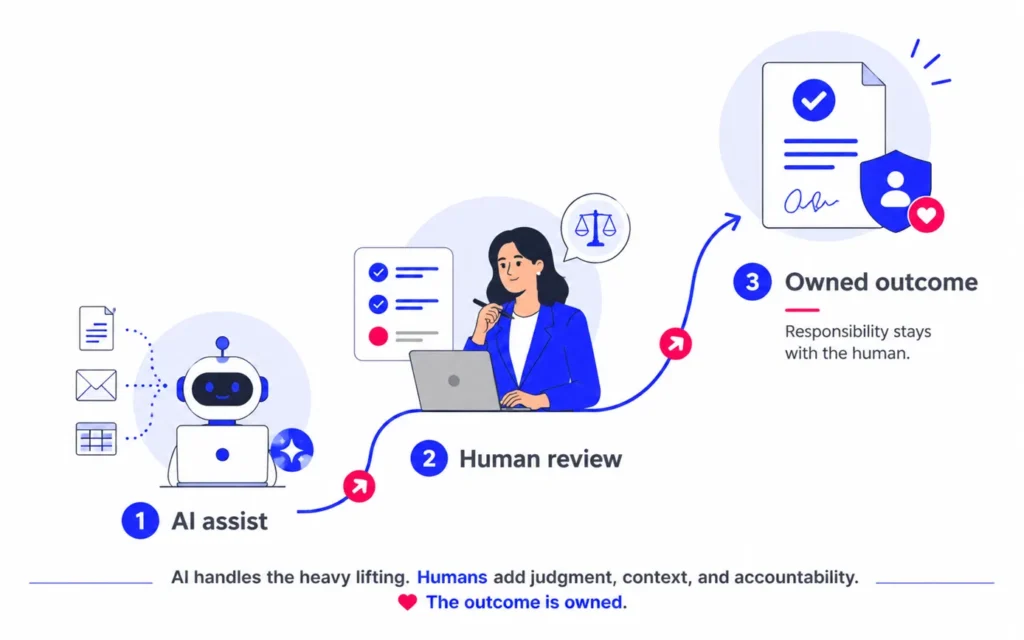
For a VA, that can mean using AI to accelerate parts of research, organize information, structure drafts, process repetitive material or support other knowledge work. The human side still has to understand the objective, check the result, handle exceptions and decide whether the output is actually usable.
McKinsey’s State of AI research reinforces that distinction. Its 2025 global survey found widespread AI use, but far fewer organizations had progressed to scaled implementation. Organizations reporting stronger results were also more likely to have redesigned workflows rather than simply giving people access to AI tools.
So the useful question is no longer:
Does a VA use AI?
A better question is:
Can the VA use AI inside a reliable process without allowing speed to replace accuracy?
At Boost VA, I use AI and lightweight automation as support for suitable work while keeping human review and source checking in the process.
2. Virtual assistance is becoming more workflow-integrated
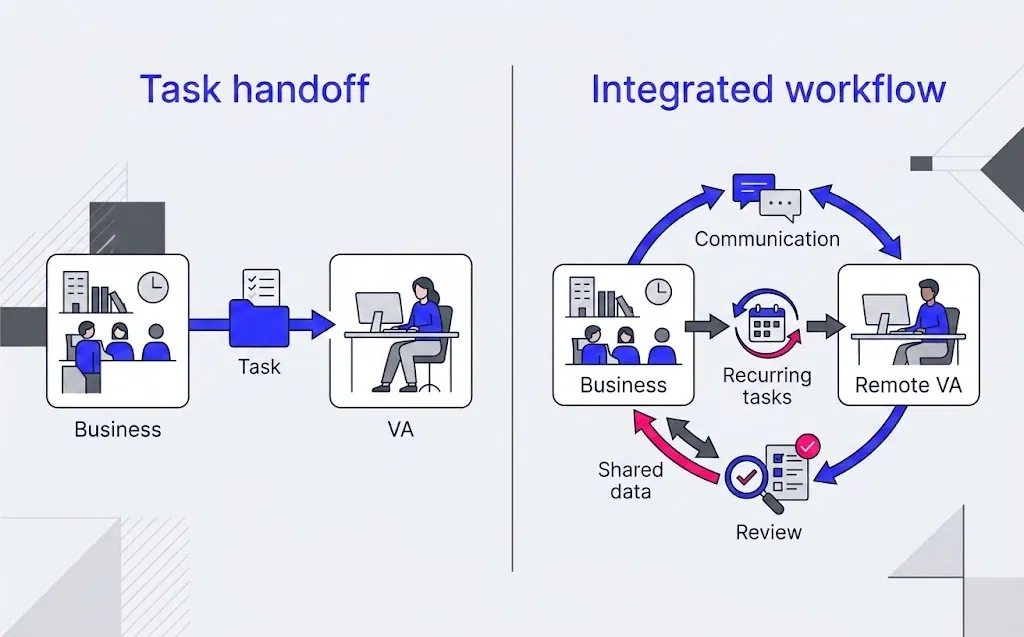
The traditional image of virtual assistance is highly transactional.
A business sends a task. The assistant completes it. The result comes back. Then another task arrives.
That model still works for defined assignments, but some recurring support is moving closer to the company’s normal operating workflow.
Instead of receiving isolated instructions each time, the VA may work from existing SOPs, shared project systems, recurring reporting structures, content calendars, CRM processes or established marketing workflows.
Wishup describes a related model as the “hybrid VA.” That term should be treated carefully because it is not a standardized industry classification.
Still, Wishup’s 2026 VA industry report provides an interesting signal from its own customer base. Its internal sample reports 54% of engagements as full-time and 40.5% as half-day, with only 5.5% under four hours.
Those numbers describe Wishup’s clients, not the whole virtual-assistant industry. But they suggest that, within one large VA provider’s customer base, longer and more embedded working relationships are significant.
The practical difference is context.
An assistant working inside a repeatable system does not have to rediscover the same information every time a task appears. They can understand how one piece of work connects to the next, what requires approval and when something should be flagged instead of guessed.
That is also why access, instructions, boundaries and review processes matter when you work with a marketing VA without constant back-and-forth.
3. Specialization and platform fluency are becoming more valuable
Being able to handle a wide range of work is still useful.
But general availability alone becomes a weaker differentiator when AI can help almost anyone produce a first draft, summarize information or complete basic digital tasks faster.
Specific capability matters more.
Upwork found that 77% of business leaders in one October 2025 survey said AI was increasing their need for fractional talent with specific specialist skill sets. That research covers the broader skilled freelance market rather than virtual assistants specifically, so it shouldn’t be treated as a VA adoption statistic.
The direction is still relevant.
Upwork’s July 2026 marketplace analysis also found AI searches becoming more specific to roles and production outcomes instead of remaining broad searches for generic AI capability.
For virtual assistance, specialization does not necessarily mean abandoning general support.
It may mean combining general execution ability with stronger competence in a particular environment, such as:
SEO and outreach workflows
WordPress content operations
CRM and structured data work
social media production
research and prospecting
local SEO
project coordination
AI-assisted content or operational workflows
The useful distinction is between knowing a tool exists and knowing how to use that tool to produce a reliable business outcome.
A VA who understands the system around the task can usually contribute more context than someone working from instructions in isolation.
That makes platform fluency, domain familiarity and process awareness increasingly important parts of the role.
4. Routine work faces automation pressure, but human judgment still matters
It would be misleading to talk about AI augmentation without acknowledging the other side of the trend.
Some administrative and repetitive work is becoming easier to automate.
The World Economic Forum’s Future of Jobs Report 2025 identifies technology as a major force reshaping jobs through 2030 and includes several clerical and administrative roles among occupations expected to decline.
That creates genuine pressure on work built primarily around predictable manual steps.
But the transition is not happening evenly.
In Upwork’s June 2026 hiring data, AI Apps & Integration hiring increased 34% month over month. During the same period, among its SMB clients, QA testing increased 20% and data entry and transcription increased 19%.
That is a useful reminder that automation does not instantly remove the surrounding work.
Businesses still need people to check outputs, clean information, resolve unusual cases, verify sources, maintain systems and notice when something doesn’t look right.
The value can therefore shift from simply performing every step manually toward:
execution + checking + context + exception handling + responsibility
This also changes delegation decisions.
If a task is predictable enough to automate safely, automation may be the right choice. If the task requires context or human checking, delegation may make more sense. And some work should remain with an owner or qualified specialist.
A delegation matrix can help separate what to keep, delegate, automate or remove instead of treating all administrative work the same way.
The important point is not that human VAs are protected from automation.
They aren’t.
The stronger position is that current evidence shows automation pressure and continuing demand existing at the same time.
5. Lean scaling now has a human-plus-automation option
Businesses have traditionally thought about capacity in relatively simple terms.
If there is too much work, hire someone.
Flexible remote work, freelance talent and automation have added more combinations.
Upwork’s 2026 Future Workforce Index reports skilled freelancing rising from 28% of skilled knowledge workers in its 2025 sample to 38% in 2026. The same research also points to growth in AI-augmented professional services.
Again, this is broader workforce evidence, not a measurement of VA adoption.
But it supports an important strategic shift.
For some companies, adding capacity can now mean combining:
automation for predictable work;
a VA for recurring execution and coordination;
a specialist freelancer for defined expertise;
employees for roles requiring deeper internal ownership.
That gives smaller businesses more ways to structure capacity without pretending one work model is automatically better than another.
If you are deciding between those options, the real comparison is not simply cost. It is continuity, required expertise, workload consistency, management needs and how closely the work must sit inside the business.
That is why it can help to compare a virtual assistant, freelancer and employee based on the work itself.
Remote work also has stronger evidence behind it than some of the inflated productivity statistics repeated online. A randomized study published in Nature followed 1,612 Trip.com employees and found that working from home two days per week reduced quitting by one-third without detectable harm to performance grades, promotions or lines of code.
That does not prove remote workers are universally more productive. It does show that distributed work can function effectively without requiring exaggerated productivity claims.
The same caution matters when assessing VA productivity. A case study can show what happened in one company, but it should not become a universal multiplier. That distinction is explored in this marketing agency VA capacity case study.
6. AI governance and validation are becoming VA competencies too
Once AI enters a workflow, the question is no longer only whether the output is useful.
You also have to consider:
What information is being entered into the tool?
Who checks the result?
What happens when the AI invents or misreads something?
Which actions require approval?
What access does the assistant have?
Which information should never leave an approved system?
Who remains accountable for the finished work?
These are operational questions.
McKinsey’s 2026 AI Trust research found that governance and controls around newer AI systems still lag adoption across many organizations.
Meanwhile, Microsoft’s 2026 Work Trend Index found that workers using AI increasingly valued skills such as quality control and critical thinking.
That matters for virtual assistance because a capable AI-enabled assistant cannot simply send everything through a model and accept whatever comes back.
Responsible use increasingly involves knowing when AI is suitable, validating important outputs, protecting information and escalating uncertainty.
The more capable the automation becomes, the more important those boundaries become.
The 2026 VA Trend Radar: what is real, emerging and still worth watching
Not every “virtual assistant trend” deserves the same level of confidence.
Here is a practical way to separate the stronger 2026 signals from claims that still need more evidence.
| Status | Signal | Evidence reading | What it means for a business |
|---|---|---|---|
| NOW | AI-assisted VA work | Strong | Evaluate how AI is used and reviewed, not merely whether it is used. |
| NOW | Greater value in specialization and platform fluency | Strong broader freelance evidence | Match the VA’s capabilities to the actual workflow and tools involved. |
| NOW | Automation pressure on repetitive administrative work | Strong | Regularly reconsider whether predictable steps should still be performed manually. |
| NOW | Human QA, judgment and validation | Strong | Define review, escalation and accountability when AI participates in execution. |
| EMERGING | Workflow-integrated or embedded VA relationships | Useful provider-level and operational evidence | Recurring work may benefit from context, SOPs and closer integration rather than repeated one-off briefs. |
| EMERGING | Lean human-plus-automation capacity models | Strong broader flexible-work evidence, less specific to VAs | Consider combinations of automation, VA support, specialists and employees instead of treating staffing as one choice. |
| WATCH | Universal “2x” or “3x” AI productivity claims | Weak | Ask for measurable outcomes in the actual workflow instead of relying on headline multipliers. |
| WATCH | Claims that AI will either replace all VAs or replace none | Unsupported as a universal prediction | Expect task mix and skill value to change rather than assuming one outcome for the whole industry. |
The radar is a Boost VA editorial synthesis of the evidence cited in this article. It is not a surveyed market-share model.
What these virtual assistant trends mean when you hire support
The six trends point toward a different question for businesses.
Instead of asking only:
“What tasks can a VA do?”
Ask what type of support the work actually needs.
A recurring process may benefit from someone who learns the workflow, follows the SOP and owns consistent execution.
A defined technical problem may need a specialist freelancer.
A sensitive strategic decision may need to stay with the owner or a qualified professional.
A predictable digital step may be suitable for automation.
And increasingly, the answer may involve more than one of those options.
For VA support specifically, useful questions include:
Can this person work inside the tools and processes I already use?
Do they understand the subject well enough to notice mistakes?
How do they use AI, and what do they check manually?
What happens when instructions, source data or AI output conflict?
Does this workload need recurring support or a defined project?
Which decisions still require me or another specialist?
Those questions are more useful in 2026 than looking for a VA who simply promises to “do everything.”
The future of virtual assistance looks less generic
The evidence doesn’t point to a simple future where AI eliminates human virtual assistance.
It also doesn’t support pretending that the role is untouched by automation.
The stronger conclusion is that virtual-assistant work is being recomposed.
AI can handle more of the execution layer. Repetitive clerical work faces real pressure. At the same time, businesses continue to buy human support, and the value of specialization, context, workflow knowledge, validation and judgment is becoming easier to see.
That creates a higher bar for both sides.
VAs need more than task completion. Businesses need to think more carefully about what should be automated, delegated, reviewed or kept internally.
If you have a recurring workstream that needs dependable execution, or a defined project that needs hands-on support, you can explore ongoing and project-based virtual assistant support through Boost VA and choose the model that fits the work rather than forcing the work into the wrong model.