


Delegation Matrix: How to Decide What to Delegate, Automate, or Keep
Your task list can contain ten jobs that all feel important, but that does not mean all ten should stay with you.
Some tasks need your judgment. Some need to be completed consistently, but not personally. Others should be assigned to someone with the right skills, automated, postponed, or removed entirely.
The difficult part is deciding which action fits each task.
A delegation matrix makes that decision more structured. Instead of delegating whatever you dislike or keeping everything that feels important, you compare each task using two practical questions:
How important is this task to the business?
How much specialized judgment does it require?
Your answers place the task into one of four categories:
keep ownership;
delegate fully;
delegate with checkpoints;
automate, batch, or eliminate.
This guide will show you how to build the matrix, apply it to your workload, and choose the first tasks to move off your plate.
A Delegation Problem Is Not Just a Time Problem
A crowded schedule is often a symptom. The deeper problem is that too many tasks still depend on you.
You may be making strategic decisions in the morning, organizing meetings after lunch, updating a spreadsheet in the afternoon, and checking routine messages in between. The tasks are different, but they all compete for the same attention.
Asana’s Anatomy of Work Index found that knowledge workers spend 60% of their time on activities such as searching for information, communicating about work, switching between tools, and chasing updates.
Not all of that work can be removed. However, much of it can be handled through clearer ownership, better systems, or practical support.
The goal of a delegation matrix is not to fill another worksheet. It is to reduce how much routine work must pass through you.
What a Delegation Matrix Helps You Decide
A delegation matrix is a 2×2 grid that sorts tasks using two criteria.
Several versions of the framework use business value and personal energy. For example, Dan Martell’s DRIP Matrix maps tasks according to the income potential they create and whether they give or drain energy..
This version uses criteria that are especially useful when deciding what to hand to a virtual assistant, employee, freelancer, automation, or specialist:
Business importance: How strongly does the task affect customers, revenue, operations, reputation, compliance, or an important project?
Specialized judgment required: Does the task depend on expertise, context, discretion, interpretation, or decisions that cannot be reduced to clear rules?
This is different from the Eisenhower matrix. The Eisenhower matrix helps you prioritize work according to urgency and importance. A delegation matrix helps you decide who or what should handle the work.
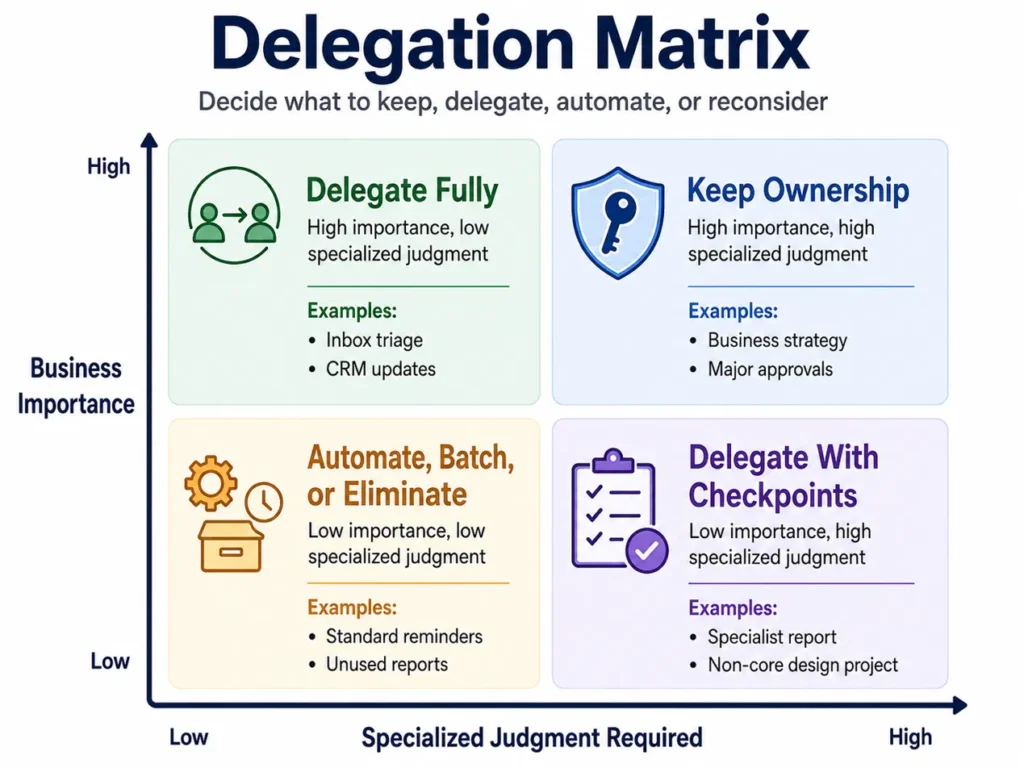
The Boost VA delegation matrix sorts tasks by business importance and the amount of specialized judgment they require.
| Low specialized judgment | High specialized judgment | |
|---|---|---|
| High business importance | Delegate fully within clear rules | Keep ownership while delegating preparation or execution support |
| Low business importance | Automate, batch, or eliminate | Delegate with checkpoints, defer, or reconsider whether the task is needed |
The matrix gives every task a starting action. It does not make the final decision for you, but it forces you to examine the task more carefully.
Step 1: Write Down the Work You Actually Do
Begin with a task inventory.
Do not write broad categories such as “marketing,” “sales,” or “administration.” They are too large to evaluate accurately.
Break them into specific activities:
approve the monthly marketing plan;
collect performance data;
format the monthly report;
update lead stages in the CRM;
review high-value sales proposals;
schedule approved social posts;
research potential outreach prospects;
organize incoming invoices;
respond to routine appointment requests.
A useful approach is to track your work for several representative days. Review your calendar, inbox, project board, browser history, recurring reminders, and recent completed work.
Include small tasks. A five-minute activity that appears ten times a week may deserve more attention than a large task that happens once a quarter.
For additional examples, the virtual assistant task checklist covers recurring work such as inbox management, calendar coordination, data updates, research, WordPress publishing, social scheduling, lead sourcing, and project reporting.
Step 2: Score Each Task on Two Criteria
You can use simple Low or High labels, but a five-point score makes borderline tasks easier to compare.
Score business importance
Ask what would happen if the task were delayed, completed poorly, or not completed at all.
| Score | Meaning |
|---|---|
| 1 | Little meaningful effect if the task disappears |
| 2 | Useful but easy to postpone |
| 3 | Supports normal operations |
| 4 | Strong effect on customers, delivery, revenue, or an important project |
| 5 | Direct effect on major decisions, reputation, risk, or business direction |
A task can be operationally important without being strategically complex.
For example, updating the CRM may not require your personal expertise, but inaccurate records can damage reporting and follow-up. That makes it important even though the process itself may be delegated.
Score specialized judgment
Ask how much context, discretion, expertise, or decision-making the task requires.
| Score | Meaning |
|---|---|
| 1 | Clear instructions and a visible result |
| 2 | A few simple rules or exceptions |
| 3 | Regular choices within defined boundaries |
| 4 | Significant expertise, interpretation, or business context |
| 5 | Requires your authority, relationships, judgment, or a qualified specialist |
Do not measure judgment by how difficult the task feels to you.
A process may be easy because you have repeated it for years. Someone else may still need training, examples, and boundaries before taking responsibility for it.
Step 3: Place Each Task in the Right Quadrant
Once you have scored the tasks, place each one in the relevant part of the matrix.
High Importance and High Judgment: Keep Ownership
These tasks can affect the direction, reputation, finances, major relationships, or long-term position of the business.
Examples may include:
setting business strategy;
approving a major offer or pricing change;
making final hiring decisions;
handling sensitive client negotiations;
approving crisis communication;
interpreting information that will determine a major investment;
making legal, tax, or specialist decisions that require a qualified professional.
Keeping ownership does not mean completing every supporting step yourself.
A virtual assistant or team member may still:
collect the required information;
organize documents;
schedule discussions;
prepare comparison tables;
maintain decision records;
draft materials from approved instructions;
track the actions that follow your decision.
You retain the judgment. The preparation and follow-through do not automatically need to remain with you.
High Importance and Low Judgment: Delegate Fully
These are often the strongest delegation opportunities.
The tasks matter to the business, but the expected result can be explained and checked. They usually follow a repeatable process with defined escalation rules.
Examples include:
triaging an inbox using approved labels and priorities;
scheduling meetings within established availability rules;
updating CRM fields from an approved source;
formatting and uploading approved WordPress content;
preparing recurring reports from defined data;
checking whether scheduled posts published correctly;
maintaining a project tracker;
collecting approved research fields;
following up on routine outstanding items.
The word “fully” does not mean without boundaries. It means the person handling the task can complete the normal process without requesting your approval at every step.
Before handing it over, define:
when the work begins;
what a completed result looks like;
which decisions are already approved;
which exceptions must be escalated;
when you need an update;
how accuracy will be checked.
This quadrant is where retained virtual-assistant support can remove significant daily friction. Boost VA currently supports recurring work across administration, research, data handling, outreach, content operations, WordPress, and reporting.
Low Importance and High Judgment: Delegate With Checkpoints
These tasks require skill or interpretation, but they are not central enough to justify a large share of your time.
Examples may include:
a one-off report requiring technical setup;
a non-core design or content project;
specialist research for an idea that has not yet been prioritized;
an occasional process improvement;
analysis for a secondary marketing channel;
configuring a tool that your business uses only occasionally.
There are three sensible responses.
First, delegate the work to someone with the appropriate ability and agree on checkpoints before they proceed too far.
Second, defer the task until it becomes more important.
Third, question whether it needs to exist at all.
Low importance plus high transfer effort can create an expensive handoff. Delegating the task immediately is not always the best answer.
When you do proceed, review the direction, assumptions, and sample output early. Do not wait until the entire task is complete before discovering that the work moved in the wrong direction.
Low Importance and Low Judgment: Automate, Batch, or Eliminate
These tasks require little judgment and create limited value.
Examples include:
manually sending reminders that software can send;
copying the same information between connected tools;
producing a report nobody uses;
attending a recurring meeting without a clear purpose;
saving duplicate versions of the same document;
checking low-priority notifications throughout the day;
completing a manual step that a rule or template could handle.
Start by asking whether the task should continue.
If it is unnecessary, remove it.
If it still serves a small purpose, automate it where practical. Email filters, calendar reminders, scheduling tools, templates, form rules, and basic integrations may remove the manual step.
If automation would take more time than the task is worth, batch it. Complete similar low-value work together instead of allowing it to interrupt the day repeatedly.
Do not pay someone to preserve a process that no longer needs to exist.
A Completed Delegation Matrix Example
Consider a small business owner who manages client delivery, marketing, and daily administration.
Their matrix might look like this:
| Task | Importance | Judgment | Matrix action |
|---|---|---|---|
| Decide the quarterly service strategy | High | High | Keep ownership |
| Approve a high-value client proposal | High | High | Keep ownership |
| Organize and flag incoming emails | High | Low | Delegate fully |
| Update lead stages and CRM notes | High | Low | Delegate fully |
| Prepare a specialized dashboard for a secondary project | Low | High | Delegate with checkpoints or defer |
| Redesign a non-core brochure | Low | High | Delegate with checkpoints |
| Send standard appointment reminders manually | Low | Low | Automate |
| Produce an unused weekly activity report | Low | Low | Eliminate |
The same task may fall into different quadrants for different businesses.
Social-media scheduling could be important to a business that receives regular leads through social channels. It could be low priority for a company that rarely publishes.
The matrix should reflect your actual business, not a universal list.
Decide Which Task to Move First
Your matrix shows the right action, but it does not automatically show the right order.
Two tasks may both belong in “Delegate Fully,” while one can be transferred in an afternoon and the other requires several weeks of documentation.
Use two additional questions:
How much time or attention is this task costing me?
How difficult will it be to transfer safely?
| Current cost to you | Transfer difficulty | Recommended timing |
|---|---|---|
| High | Low | Delegate now |
| High | High | Create a phased handoff plan |
| Low | Low | Batch, automate, or assign when convenient |
| Low | High | Leave for now unless its importance changes |
A recurring task that consumes several hours and follows clear rules is usually a stronger first handoff than an occasional task requiring extensive explanation.
Start with one or two transfers. A smaller handoff gives you time to improve the instructions, identify exceptions, and build confidence before expanding the responsibility.
Turn the Matrix Into a Clear Handoff
A matrix can help you choose the work, but the handoff still needs structure.
For each delegated task, document four things.
The trigger
Explain when the task begins.
Examples include:
when a new lead enters the CRM;
every weekday morning;
after an article receives final approval;
two days before a recurring report is due.
The expected result
Describe what should exist when the task is complete.
“Manage my inbox” is vague.
“Categorize new messages, archive obvious spam, flag urgent client conversations, and prepare routine replies for review by 11:00 a.m.” provides a visible result.
The boundaries
State what the person may decide and what must return to you.
This is especially important for financial commitments, complaints, public communication, sensitive information, unusual requests, and decisions that could affect a relationship.
The first review point
Check early work closely enough to find missing instructions, but do not take the task back at the first small mistake.
Correct the process, add the missing exception, and allow the handoff to improve.
Delegation should reduce your routine decisions over time. If the assistant must ask the same question during every cycle, the task may need clearer rules.
Use the Matrix as a Living Resource
Your matrix should change as the business changes.
A task may begin in “Keep Ownership” because the process is new and depends heavily on your judgment. After several months, parts of it may become predictable enough to delegate.
A low-priority task may become important after a new service launch. Another task may move directly from your workload into automation.
Review the matrix when:
your responsibilities change;
a new assistant or specialist joins the business;
a repeated task begins consuming more time;
a process becomes easier to document;
a tool introduces useful automation;
you notice that routine work is interrupting important decisions again.
The purpose is not to delegate as much as possible. It is to keep the right responsibilities while creating reliable ownership for everything else.
At Boost VA, I support founders, agencies, and online businesses with recurring execution across research, data, outreach, content operations, WordPress, reporting, and administrative work.
Once you have identified the tasks in your “Delegate Fully” and “Delegate With Checkpoints” quadrants, explore the support available through Boost VA and decide whether ongoing assistance or a defined project is the better fit.