


Marketing Agency Virtual Assistant Case Study: What Brand3’s Reported Productivity Gain Really Shows
Brand3 had an operational capacity problem before it had a virtual-assistant success story.
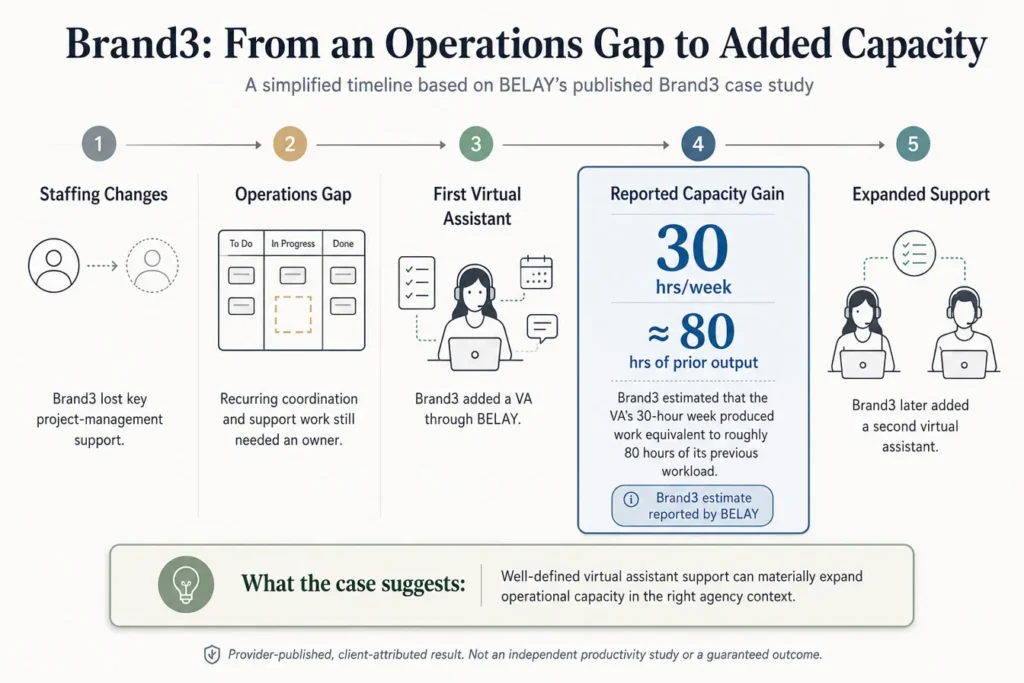
In BELAY’s public Brand3 case study, the marketing and branding firm had lost a longtime employee and then its second project manager. The founders were left without the operational support they had relied on, and a conventional hiring search had not solved the gap.
BELAY says Brand3 then worked with a virtual assistant named Ashley. According to the case, Brand3 believed Ashley could accomplish in 30 hours per week what had previously required the workload associated with two full-time employees. BELAY also reports that the team estimated her 30-hour week produced the equivalent of about 80 hours of prior output. Brand3 later added a second virtual assistant.
That is a striking result. It is also easy to overread.
This marketing agency virtual assistant case study looks at what those numbers actually tell us, what they do not prove, how other agencies have measured capacity, and how you can track the effect of virtual assistant support in your own agency.
Brand3’s Reported Result: A Large Capacity Gain
The most useful part of the Brand3 story is not the headline phrase “doubled productivity.” It is the operating situation around the result.
Brand3 had lost people who were providing project-management and operational support. The gap was not simply “we need more ideas” or “we need a better strategy.” It was a capacity problem. Necessary work still had to move, but the support structure behind that work had changed.
BELAY’s case says the first virtual assistant became part of the team and took on enough work that Brand3 compared a 30-hour week with a much larger amount of prior staff output. The company then added a second VA.
That sequence matters. The case is evidence that a virtual assistant can create substantial operational capacity in a lean agency when the role is useful and integrated. It is not evidence that every VA will produce the same multiple.
What This Marketing Agency Virtual Assistant Case Study Does and Does Not Prove
A case-study number becomes more useful when you ask what was actually measured.
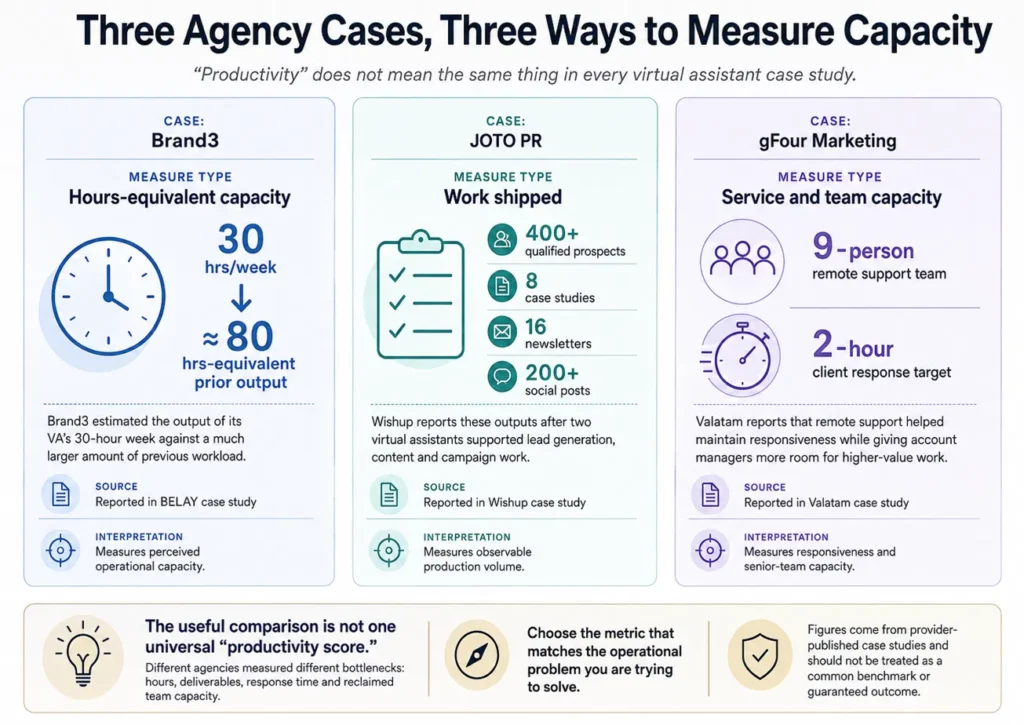
In Brand3’s case, the main figure is an hours-equivalent estimate. It describes how the team perceived the amount of work being produced relative to the workload it had previously handled.
That is different from saying:
revenue doubled;
client retention doubled;
campaign performance doubled;
one VA is objectively equal to two employees;
every agency should expect the same result.
The accessible BELAY case does not publish a task-by-task baseline, a quality-adjusted output model, an independently audited time study, or enough methodology to turn the reported 30-hour versus 80-hours-equivalent comparison into a universal productivity formula.
That does not make the case useless. It changes the claim you can responsibly make from it.
The reasonable conclusion is that Brand3 reported a major increase in usable capacity after adding virtual assistant support. The case shows what is possible in one operating context. It does not establish a standard productivity rate for virtual assistants.
This distinction matters because “productivity” can hide several different outcomes. An agency might become more productive because more deliverables ship, because account managers recover time, because client requests are answered faster, because a backlog falls, or because specialists stop spending hours on coordination work.
Those are all measurable, but they are not the same measure.
Two Other Agency Cases Show Why Productivity Needs a Unit
Looking at other public agency cases makes the measurement problem clearer. The strongest examples do not all use the same definition of success.
JOTO PR: Measure the Work That Actually Shipped
In a case published on May 26, 2026, Wishup reports that two virtual assistants supported JOTO PR across lead generation, content, and campaign-management work.
Wishup reports more than 400 qualified prospects alongside eight case studies, 16 newsletters, and more than 200 social posts. The case also describes the earlier situation as one with weak lead qualification, content backlogs, coordination gaps, and insufficient campaign monitoring.
Those numbers are useful because they are attached to observable units. A prospect can be counted. A newsletter can be counted. A case study can be counted. A backlog can be measured before and after.
They still need context. The case is published by the VA provider involved, and the public page does not turn those deliverables into proof that the VAs alone caused a specific revenue result.
For an agency owner, the practical lesson is simpler: define the work in units you can see.
If the recurring work you want to remove is marketing execution, this guide to marketing tasks that can be delegated to a virtual assistant can help you identify suitable work without handing over strategic decisions by default.
gFour Marketing: Measure Service Capacity, Not Only Task Count
A different example comes from Valatam’s public gFour Marketing case study.
Valatam reports that gFour built a nine-person remote support team, maintained a two-hour response target for client requests, and gave account managers more room to focus on higher-value relationship work.
Here, the useful productivity measures are different. The story is less about counting content assets and more about response capacity and who has time for which work.
That is important for agencies because some of the most valuable gains do not appear as “more tasks completed.” If an account lead recovers five hours a week from recurring coordination and uses those hours for client retention, strategy, or new business, the operational gain is real even when the total task count does not look dramatic.
The Common Pattern Is Not “A VA Works Faster Than Everyone Else”
Across these public cases, the more defensible pattern is capacity reallocation.
Brand3 needed operational support after staffing losses. JOTO PR’s case describes backlogged and inconsistent execution. gFour’s case emphasizes service response and giving account managers more space for relationship work.
These examples suggest that a VA can create value when there is already a meaningful body of necessary work consuming the wrong person’s time or sitting unfinished.
That is different from hiring someone with an undefined brief and hoping “productivity” improves.
The work still needs an owner, a clear output, access to the right tools, and a place inside the agency’s existing process. If you need the operating mechanics behind that handoff, the marketing agency execution workflow goes deeper into how recurring execution can be separated from strategy, specialist work, and approval.
The case-study lesson is narrower: measure the capacity change instead of assuming it.
How to Measure Whether a VA Increased Your Agency’s Capacity
Before adding support, choose one workstream and record a simple baseline. Then compare the same measures after a defined review period.
Do not start with a vague question such as “Are we more productive?” Start with a question you can answer from your own records:
Did the backlog fall?
Did the same amount of work take fewer specialist hours?
Did more deliverables ship?
Did response or cycle time improve?
Did the founder or account lead recover usable time?
Was rework stable or lower?
If you are still preparing the handoff, a structured virtual assistant onboarding process can help you set access, training, communication, and early review expectations before you judge the result.
Agency Capacity Before-and-After Tracker
Use this as a simple 30-day review sheet. It is a management tool, not a scientific productivity formula.
| Measure | Baseline before VA support | 30-day review | Notes / context |
|---|---|---|---|
| Workstream | e.g. client reporting | ||
| Baseline owner | founder / strategist / account lead | ||
| Hours spent per week | |||
| Output unit | reports, prospects, pages, posts, tickets, etc. | ||
| Units completed per week | |||
| Average cycle or response time | |||
| Backlog | |||
| Rework / corrections | |||
| VA hours used | not applicable | ||
| Specialist hours reclaimed | not applicable | ||
| What reclaimed time was used for | not applicable | ||
| Other changes during the period | staffing, automation, campaign volume, seasonality |
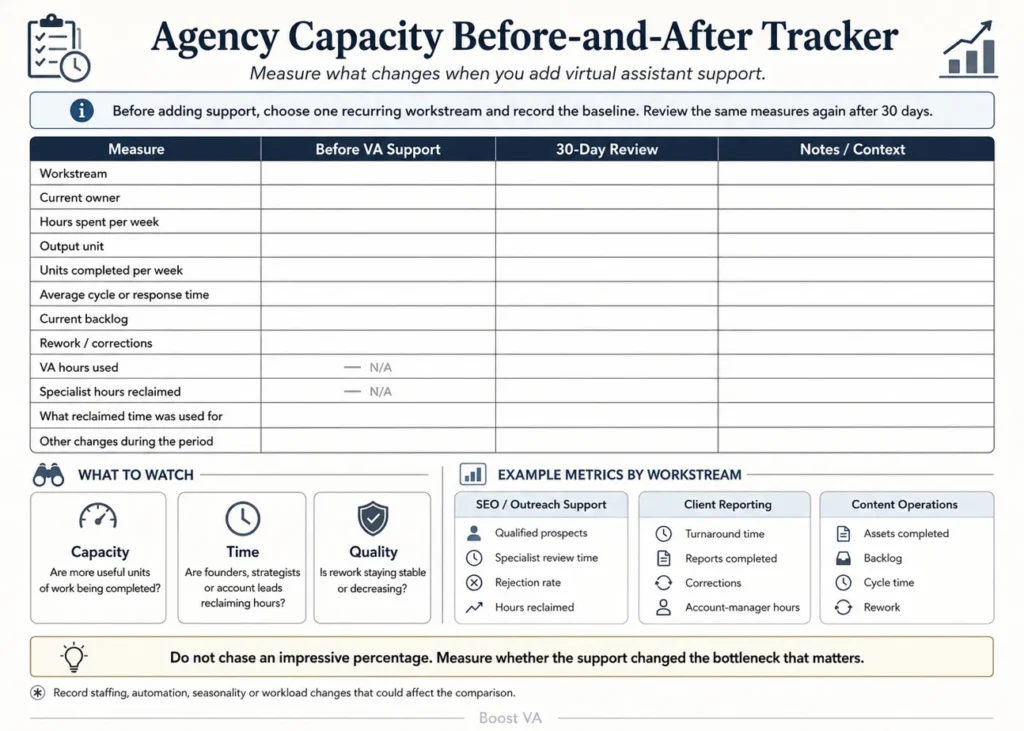
The last row is easy to skip, but it matters. If client volume increased, a new automation was introduced, or another employee joined during the same period, note it. Otherwise, you may attribute an improvement to the VA that actually came from several changes at once.
You also do not need every metric in the table. Pick the two or three that best reflect the bottleneck you are trying to remove.
For example, if an SEO agency delegates prospect research, useful measures might be qualified prospects produced, specialist review time, rejection rate, and hours reclaimed. If the workstream is client reporting, cycle time, rework, and account-manager hours may matter more.
The goal is not to manufacture an impressive percentage. It is to know whether the support changed something that matters.
What a Useful Result Looks Like
A useful VA result should be specific enough that you can describe the before-and-after change without relying on vague words such as “efficient” or “productive.”
A strong statement might look like this:
After 30 days, the reporting backlog fell from 12 overdue reports to two, average turnaround dropped from four business days to two, and the account lead spent about three fewer hours per week compiling data. Rework stayed at the same level.
That is only an illustration of how to report a result, not a Boost VA client claim.
Notice what makes it useful. The workstream is clear, the baseline exists, the same measures are compared, quality is not ignored, and the result is not automatically converted into revenue.
This is also why dramatic case-study figures should be treated as starting points for questions rather than promises. A number such as “2x productivity” sounds precise, but the management value comes from knowing what changed underneath it.
The Real Lesson Is Capacity, Not a Guaranteed Multiplier
The public agency cases support a measured conclusion: virtual assistants can create substantial operational capacity when the work is suitable, the role is defined, and the result is measured in something observable.
Brand3’s reported result is the most dramatic example here, but it should not become your forecast. JOTO PR shows the value of counting shipped work. gFour shows that service speed and senior-team capacity can matter just as much.
For your own agency, the better question is not “Can a VA double productivity?”
It is: Which recurring bottleneck is consuming valuable capacity now, and what would improve if that work moved to reliable support?
At Boost VA, I support agencies with defined recurring and project-based execution across areas such as research, outreach support, data handling, content operations, WordPress, reporting, and related backend work. If you can identify one measurable bottleneck, explore Boost VA’s virtual assistant support and start the conversation around that specific workstream rather than a promised productivity multiplier.
Independent analysis: This article uses publicly available case studies. Boost VA was not involved in the Brand3/BELAY, JOTO PR/Wishup, or gFour/Valatam engagements. Reported results are attributed to the companies that published them and should not be treated as guaranteed outcomes.