


Virtual Assistant vs Freelancer vs Employee: Which Is Right for Your Business?
You know you need help. The harder question is what kind of help to hire.
Should you work with a virtual assistant who supports the business every week? Bring in a specialist freelancer for one defined project? Or hire an employee who becomes a permanent part of the team?
That choice affects more than cost. It also determines how much control you have, how quickly the person can start, how deeply they learn the business, and how easily you can change the arrangement later.
This virtual assistant vs freelancer vs employee comparison explains those trade-offs and gives you a practical way to choose the right model for the role.
First, Understand What You Are Actually Comparing
A virtual assistant, freelancer, and employee are not three perfectly separate legal categories.
A virtual assistant is usually defined by the type of support and how it is delivered. The person works remotely and may provide ongoing administrative, research, marketing, data, WordPress, or operational support.
A freelancer is usually defined by the way their services are purchased. Freelancers often sell a particular skill or deliverable to several clients and may work on projects with a clear beginning and end.
An employee has a formal employment relationship with the business and is normally integrated more closely into its schedule, management structure, and long-term plans.
A virtual assistant may technically operate as an independent freelancer. Some virtual assistants also work through agencies or service companies. For a useful business comparison, this guide treats the three models as follows:
Virtual assistant: Retained remote support for ongoing or recurring work.
Freelancer: Independent specialist hired for a defined project or outcome.
Employee: A payroll team member hired for continuing responsibility and closer organisational control.
The question is not which label sounds best. It is which working model fits the responsibility you need someone to take on.
Virtual Assistant vs Freelancer vs Employee at a Glance
| Decision factor | Virtual assistant | Freelancer | Employee |
|---|---|---|---|
| Best suited to | Ongoing remote support and recurring execution | Defined projects and specialist deliverables | Core, continuing roles that require close integration |
| Typical engagement | Hourly package, retainer, or recurring agreement | Project fee, milestone, day rate, or hourly contract | Salary or wage |
| Commitment | Flexible recurring commitment | Usually limited to a project or contract period | Longer-term employment commitment |
| Control | Moderate, focused on outputs, deadlines, and agreed processes | Usually lower day-to-day control | Generally the highest level of direct control |
| Business knowledge | Builds over time through recurring work | Often limited to what the project requires | Can develop deep internal knowledge |
| Specialist depth | Generalist or moderately specialised support | Often strong in a narrow skill area | Depends on the role and hiring criteria |
| Start-up speed | Can begin quickly when the work is clear | Can begin quickly after a suitable specialist is found | Usually requires a fuller recruitment and employment process |
| Scalability | Hours or responsibilities may be adjusted | Project capacity can be added or reduced | Scaling requires additional hiring or role changes |
| Main risk | Poor results when instructions, scope, or communication are unclear | Limited availability or weak continuity after the project | Higher fixed commitment and greater administrative responsibility |
| Strongest reason to choose | You need reliable recurring execution without creating a full-time role | You need a specific expert result | You need permanent ownership, availability, and team integration |
This table is a starting point. The best choice becomes clearer when you examine the actual workload behind the role.
Compare the Total Cost, Not Only the Hourly Rate
Cost is usually the first factor people consider, but a direct rate comparison can be misleading.
The cost of an employee
An employee’s salary or wage is only one part of the employer’s cost.
Depending on the country and employment arrangement, the business may also be responsible for payroll taxes, paid leave, insurance, retirement contributions, equipment, workspace, training, recruitment, and administration.
For a useful U.S. reference point, the Bureau of Labor Statistics reported that benefits represented 30.1% of total compensation costs for private-industry workers in March 2026. That figure does not apply to every role or country, but it shows why salary alone is not a complete employee-cost calculation. See the BLS employer compensation table for the full breakdown.
An employee can still provide the best value when the work requires full-time availability, internal authority, long-term knowledge, or close coordination with the rest of the team. A higher fixed cost is not automatically a poor decision when the role genuinely requires that commitment.
The cost of a freelancer
A freelancer normally charges for a project, milestone, day, or block of hours.
The business may avoid some employment-related costs, but an experienced specialist can command a high rate. That rate may be justified when the freelancer can solve a difficult problem quickly or produce a deliverable your existing team cannot create.
A specialist who completes the right work in ten hours may cost less overall than a cheaper person who needs thirty hours, repeated explanations, and several revisions.
The cost of a virtual assistant
A virtual assistant is often engaged only for the amount of ongoing capacity the business currently needs.
That may be a few hours each week, a monthly block of time, or a defined recurring workload. This can make the model useful when the work is important and continuous but does not yet justify a full-time position.
However, hiring a VA does not remove every indirect cost. You still need to provide instructions, access, feedback, and an appropriate review process. Choosing mainly by hourly rate can create more management work and a worse result. The guide to common mistakes when hiring a virtual assistant explains why total value and process fit matter more than the lowest proposal.
Cost conclusion: A VA often provides flexible capacity for recurring work. A freelancer may provide the best value for a specialist outcome. An employee may provide the strongest long-term value when the business genuinely needs a permanent role.
Decide How Much Control and Availability You Need
Control is one of the clearest differences between contract support and employment.
With an employee, the business generally has greater authority over working hours, internal responsibilities, methods, training, reporting, and availability. This can be important when the person must respond throughout the working day, supervise others, make internal decisions, or represent the business continuously.
A freelancer usually has more independence over how the project is completed. You agree on the scope, deadline, quality standard, and deliverable, but the freelancer may choose their own working method and serve other clients at the same time.
A virtual assistant often sits between these two practical extremes. The client may set recurring deadlines, provide an SOP, define approval boundaries, and request regular updates. However, the relationship is still commonly managed through agreed outputs rather than the same level of control used with an employee.
This means you should ask a direct question:
Do I need a result, or do I need the right to control the person’s working day?
When the result matters more than the exact schedule, a VA or freelancer may be suitable. When fixed availability and close management are essential, an employee may be the safer operational choice.
Match the Model to the Shape of the Work
The type of work matters more than the job title.
Choose a virtual assistant for recurring execution
A VA is often a strong fit when the workload is:
ongoing rather than one-off;
remote;
repeatable or process-driven;
important but not a full-time responsibility;
spread across several related operational tasks;
likely to grow or change over time.
Examples may include weekly WordPress uploads, lead research, spreadsheet updates, content scheduling, inbox organisation, reporting preparation, citation work, outreach preparation, and other recurring backend responsibilities.
Before choosing this model, identify the tasks you are ready to delegate. A clear initial responsibility makes it easier to judge the skills, hours, access, and communication system the role requires.
Choose a freelancer for a defined specialist result
A freelancer is often a better fit when the business needs:
a website redesign;
a brand identity;
a technical audit;
a copywriting project;
a custom integration;
a video production;
a legal document reviewed by a qualified professional;
another specialist deliverable with a clear end point.
Freelancing is a substantial part of the modern labour market. Upwork’s Freelance Forward 2023 study estimated that 64 million Americans performed freelance work during 2023, including millions providing skilled knowledge services.
The size of that market gives businesses access to many specialist skills, but it also makes careful vetting important. A strong portfolio in one area does not automatically prove that the person is suitable for ongoing general support.
Choose an employee for permanent organisational ownership
An employee is usually the stronger choice when the role:
requires full-time or fixed-hour availability;
is central to the company’s daily operation;
includes authority over people, budgets, or sensitive decisions;
requires close involvement in company culture;
depends on deep knowledge that must remain inside the organisation;
is expected to continue indefinitely;
must be performed on-site;
requires the business to direct how and when the work is completed.
Examples may include a full-time operations manager, department lead, in-house customer-success representative, office manager, or another position that must be continuously embedded in the organisation.
Consider Onboarding and Time to Useful Output
A freelancer may already understand the specialist work you are buying. A designer does not need to be taught design fundamentals, but they still need the brand brief, audience, required files, approval process, and deadline.
A virtual assistant may already understand WordPress, research, spreadsheets, social scheduling, or outreach support. They still need to learn how your business applies those skills.
An employee may need both role training and broader company onboarding. That can include employment paperwork, policies, equipment, team introductions, performance expectations, system access, and long-term development.
None of the three models produces perfect work without context.
The difference is what kind of context each person needs:
| Model | Most important onboarding need |
|---|---|
| Virtual assistant | Your recurring process, source of truth, approval boundaries, and communication rhythm |
| Freelancer | A complete project brief, required deliverables, technical constraints, and review milestones |
| Employee | Role expectations, company systems, team structure, policies, authority, and development plan |
When a VA is the chosen model, a structured start can reduce early confusion. This virtual assistant onboarding process covers access, instructions, the first responsibility, communication, and early review.
Think About Continuity and Business Knowledge
A specialist freelancer may deliver an excellent project and then move on. That is not a failure. It is often exactly what the arrangement was designed to do.
The problem appears when a business uses a string of one-off freelancers for work that depends on accumulated context. Each new person must learn the same products, folders, naming rules, customer types, preferred formats, and approval process.
A retained VA can offer more continuity for recurring support. Over time, the assistant can become familiar with the systems and notice patterns that would be invisible during a single project.
An employee can develop the deepest organisational knowledge because the role is normally broader and more permanent. This can be especially valuable when judgment depends on understanding internal history, team relationships, customers, or long-term strategy.
Ask how much knowledge the role will accumulate.
If replacing the person every few months would force you to rebuild the entire process, continuity deserves more weight in the decision.
Do Not Ignore Worker Classification
The commercial label in a contract does not automatically decide whether someone is legally an employee or an independent contractor.
In the United States, the IRS worker-classification guidance considers behavioural control, financial control, and the type of relationship. The Department of Labor also applies an economic-realities analysis when determining whether a worker is an employee under the Fair Labor Standards Act.
Other countries and local jurisdictions use their own rules.
A business should not hire someone as a contractor, control the relationship like employment, and assume that calling the person a freelancer or VA resolves the issue.
This section is general information, not legal or tax advice. Obtain qualified local guidance when classification is uncertain, especially for long-term, full-time, closely controlled arrangements.
Use This Hiring Model Decision Tree
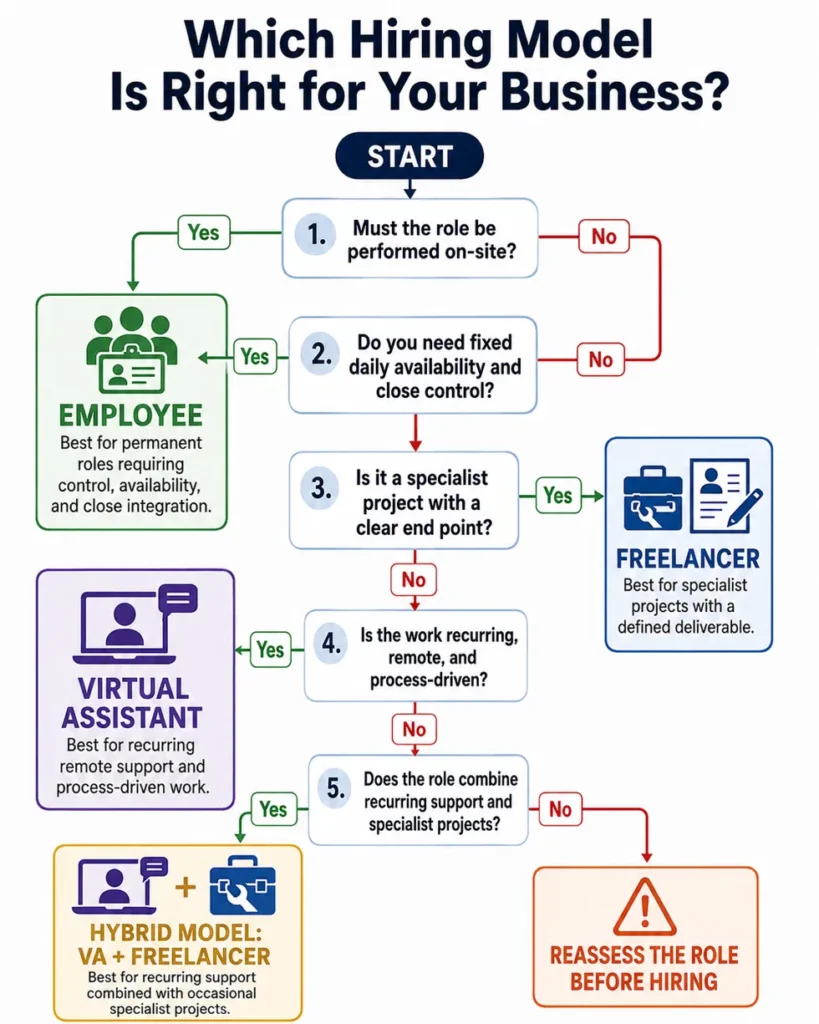
Work through these questions in order.
1. Must the role be performed on-site?
Yes: An employee is likely the strongest option.
No: Continue to the next question.
2. Do you need fixed daily availability and close control over how the work is performed?
Yes: Consider an employee, particularly when the arrangement will be permanent.
No: Continue.
3. Is there one specialist deliverable with a defined end point?
Yes: Hire a suitable freelancer.
No: Continue.
4. Is the workload recurring, remote, and suitable for a documented process?
Yes: A virtual assistant may be the best fit.
No: Continue.
5. Is there enough continuing work to justify a permanent position?
Yes: Compare the full cost and integration benefits of an employee.
No: Use a VA or freelancer for the capacity you currently need.
6. Does the role combine recurring execution with occasional specialist projects?
Yes: Use a hybrid model. Keep the recurring workload with a VA, then bring in freelancers for specialist deliverables.
No: Choose the single model that best matches the dominant responsibility.
The decision does not need to be permanent. A business may begin with ten hours of VA support, use a freelancer for a defined project, and later hire an employee when the workload and responsibility become permanent.
Four Practical Examples
Weekly content and WordPress operations
The business publishes approved content every week and needs someone to format drafts, add internal links, complete supplied SEO fields, prepare images, and report publishing issues.
Likely choice: Virtual assistant.
The work is recurring, remote, process-driven, and easier to manage through a consistent working relationship.
A new brand identity and website design
The business needs a specialist to develop a visual identity and complete a website redesign within an agreed scope.
Likely choice: Freelancer or specialist studio.
The requirement is expertise-led and deliverable-based, with a clear end point.
A full-time operations leader
The person will manage staff, approve spending, attend daily leadership meetings, and take permanent ownership of internal operations.
Likely choice: Employee.
The role requires authority, availability, integration, and long-term organisational knowledge.
Ongoing marketing support with occasional specialist work
The business needs weekly research, content uploads, campaign reporting, and database maintenance. It also needs a conversion copywriter or developer several times a year.
Likely choice: Hybrid model.
A VA can manage recurring execution while specialist freelancers handle the projects that require deeper expertise.
Which Hiring Model Is Best?
There is no universal winner.
Choose a virtual assistant when you need recurring remote execution, continuity, and adjustable capacity without creating a full-time position.
Choose a freelancer when you need specialist expertise for a clear project, deadline, or deliverable.
Choose an employee when the role requires permanent ownership, fixed availability, close control, team integration, or deep internal knowledge.
The strongest decision begins with the work itself. Define the outcome, frequency, level of authority, required expertise, and amount of continuing capacity before choosing the label.
At Boost VA, I provide retained and project-based virtual assistant support for founders, agencies, and online businesses. When your workload is recurring, remote, and ready for reliable execution, explore the virtual assistant support available through Boost VA.