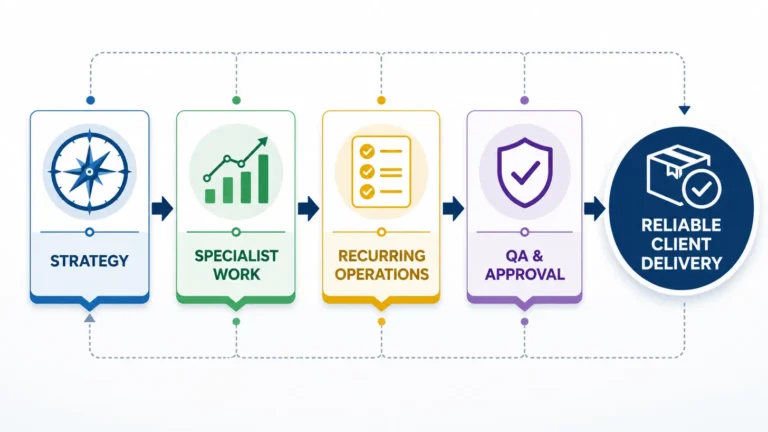


You have decided to hire a virtual assistant, but now you need to explain the job to someone who has never worked with your business.
A generic job description can make that harder than necessary. Many templates assume you are hiring an employee with a department, a manager, and fixed working hours. That may not describe a freelance VA providing ten hours of support each week from another time zone.
This virtual assistant job description template gives you a public-facing job post you can copy, adapt, and publish. It includes ten editable fields, a completed fictional example, and guidance on describing contractor work without turning the posting into a legal agreement.
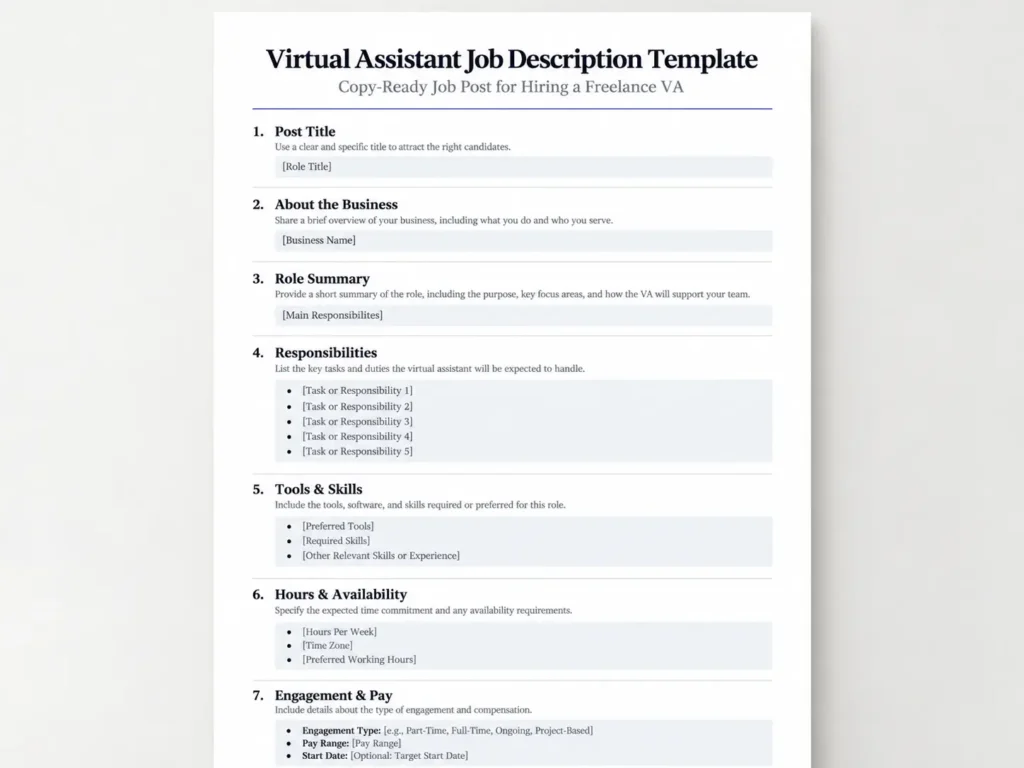
Copy the Virtual Assistant Job Description Template
Replace the bracketed details below with your requirements. Delete anything that does not apply, and keep the final post short enough for candidates to understand the work without reading a lengthy company handbook.
1. Post title
[PART-TIME / FREELANCE] Virtual Assistant for [MAIN RESPONSIBILITY OR OUTCOME]
2. About the business
[ONE OR TWO SENTENCES ABOUT YOUR BUSINESS, INDUSTRY, AND TEAM WITHOUT CONFIDENTIAL CLIENT DETAILS.]
3. What this role is for
I am looking for an independent virtual assistant to [PRIMARY OUTCOME]. The first priorities will be [PRIORITY 1] and [PRIORITY 2].
4. Recurring responsibilities
Daily / as needed:
[CLEAR ACTION + OUTPUT]
Weekly:
[CLEAR ACTION + OUTPUT]
Monthly / occasional:
[CLEAR ACTION + OUTPUT]
5. Tools
You should be comfortable using [REQUIRED TOOL 1], [REQUIRED TOOL 2], and [REQUIRED TOOL 3]. Familiarity with [OPTIONAL TOOL] is helpful but not essential.
6. Availability and time-zone overlap
Estimated workload: [X–Y HOURS PER WEEK OR MONTHLY HOUR BLOCK].
Please confirm whether you can overlap for [X MINUTES/HOURS] during [WINDOW AND TIME ZONE, INCLUDING DAYS], and state how you generally handle updates outside that window.
7. Engagement and pay
Engagement: [ONGOING CONTRACTOR / DEFINED PROJECT].
Budget: [CURRENCY + HOURLY RANGE / MONTHLY BLOCK + HOURS / PROJECT AMOUNT].
Scope, invoicing, and other agreed terms will be documented separately.
8. Must-haves and nice-to-haves
Required:
[SKILL 1]
[SKILL 2]
[SKILL 3]
Preferred, not required:
[HELPFUL EXPERIENCE OR TOOL]
9. Start date and optional paid trial
Preferred start: [DATE OR WINDOW].
Shortlisted applicants may be invited to complete an optional paid [SMALL REALISTIC TASK] with the fee and deliverable agreed in advance.
10. How to apply
Please send [RELEVANT EXAMPLE OR SHORT SUMMARY], your available hours, rate, and a brief answer to:
[ONE ROLE-SPECIFIC QUESTION]
Apply through [THE PLATFORM’S APPROVED APPLICATION METHOD].
Get the editable template:
The editable document also contains the completed example below and a pre-publish checklist.
A Filled-In Virtual Assistant Job Posting Example
Here is how the template might look for a small marketing agency hiring a part-time administrative assistant.
This example is fictional. The business, workload, pay range, and hiring requirements are illustrations, not an actual vacancy or a recommended market rate.
Example Job Post: Part-Time Admin & Inbox Virtual Assistant
About us
We are a small marketing agency supporting several recurring client projects. We need dependable help keeping day-to-day admin requests organized and ensuring routine updates do not disappear in the inbox.
What this role is for
We are looking for an independent VA to keep our shared inbox organized and client-project records current, with clear handoffs to the project lead when a decision is needed.
Responsibilities
On working days: Categorize new messages in the shared inbox and flag requests requiring the project lead’s reply.
Weekly: Update task statuses from approved meeting notes and share a short list of unanswered requests.
Weekly: Check CRM records for missing contact fields and flag conflicts rather than guessing.
Monthly: Compile a simple list of overdue admin items for review.
Tools and required skills
Required: Comfortable with Gmail, Google Sheets, and a task-management platform; accurate record keeping; clear written communication; and good judgment about when to ask questions.
Preferred: Familiarity with ClickUp or similar tools.
Hours, pay, and engagement
Estimated 10–12 hours per week, ongoing freelance arrangement.
Please be available for one agreed 60-minute overlap on Tuesdays and Thursdays between 10 a.m. and noon Eastern Time. Other work can usually be completed independently around deadlines.
Illustrative budget: USD $18–$25 per hour.
Start and application
Start: Within the next two to three weeks.
Shortlisted applicants may be offered a paid mini-task: organize a sample set of non-confidential inbox requests into a short action list.
To apply, share one relevant example of similar support, your rate and availability, and answer:
“If a client email is missing a deadline, what would you do before adding the task to our project board?”
Apply through the job board or platform where this listing appears.
Why the Title Names the Work
“Virtual Assistant Needed” tells candidates almost nothing about the assignment.
“Part-Time Admin & Inbox Virtual Assistant” is more useful because it identifies the principal responsibility and distinguishes the role from a VA specializing in bookkeeping, social media, SEO, or another service.
Upwork’s job-posting guidance recommends a specific title containing relevant skills or deliverables. Its matching process also uses job-title keywords to help identify suitable professionals.
Name the actual work rather than trying to make the title sound impressive.
Why the Responsibilities Describe Results
Consider the difference between “manage our CRM” and “check CRM records for missing contact fields and flag conflicts.”
The second version tells an applicant what they would actually do. It also makes clear that missing or conflicting information should be raised, not guessed.
The example groups responsibilities by frequency so a candidate can estimate the workload. It does not attempt to prescribe every click, message, or decision.
A short job post should describe the results the business needs. Detailed procedures can follow once the working relationship begins.
Why the Hours Ask for Overlap, Not a Full Shift
The example gives two specific availability windows without saying the contractor must remain online throughout the agency’s working day.
That distinction matters when the business needs a little synchronous communication but much of the assignment can be completed independently.
It also avoids an important scheduling mistake. Saying “Eastern Time” rather than assuming a fixed UTC offset accommodates seasonal daylight-saving changes.
For more on setting realistic overlap expectations, see my guide to working with a virtual assistant in a different time zone.
How to Fill In Each Section of Your VA Job Description
The template is a starting point. These decisions will determine whether candidates understand the work and can assess their fit.
Role Summary and Responsibilities
Write the role summary around one primary outcome.
For example:
Keep recurring administrative requests organized.
Maintain accurate prospect and CRM records.
Prepare approved WordPress content for publication.
Coordinate routine scheduling and follow-up.
Then describe the actual work involved. Five to eight well-chosen responsibility bullets will usually be more useful than a long inventory of everything the VA might eventually handle.
Group them by daily, weekly, or occasional work where the frequency matters.
If you have not decided what to delegate, start with the tasks-to-delegate checklist before writing the post.
Avoid including future possibilities as though they are current responsibilities. If the role may expand, say that additional work could be discussed later.
Skills and Tools
Separate the skills candidates genuinely need from tools they could reasonably learn.
If the work involves updating client spreadsheets, accurate data handling and confidence with spreadsheet software may be essential. Familiarity with one particular project-management tool might be helpful without being a requirement.
Upwork’s 2026 posting guidance recommends choosing three to five important skills instead of filling every available skill field.
Indeed’s job-post checklist also recommends clearly separating required qualifications from preferred ones.
For a general contractor VA, useful requirements may include relevant tool experience, written communication, attention to detail, and the ability to identify unclear instructions.
Do not automatically add degree requirements, certifications, or years of experience unless they are important to the actual work.
Hours and Availability
A useful hours section answers three different questions:
Capacity: How much work is expected each week or month?
Overlap: When, if ever, must both parties be available together?
Communication: How will updates, urgent questions, and deadlines be handled?
“Flexible hours” is not enough if the business regularly needs the VA for live meetings or time-sensitive inbox coverage.
Likewise, a fixed schedule may be unnecessary if the assignment is mainly independent research or data work with agreed deadlines.
If you do not yet know the workload, estimate the virtual assistant hours you need before choosing an arbitrary number.
Use the time-zone name, days, and specific overlap window where possible. Consider daylight-saving changes when working internationally.
Pay and Engagement Type
Candidates should understand whether the opportunity is hourly, a recurring block of support, or a fixed-price project.
For example:
Hourly: USD $[MIN]–$[MAX] per hour, approximately [X] hours weekly.
Monthly block: USD $[AMOUNT] per month for up to [X] agreed hours, subject to defined terms.
Project: USD $[AMOUNT OR RANGE] for [SPECIFIED DELIVERABLES].
A monthly block should not leave candidates guessing whether the amount covers ten hours or forty.
Pay visibility can also help applicants decide whether the opportunity is realistic for them. Indeed reports that job descriptions containing pay receive up to 31% more application starts per impression, based on its U.S. platform data. That is a platform-wide finding, not a predicted result for VA vacancies.
Pay-disclosure requirements differ by location and type of engagement. Check the rules that apply to your posting before publication.
Screening Questions and a Paid Trial Task
One useful screening question can tell you more than five generic requests for someone who is “hardworking” or “detail-oriented.”
Ask something connected to the actual role:
Inbox support: “What would you do if a client requested something but did not provide a deadline?”
Research: “How would you handle two conflicting sources for the same business contact?”
Content publishing: “What would you check before marking a WordPress article ready for review?”
These questions ask applicants to explain their judgment.
A small paid trial can also help evaluate a candidate’s work on a realistic assignment. Keep the scope clear, avoid sensitive client information, and agree on payment before the work begins.
Do not disguise a substantial project as an unpaid skills test.
Wording That Fits a Contractor Relationship
A freelance VA job post should describe the service and working requirements without automatically copying employee-management language.
For U.S. federal tax classification, the IRS explains behavioral control in terms of a business’s right to direct how the worker performs the work.
Instructions about when, where, and how someone works can be relevant to that assessment.
Here are examples of wording worth reviewing:
| Employee-style wording to examine | Contractor-focused alternative when accurate |
|---|---|
| “Must be online 9 a.m. to 5 p.m. under daily supervision.” | “Estimated 12 hours weekly, with an agreed overlap for scheduled coordination.” |
| “Our manager will assign and direct your work throughout the day.” | “The agreed deliverables, deadlines, and review contact will be set out for each assignment.” |
| “You must follow our methods for every part of the work.” | “Deliver work against the agreed requirements and flag issues needing clarification.” |
These are not magic phrases that turn an employee into a contractor.
A business may legitimately need specific availability, quality requirements, security procedures, or tool rules. Those arrangements must still reflect the actual relationship.
The IRS worker-classification guidance considers behavioral control, financial control, and the broader relationship. No single phrase or factor determines the result.
This is general information using a U.S. federal tax framework, not legal or tax advice. Other countries and laws may apply different standards.
If you are still deciding which relationship suits the work, review the comparison of a virtual assistant, freelancer, and employee first.
What to Leave Out of a Public Job Post
A job description is an advertisement to people you have not yet selected. It is not the place to disclose everything about how your business operates.
Keep these details out of the public listing:
Private client information: Unnecessary client names, contacts, financial information, or internal project details.
Account credentials: Passwords, recovery codes, API keys, or sensitive account identifiers.
Confidential procedures: Internal documents and processes that should only be shared with authorized people.
Detailed contract clauses: Intellectual property ownership, termination procedures, non-solicitation language, governing law, and other binding terms.
Use the document that suits the stage of the relationship.
| Job post | Contract | Onboarding |
|---|---|---|
| Role purpose, expected work, skills, workload, pay range, availability, and how to apply | Agreed scope, payment terms, confidentiality, ownership, responsibilities, and termination | Actual tools, access permissions, working instructions, contact details, and first assignments |
Once you choose a candidate, use a separate virtual assistant contract template to organize the agreed terms.
Account access should be addressed through an appropriate onboarding process. My guide to sharing passwords safely with a virtual assistant covers that later stage.
Adapting the Post for Upwork, LinkedIn, or Indeed
The ten-field template can serve as your master draft, but each platform has its own posting fields and rules.
Upwork
Use a title naming the main deliverable, select the most relevant three to five skills, and choose an hourly or fixed-price budget suited to the work.
Its 2026 guidance also describes optional screening questions and job visibility choices, including public and invite-only listings.
Follow Upwork’s current job-post requirements, including its rules on contact details and pre-contract communication. Do not put an external contact request into an Upwork listing where it is prohibited.
LinkedIn and other job boards
Keep the core content, but check the available job type, employment type, location, compensation, and application settings.
Do not assume a contractor opportunity can be represented using the same employment labels on every platform. Verify the current rules rather than selecting a category simply because it looks closest.
Indeed
Prioritize a scannable job description with clear sections, responsibilities, qualifications, and pay information.
Indeed recommends short paragraphs, lists, and separate required and preferred qualifications. Its hiring guidance is often written around employment roles, so check the platform’s current eligibility and posting rules for your intended contractor arrangement.
In every case, review the final platform preview. Some details in your master document may be represented by separate form fields rather than appearing in the description itself.
Before You Publish: A Quick Check
Read your finished post as someone who knows nothing about your business.
Does the title identify the work?
Are the first responsibilities specific enough to understand?
Are required skills separated from preferred experience?
Can applicants see the likely weekly or monthly workload?
Are the pay structure and currency clear?
Is any required time-zone overlap stated?
Is the start window realistic, and is any trial task paid?
Is there a relevant screening question?
Have you removed confidential details and contract-only clauses?
Have you checked the applicable platform and hiring rules?
If you answer no to an item, revise that part of the post rather than adding another generic paragraph.
For wider preparation issues beyond the listing itself, see the five mistakes to avoid when hiring a virtual assistant.
After the Post: From Shortlist to Agreement
A well-written posting is the beginning of the hiring process, not the end.
Once applications arrive, compare relevant experience against the actual responsibilities, ask focused follow-up questions, and consider a small paid trial when appropriate.
After selecting someone, move the agreed scope, working arrangements, payment, confidentiality, and other binding details into a contract. Then use an onboarding checklist to prepare the first assignments and necessary access.
Prefer not to run a hiring process?
The completed template can also work as a brief for direct VA support. If it describes recurring admin, research, content, website, or operational work you need help with, send me your brief through Boost VA so we can discuss the scope and whether it is a suitable fit.
You do not need a corporate-style job description to start that conversation. You need a clear explanation of the work, the expected capacity, and the results you want.