

Were there really virtual assistants in the 1800s?
Not in the way we use the term today.
Nineteenth-century clerks, stenographers and secretaries worked in a very different technological and employment environment. They were not logging into cloud systems, serving clients remotely or operating as independent online support professionals.
They were, however, part of the longer history that eventually made modern virtual assistance possible.
The history of virtual assistants is therefore better understood as an evolution rather than the story of one invention. Administrative work developed first. Communication technology gradually separated some work from a physical office. Telecommuting demonstrated that knowledge work could happen elsewhere. The internet made remote services practical at scale. Professional organizations helped give the emerging VA role an identity. Cloud platforms then made everyday collaboration across distance much easier.
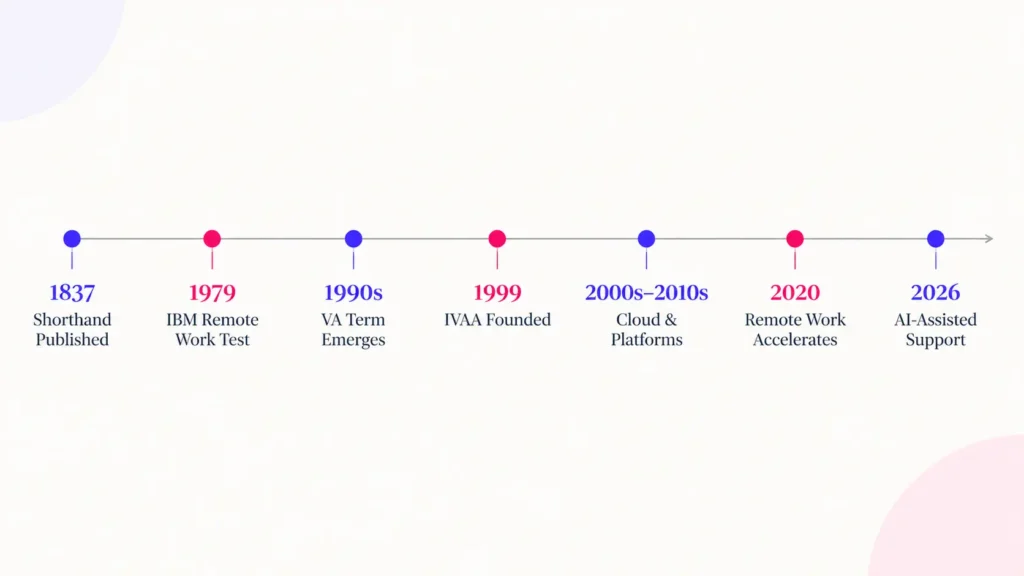
An annotated virtual assistant history timeline
| Period | Milestone | Why it matters |
|---|---|---|
| 1837 | Isaac Pitman’s shorthand system was published | A milestone in the development of faster administrative and clerical information handling, not the birth of virtual assistance |
| 1979 | IBM tested home working with five employees using terminals | Shows that technology-supported remote knowledge work was being tested decades before modern online collaboration |
| 1990s | The modern “virtual assistant” label and professional identity began emerging | Industry histories associate several people with this period, but the exact origin remains disputed |
| 1999 | International Virtual Assistants Association founded | Evidence that virtual assistance was becoming organized as a recognizable professional field |
| 2000s to 2010s | Faster internet, online communication, cloud software and freelance marketplaces spread | Remote support became easier to deliver, coordinate and purchase across locations |
| 2020 | Remote work accelerated dramatically | Distributed work became familiar to far more businesses, but virtual assistance had already existed for years |
| 2026 | VA work increasingly overlaps with specialization, workflow integration and AI-assisted execution | The profession continues to evolve rather than remaining a remote copy of traditional secretarial work |
Before virtual assistants: the administrative-support lineage
One useful starting point is shorthand.
Glasgow Libraries’ Pitman Collection records that Isaac Pitman’s shorthand system was published in 1837 as Stenographic Sound-Hand. Pitman developed a method that used strokes, curves, dots and other marks in place of normal alphabetic writing.
That matters to this history because administrative support has always been shaped by the tools available for recording, organizing and moving information.
It does not mean Pitman invented virtual assistance.
There was nothing virtual about nineteenth-century shorthand. The work was generally tied to physical offices, documents and face-to-face business structures.
Secretaries, clerks and stenographers should therefore be understood as predecessors in the administrative-support lineage.
Their work established functions that remain recognizable today: correspondence, document preparation, record keeping, scheduling, information organization and communication support.
The tools and employment structures changed enormously later.
The underlying business need for organized support did not disappear.
Technology gradually separated work from the office
The modern virtual-assistant model required more than administrative skills.
It required technology that allowed information and work to travel.
An important remote-work milestone came in 1979.
According to The Atlantic’s history of IBM telecommuting, IBM’s Santa Teresa Laboratory in Silicon Valley installed terminals in the homes of five employees. The immediate purpose was practical: ease pressure on the office mainframe while allowing those employees to work from home.
That small experiment was not the beginning of the virtual-assistant profession.
It demonstrated something broader that would become essential to remote support: some knowledge work could be separated from the physical office when workers had the right communications and computing infrastructure.
The following decades brought much more capable personal computers, electronic communication and internet access.
Work that once required a person to be physically near filing cabinets, paper correspondence, office telephones and company systems became increasingly possible from another room, another city or eventually another country.
That technological separation between work and workplace was one of the necessary foundations of virtual assistance.
The modern VA label emerges in the 1990s
This part of virtual-assistant history requires more caution than many online timelines suggest.
There are several frequently repeated stories about who first coined the term “virtual assistant” and exactly when it happened.
They are not completely consistent.
A Society of Virtual Assistants industry history describes Stacey Brice as already working virtually in 1992 and attributes the phrase “virtual assistant” to her client, Thomas Leonard.
The same industry history also credits Christine Durst with an important role in developing the virtual-assistant industry during the 1990s.
These stories are useful evidence of how the profession remembers its early development, but they are later industry accounts rather than definitive contemporaneous primary documentation establishing a single inventor.
So the safest historical conclusion is narrower:
Industry histories place the emergence of the modern virtual-assistant label and professional identity in the 1990s.
That is stronger than claiming one uncontested person coined the term in one uncontested year.
It also fits the technological environment.
By this point, computers, modems, email and internet services were making it increasingly realistic for administrative work to be delivered without the assistant sharing a physical office with the client.
The idea of remote support was no longer only a large-company telecommuting experiment.
It could become a service model.
Professional organizations helped formalize the role
One of the firmer dates in the profession’s early history is 1999.
The Union of International Associations’ Open Yearbook records the International Virtual Assistants Association, or IVAA, as founded in the United States in February 1999.
Its stated aims include promoting professional education and development for members of the virtual-assistance profession and educating the public about the role and function of virtual assistants.
That is historically useful because it provides independent evidence that, by the end of the 1990s, “virtual assistance” was more than a loose description of someone working from home.
A professional identity was taking shape around it.
Associations do not prove exactly who invented a profession or coined its name.
They do show formalization.
Training, professional standards, networking and public education all become more likely once people identify themselves as belonging to a shared field.
That makes 1999 a stronger milestone than many of the more dramatic but weakly documented origin stories repeated online.
Broadband, cloud tools and online marketplaces changed the model
The next major shift did not come from one person or one invention.
It came from infrastructure.
As home and business internet improved, remote service work became easier to perform consistently.
Email replaced much slower forms of remote correspondence.
Online calendars allowed shared scheduling.
Internet calling and later video meetings made real-time communication practical.
Cloud documents allowed several people to work with the same information without passing physical files around.
Project-management software made it possible to assign work, track progress and maintain context across locations.
Online payment systems reduced some of the friction involved in purchasing services from another city or country.
Freelance marketplaces and specialist VA businesses also made remote talent easier for clients to discover.
Together, these changes affected what “virtual” meant.
A virtual assistant was no longer simply an administrative worker doing office-style work from home.
The model could support ongoing collaboration inside a client’s digital systems.
That distinction is important.
Distance became less central to the identity of the work because the tools increasingly made distance ordinary.
The more interesting question became what the assistant could reliably do inside the client’s workflow.
2020 accelerated remote work, but it did not invent virtual assistants
The COVID-19 pandemic dramatically increased the visibility of remote work.
Businesses that had built their routines around physical offices suddenly had to communicate, manage information, hold meetings and coordinate work across distance.
That experience made distributed work much more familiar to managers and employees who had rarely used it before.
But virtual assistance was not created by the pandemic.
IBM’s 1979 experiment alone demonstrates that technology-supported home working had a much older history. The emergence of the VA profession in the 1990s and the professional organizations that followed show that remote business support was established well before 2020.
The pandemic is therefore best treated as an acceleration point rather than an origin point.
It broadened familiarity with remote collaboration.
It did not create the underlying idea.
This distinction also avoids relying on dramatic but poorly sourced claims about exactly how many virtual assistants were hired during the pandemic.
The historical point does not require them.
What a virtual assistant looks like in 2026
The current role is still evolving.
Upwork’s 2026 skills research lists general virtual assistance among the platform’s consistently sought-after skills even as AI-related capabilities expand rapidly.
That combination is more useful than either extreme claim that AI will eliminate virtual assistants or that the role is unchanged.
Modern virtual assistance increasingly overlaps with specialized digital skills, recurring workflow execution, research, data work, content operations, platform-specific support and AI-assisted processes.
AI can accelerate parts of drafting, research, classification, information organization and repetitive knowledge work. Human responsibility still matters where results need context, checking, judgment or exception handling.
That modern endpoint is explored in more detail in the guide to current virtual assistant industry trends.
For this historical article, the important point is simply that the role keeps changing with the tools around it.
The nineteenth-century clerk worked with paper.
The twentieth-century office assistant increasingly worked with telephones, typewriters and computers.
Late-twentieth-century remote workers gained electronic access to work outside the office.
Internet-era virtual assistants could collaborate across large distances.
Today’s VA may work inside cloud platforms, established SOPs, project systems and AI-assisted workflows.
Those stages are connected, but they are not the same job.
What the history of virtual assistants actually shows
The history is more interesting when it is not forced into a single origin story.
Modern virtual assistance was not invented in the 1800s.
It also did not suddenly appear during the pandemic.
It emerged from several developments coming together:
-
a long tradition of administrative and clerical support;
-
tools that made information work faster;
-
computing and communications systems that separated work from the office;
-
the rise of internet-enabled professional services;
-
the emergence of a VA identity during the 1990s;
-
professional organizations that helped formalize that identity;
-
cloud collaboration and online marketplaces;
-
and, more recently, AI-assisted and increasingly specialized digital work.
That progression also explains why today’s VA is not simply an office secretary with a laptop.
The relationship between traditional administrative support and modern remote work is still important, but the technology, employment models, skills and workflows have changed.
If you are interested in the business consequences of that change rather than the chronology itself, explore how remote support changed business flexibility.
And if you want to see what remote support looks like in practice now, you can explore the current virtual assistant support available through Boost VA.
History does not show a profession standing still.
It shows business support repeatedly adapting to the way information, communication and work itself are organized.