

In October 2017, Upwork and Freelancers Union made a striking prediction: freelancers would become the majority of the US workforce by 2027.
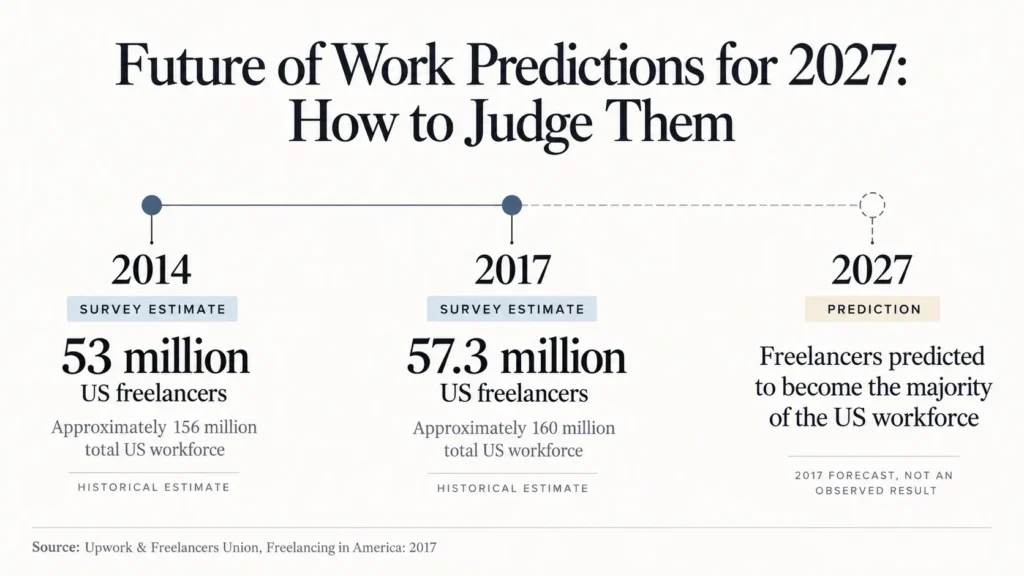
At the time, the researchers estimated that 57.3 million Americans were freelancing, representing 36% of the workforce. The prediction was based on recent growth rates. Now, with 2027 just over two months away, it offers a useful question: how much confidence should a business place in a forecast before making decisions around it?
Founders and agency owners face the same question today. Predictions about AI replacing jobs, freelance work expanding, and autonomous systems taking over business processes can influence hiring, software spending, and virtual assistant support plans.
The trouble is that a measured result, an extrapolation, and an analyst’s forecast can look equally convincing when reduced to a headline.
If you’re reviewing future of work predictions for 2027, the goal shouldn’t be to find the most confident-sounding number. It should be to understand what the forecast measures, what assumptions support it, and whether it justifies changing your plans.
One 2027 Workforce Prediction Is Approaching Its Deadline
The 2017 Freelancing in America study provides a useful example because its forecast has a clearly stated target year.
What the Study Measured and What It Projected
Upwork and Freelancers Union commissioned Edelman Intelligence to survey 6,000 working US adults between July 21 and August 14, 2017.
The researchers estimated:
53 million freelancers in 2014, compared with a total US workforce of approximately 156 million.
57.3 million freelancers in 2017, representing around 36% of a workforce of 160 million.
A freelancer majority by 2027, projected using the recent pace of growth.
Those statements have different levels of certainty.
The 2014 and 2017 figures were survey-based estimates. They described populations the researchers were attempting to measure at the time.
The 2027 figure was a projection. It depended on the assumption that freelance participation would continue growing fast enough to cross the halfway mark.
That distinction matters.
The study provided a transparent sample and methodology. It reported an overall sampling margin of error of approximately 1.27 percentage points at the 95% confidence level.
But a survey’s sampling margin of error doesn’t tell us how accurately a ten-year projection will perform. Forecast uncertainty depends on future conditions, definitions, and whether the assumptions behind the projection remain reasonable.
A founder deciding whether to move substantial work to freelancers in 2017 could reasonably treat the research as evidence that freelance work was important and expanding. Treating the 2027 projection as a guaranteed workforce outcome would be a different decision.
Why a 2026 Statistic Cannot Automatically Confirm the Prediction
In July 2026, Upwork released its Future Workforce Index 2026.
It reported that 38% of skilled US knowledge workers freelance, compared with 28% in its previous annual index.
That sounds relevant to the old forecast, but it doesn’t provide a direct answer.
The 2017 research estimated freelancing across the broader US workforce. The 2026 index surveyed 2,400 US skilled knowledge workers, using eligibility criteria that excluded many other kinds of employment.
Those aren’t identical populations.
It would be misleading to place 36% from 2017 next to 38% from 2026 and conclude that freelancing had barely increased. It would be equally misleading to use the newer survey to declare that the 2017 prediction was on track.
A valid comparison would require sufficiently consistent definitions, populations, and measurement methods.
The lesson: Before asking whether a prediction came true, establish what evidence would actually count as confirmation.
Why Different 2027 Forecasts Can Tell Different Stories
Forecasts disagree for several reasons. Some describe current activity. Others extend historical growth into the future. Still others represent an analyst’s judgment about what organizations are likely to do.
The distinction is especially important when discussing AI and workforce changes.
A Measurement Is Not a Forecast
Consider a December 2025 Gartner survey involving 321 customer service and support leaders.
Gartner reported that:
20% had reduced agent staffing because of AI.
55% maintained stable staffing while handling higher customer volumes.
42% were hiring for specialized AI-related roles.
These were reported survey findings about participating organizations.
In the same announcement, Gartner predicted that by 2027, half of organizations anticipating substantial AI-driven customer service workforce reductions would abandon those plans.
That last statement was a forecast, not an observed result.
Both pieces of information can be useful, but they answer different questions.
The survey describes what respondents reported in October 2025. The prediction describes what Gartner expects certain organizations to do by 2027.
Neither establishes what will happen to staffing in every small business, marketing agency, or virtual assistant arrangement.
When the Organization Publishing the Numbers Sells the Service
Virtual assistant market statistics illustrate another difficulty: different reports may measure different markets while using similar terminology.
For example, one VA Masters article describes the human virtual assistant services market at approximately $5.6 billion to $6.5 billion in 2026.
Another VA Masters statistics article discusses distinct 2025 market estimates of $5.3 billion and $19.5 billion, with different definitions of what is included.
The second article acknowledges that the scope of a market estimate changes the reported figure.
That’s the important point. A market estimate may include independent human virtual assistants, managed service providers, recruitment arrangements, or technology platforms. Other research uses “virtual assistant” to describe AI software rather than people.
Those figures cannot be combined into one reliable market-size number without reconciling their definitions.
There is also a commercial context. Businesses publishing VA industry statistics may sell virtual assistant services. Their figures aren’t automatically wrong because of that, but their sources and methods deserve scrutiny.
The same applies to Upwork, which operates a marketplace connecting clients with freelancers, and Gartner, which sells research and advisory services.
Understanding the publisher’s interests doesn’t mean dismissing the evidence. It means examining what the figures actually support.
Some AI Forecasts Predict Failure Rather Than Adoption
In June 2025, Gartner predicted that more than 40% of agentic AI projects would be canceled by the end of 2027.
The reasons it identified included rising costs, uncertain business value, and inadequate risk controls.
That forecast deserves attention because it challenges a common assumption: greater AI capability doesn’t automatically mean successful implementation.
An AI system might demonstrate an impressive capability in a controlled setting but still be expensive or unreliable when connected to real business records, customers, tools, and approvals.
At the same time, Gartner’s prediction doesn’t prove that a particular AI project will fail. It isn’t a cancellation rate already measured across completed 2027 projects.
For a business considering autonomous tools, the useful question is whether the proposed system can deliver enough measurable value to justify its cost, oversight, and risk.
That is more actionable than assuming that agentic AI will either transform every business process or collapse as a category.
Five Questions to Ask Before a Forecast Enters Your 2027 Plan
Forecasts become more useful when they’re evaluated against the decision you are considering.
These five questions provide a way to examine a prediction without treating every headline as equally reliable.
1. Who Produced the Forecast, and What Do They Sell?
Identify the publisher, the original study, and any commercial interest connected to the subject.
A staffing marketplace may emphasize workforce flexibility. An AI vendor may emphasize automation potential. A research company may emphasize the risks or opportunities its clients are trying to understand.
Commercial interests don’t automatically invalidate research. But they are a reason to look beyond promotional summaries.
Follow the source back to the original report or announcement whenever possible.
This is similar to checking important factual claims against their original sources before publishing AI-assisted content.
2. What Exactly Is Being Counted?
Look for the population, definition, geography, timeframe, and denominator.
A percentage of customer service leaders isn’t a percentage of all employers. A marketplace’s hiring data doesn’t describe the entire labour market. A survey of skilled knowledge workers doesn’t represent every working adult.
If the headline says that 40% of projects may fail, ask which projects qualify and how cancellation is defined.
Without that context, a precise number can create a false sense of certainty.
3. Is the Number Measured, Extrapolated, or Predicted?
These three categories need different treatment.
Measured: A survey, administrative dataset, or other observation attempts to describe what has happened.
Extrapolated: A historical pattern is extended forward, often assuming that some part of the pattern continues.
Predicted: Analysts estimate a future outcome using assumptions, expertise, models, or a combination of evidence.
The categories can overlap. A forecast may use measured data as its starting point.
The key is to avoid presenting a future estimate as though the event has already occurred.
4. What Would Have to Be True for the Forecast to Happen?
Identify the conditions behind the prediction.
For freelancer growth, these may include continued demand, worker preferences, economic conditions, and consistent definitions.
For agentic AI adoption, relevant conditions could include reliable performance, acceptable operating costs, suitable data access, integration with existing systems, and manageable risks.
You don’t need to predict all those conditions perfectly. You need to know which ones could cause the headline outcome to change.
5. Would Your Decision Change if the Number Were Half as Large?
This is a useful test of how dependent your plan is on the forecast.
Suppose a business wants to remove human support capacity because of an AI replacement prediction.
If the predicted productivity benefit turned out to be substantially smaller, would the staffing decision still make sense?
If not, the business may be making a difficult-to-reverse commitment based on an uncertain assumption.
If the decision remains sensible across several plausible outcomes, the forecast may be less important than the underlying business case.
The Forecast Triage Table
Use this table before allowing a headline prediction to influence a staffing, outsourcing, or automation decision.
| Forecast | Source and commercial context | What is counted | Evidence type | Horizon and conditions | Decision | What would change the decision |
|---|---|---|---|---|---|---|
| Freelancers become the majority of the US workforce by 2027 | Upwork and Freelancers Union, 2017; Upwork operates a freelance marketplace | Freelancing across the broader US workforce | Historical estimates plus extrapolation | By 2027; continued growth and sufficiently consistent definitions | WATCH | Comparable workforce measurements showing whether the majority threshold has been reached |
| More than 40% of agentic AI projects are canceled by end-2027 | Gartner, June 2025; research and advisory provider | Agentic AI projects within the forecast’s scope | Analyst prediction | End of 2027; affected by costs, business value, and risk controls | TEST relevant AI applications rather than assume success or failure | Reliable project results, costs, error rates, and evidence about deployment outcomes |
| Your next forecast | Publisher and commercial interest | Population and definition | Measured / extrapolated / predicted | Deadline and necessary conditions | COMMIT / TEST / WATCH | Specific new evidence that would justify changing course |
How to use it: Copy the final row for each forecast you’re considering. Don’t choose COMMIT simply because the source is well known. Choose it when the decision is supported by evidence relevant to your business and remains reasonable across plausible outcomes.
TEST means gathering results from a small, controlled application. WATCH means the information is worth following but hasn’t yet justified changing your plan.
What the More Reliable Signals Suggest About Support Work in 2027
The available evidence doesn’t support a single, universal conclusion about staffing.
It does show that organizations are experimenting with new combinations of technology and human work.
Gartner’s December 2025 survey found that some customer service organizations had already reduced staff because of AI, while others had maintained staffing and handled more customer activity.
A later August 2026 Gartner survey of 199 service and support leaders reported a 38% increase in AI spending against a 2% increase in overall service and support budgets.
Those findings suggest considerable investment in AI, but spending more on technology doesn’t establish that a corresponding amount of human work has disappeared or that the investment has delivered its intended return.
Another relevant indicator comes from Upwork’s 2026 In-Demand Skills research.
On its marketplace, General Virtual Assistance, Executive Virtual Assistance, and other human support categories remained among the most sought-after skills in customer service and administrative support.
That’s evidence of ongoing demand within Upwork’s marketplace. It isn’t a forecast of total global VA employment.
Together, the findings suggest that AI adoption and demand for people can coexist, although the balance may differ substantially between roles and organizations.
For a closer examination of task automation versus human responsibility, I’ve explored whether AI will replace virtual assistants in a separate article.
For 2027 planning, the more defensible position is to evaluate specific work, costs, and results instead of assuming that one technology forecast settles the entire staffing question.
Turning Predictions Into Decisions: Commit, Test, or Watch
The purpose of evaluating a forecast isn’t to achieve perfect certainty.
It’s to make a decision proportionate to what the evidence supports.
Commit When the Decision Remains Useful Across Different Outcomes
Some improvements don’t require an industry prediction to come true.
For example, a business with undocumented recurring processes, unclear workload ownership, or unreliable task records already has reasons to improve those areas.
Those changes can be worthwhile whether AI adoption accelerates or slows.
The same applies to understanding actual support costs before making a staffing commitment.
If you’re weighing different arrangements, compare the real costs of a virtual assistant and a full-time employee using your expected workload rather than a market forecast.
A commitment deserves stronger consideration when its value doesn’t depend entirely on a predicted future.
Test When the Outcome Depends on Uncertain Technology Performance
Suppose a founder is considering an AI tool to handle part of a recurring research or administrative process.
Instead of assuming a projected productivity gain will apply, the business can test the tool on a defined workload and compare it with the current approach.
The comparison should include more than the time taken to produce an initial result.
Relevant measures may include accuracy, corrections, supervision, subscription or usage costs, exception handling, and the time needed to resolve failures.
A test could demonstrate meaningful savings. It could also reveal that the remaining human oversight makes the tool less economical than expected.
Either result is useful because it comes from the business’s own process.
If the decision concerns an individual activity rather than the overall workforce, the separate guide on when to automate versus delegate a business task covers that practical distinction.
Watch When the Forecast Hasn’t Earned a Change in Direction
Some predictions are worth knowing without requiring immediate action.
A claim about the percentage of US workers who will freelance next year doesn’t necessarily justify changing a particular agency’s staffing model.
Likewise, a prediction about enterprise AI adoption may be important context without being relevant to a small business’s current workload.
Keep the forecast in view, identify what evidence would change the decision, and revisit it when that evidence becomes available.
This approach also reduces the risk of repeatedly reorganizing work in response to competing headlines.
Plan for 2027 Without Betting on a Headline
The 2017 prediction about a freelance workforce majority is valuable because it exposes the difference between a credible measurement and an uncertain future outcome.
The same distinction matters when reading Gartner’s AI forecasts, vendor market estimates, and claims about the future of virtual assistance.
A forecast should influence a decision in proportion to the quality and relevance of its evidence, not the confidence of its headline.
For 2027, commit to improvements that remain valuable across several outcomes. Test changes that depend on uncertain productivity or automation assumptions. Watch broader predictions until sufficiently comparable measurements or business-specific results justify action.
At Boost VA, I provide ongoing and project-based virtual assistant support, and if you’re exploring flexible support capacity while evaluating your 2027 plans, we can discuss what your workload actually requires.