

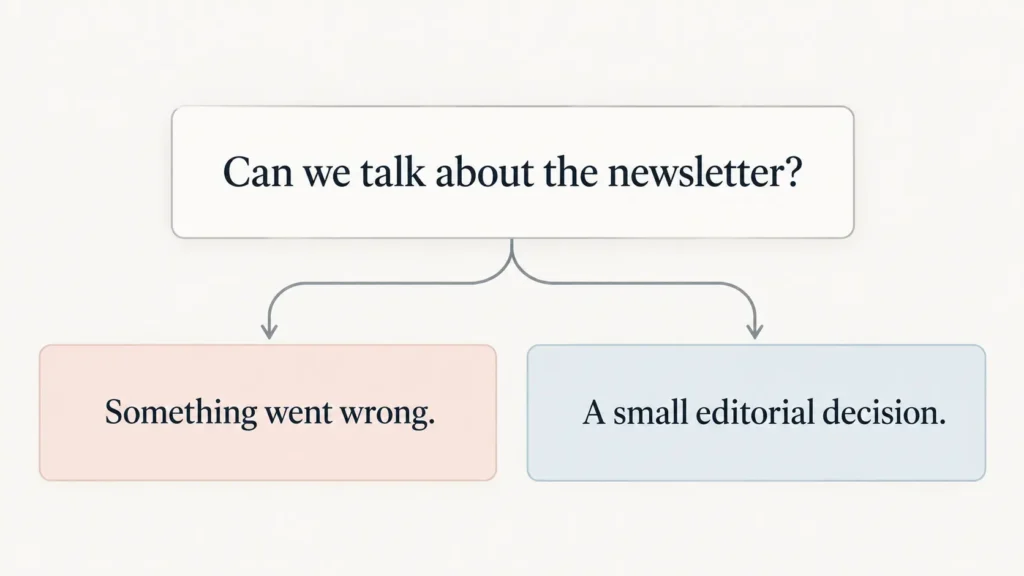
“Can we talk about the newsletter?”
You send that message to your virtual assistant because you want to discuss a small change before Friday’s edition goes out.
Your VA might read it very differently.
Maybe something is wrong with the newsletter. Maybe the last draft was disappointing. Perhaps the conversation is going to be uncomfortable.
You meant, “Let’s decide which article to feature.” They may hear, “We need to discuss a problem.”
Neither interpretation is unreasonable. The message simply leaves too much of your intended meaning in your own head.
Knowing how to write messages to your virtual assistant is different from knowing how to prepare a complete task brief. A clear task brief explains the assignment. Everyday messages handle all the little conversations around it.
Those shorter exchanges are where urgency, tone, feedback, and expectations can get misunderstood.
Here are six common messages, how they might be received, and how to rewrite them without turning every conversation into a lengthy instruction.
The messages below are illustrative examples, not transcripts from actual client relationships.
Why a message sounds clearer in your head
When you write a message, you already know what you mean.
You know whether you’re annoyed, relaxed, joking, or simply trying to get something done. You can almost hear your own tone as you type.
The person receiving it doesn’t have access to that internal voice.
A 2005 study by Kruger, Epley, Parker, and Ng, published in the Journal of Personality and Social Psychology, examined how well people communicate tone through email.
In one small experiment involving 12 university students, participants expected recipients to identify the intended sarcastic or serious meaning of their statements 97% of the time. The actual accuracy was 84%.
In another experiment, involving 29 pairs, participants anticipated 78% accuracy when communicating by email, but recipients correctly interpreted the intended tone 56% of the time.
These findings don’t mean people generally misunderstand half their emails. The experiments tested specific forms of tone communication, particularly sarcasm, with small participant groups.
The important finding is the gap between how clearly senders believed they were communicating and how accurately their messages were understood.
The research examined email in 2005, not modern chat applications or virtual assistants. Still, the same absence of vocal tone may create problems in quick written conversations today.
There is also a wider remote-work challenge. Gallup research published in 2024 reported that clarity of workplace expectations had declined over the preceding five years, with remote and hybrid employees experiencing that decline at twice the rate of the broader US workforce.
That finding concerns employees, not independent virtual assistants, and it doesn’t specifically measure message tone. It does reinforce why expectations need attention when people aren’t working together in person.
The practical lesson isn’t to make every message longer or friendlier. It’s to include the small piece of meaning the other person cannot hear.
Rewrite 1: Make urgency clear without making everything sound urgent
Before:
Need this ASAP.
ASAP might mean within the next hour to you.
Your VA might interpret it as today’s highest priority, something to finish before the end of their shift, or simply another request that should be handled soon.
The message also gives them no idea what should happen to their existing work.
After:
Could you send me the invoice draft by 3:00 PM WAT (UTC+1) today? I need to review it before sending it to the client. Please prioritize this over the blog update. The blog can wait until tomorrow.
Why it lands better
The revised message explains the timing, the reason, and the priority change.
It also gives your VA permission to delay something else. That’s important because urgency without a priority decision can leave someone trying to satisfy two competing expectations.
You don’t need that much detail for every request. A short message such as “Not urgent, tomorrow is fine” may be enough when the work is already understood.
The useful distinction is between important, time-sensitive, and immediately urgent. Those aren’t interchangeable.
If deadlines are repeatedly missed even after the priority is clear, the issue may be available capacity rather than how you phrase a message. That’s a separate problem covered in my guide to handling missed VA deadlines.
Rewrite 2: Give an ambiguous one-liner its missing meaning
Before:
Can we talk about the newsletter?
This is the kind of message that makes sense when you’re the person sending it.
You know there’s nothing wrong. You just want to choose a different featured link.
Your VA sees a request to talk, but not the subject, importance, or reason.
After:
Nothing wrong with the newsletter draft. I just want to decide which article should appear first. Could we spend 10 minutes on that tomorrow?
Why it lands better
The first sentence removes an unnecessary possible interpretation.
The second explains the actual decision.
The third makes the request easy to answer.
The improvement isn’t really about adding more words. It’s about replacing uncertainty with context.
You can apply the same idea to messages such as:
“Quick question about the website.”
“I noticed something in the report.”
“We should discuss the social posts.”
When a message could reasonably sound like a warning, but you only mean to make a routine adjustment, say what the conversation is actually about.
And if you do need to raise a serious problem, be clear about that too. Reassuring someone that nothing is wrong when there genuinely is an issue would only create another misunderstanding.
Rewrite 3: Correct the work without making the person feel attacked
Before:
This isn’t what I wanted.
That response tells your VA you’re unhappy with something, but it doesn’t distinguish the mistake from the work that was done correctly.
It may also sound more personal than you intended.
After:
The layout works well, but the headline changes the meaning of the offer. Please use the exact headline from the approved copy and send me the updated graphic. Everything else can stay as it is.
Why it lands better
The correction is still direct.
You haven’t hidden the problem behind unnecessary compliments or avoided saying what needs fixing.
Instead, you’ve made three things clear: what works, what doesn’t, and what should change.
There’s also a difference between describing a mistake and assigning a personal quality to someone.
“There’s an incorrect price in the graphic” addresses the deliverable.
“You’re careless with details” turns one issue into a judgment about the person.
When you’re communicating in writing, that distinction matters because your tone isn’t available to soften or explain the words.
This doesn’t mean every error needs gentle treatment. Repeated problems, missed commitments, and serious quality issues still need to be addressed. The message should simply match the issue instead of adding frustration that doesn’t help resolve it.
For the separate question of how to assess a finished deliverable, see my virtual assistant work-review guide. Here, we’re focusing on how the correction itself is communicated.
Rewrite 4: Make questions easier to ask and easier to answer
Before:
Let me know if you have questions.
There’s nothing inherently wrong with this message.
The trouble is that it asks your VA to decide what counts as a question worth interrupting you about.
If they’re new to working with you, they may hesitate to ask about something that seems obvious to you. Or they may believe you expect them to figure things out independently.
After:
If anything is unclear, please send me the part you’re unsure about and what you were planning to do. I’d rather answer a quick question than have you spend time working in the wrong direction. If you’re waiting for my approval, flag that separately.
Why it lands better
The revised message gives your VA a way to raise uncertainty without feeling they need a perfectly formed question first.
It also tells them that asking is a useful part of the work, not evidence that they can’t handle it.
But the invitation means more when you respond constructively.
Imagine your VA asks whether they should replace an existing contact record because two sources disagree.
Compare these replies:
I thought that was obvious.
And:
Good question. Keep the original record for now and add the conflicting information to the notes. I’ll decide which version to use.
The second answer resolves the immediate issue and gives them a useful reference for the next similar situation.
Questions can also be missed when they arrive in a busy conversation. For recurring assignments, a visible blocker or decision-needed field can help. My virtual assistant weekly report template includes a place for those unresolved items.
The written message should make raising a question easy. The ongoing work system should make sure that question doesn’t disappear.
Rewrite 5: Check understanding without making it sound like a test
Before:
Do you understand?
Your VA may simply reply, “Yes.”
That doesn’t necessarily tell you whether you’re both imagining the same result.
It can also sound like you’re questioning their ability rather than checking whether your explanation was clear.
After:
Before you make the live changes, could you briefly confirm which two pages you’re updating and what you’re leaving unchanged? I want to make sure I explained the request clearly.
Why it lands better
You’re asking for a description of the intended action, not a declaration of understanding.
That gives you something concrete to compare with what you actually wanted.
It also makes clarification a shared responsibility rather than putting all the pressure on the VA.
This is most useful when a misunderstanding would be expensive, public, or difficult to reverse. Examples include changing live website content, sending client-facing materials, or updating important business records.
For ordinary recurring work, asking your VA to repeat every request would become unnecessary supervision.
Use a short confirmation when the cost of misunderstanding justifies it.
Rewrite 6: Make praise useful, not just pleasant
Before:
Thanks, great job!
There’s nothing wrong with a simple thank-you.
Sometimes that’s exactly the response you should send.
But when your VA has done something particularly useful, you have an opportunity to explain what made it valuable.
After:
This is exactly the kind of weekly summary I needed. Putting the three decisions at the top made it much easier to review. Please keep that format for future reports. Thank you!
Why it lands better
Your VA doesn’t have to guess what you particularly appreciated.
Was it the writing style? The research? The speed? The layout? The fact that they spotted a problem before it reached you?
Specific recognition tells someone what is worth repeating without turning praise into another instruction session.
It also helps reinforce the small improvements that might otherwise go unnoticed.
You don’t need to manufacture detailed feedback for routine work. But when someone makes your job noticeably easier, say how.
That information can be as useful as a correction.
When a message should become a conversation
Not every misunderstanding can be solved by rewriting another sentence.
Sometimes the written exchange has reached the point where both people are adding explanations without getting closer to agreement.
A short call may be better when:
Feedback is emotionally sensitive. The conversation involves trust, frustration, repeated mistakes, or a concern that could be misinterpreted in writing.
The same point has been misunderstood twice. Another written explanation may repeat the ambiguity.
The decision has several moving parts. A few minutes of discussion could resolve questions that would take many messages.
You need to show a process. A short screen recording may communicate an unfamiliar sequence better than several paragraphs.
The choice between messages, calls, and recordings is covered more broadly in my guide to tools for managing a virtual assistant.
And if you and your VA have limited working-hour overlap, consider whether the issue truly needs a live conversation. A clear written explanation or recording may be more practical than waiting until the next available meeting. The considerations are different when working with a VA across time zones.
Whatever channel you choose, keep important final decisions somewhere both people can find them later.
The habit behind all six rewrites
Before sending your next message, read it once as though you were the person receiving it.
Not with the tone you intended.
Not with the context you already know.
Just the words on the screen.
Would you know whether the request is urgent? Would you understand what response is expected? Could a simple question sound like criticism? Is there an important detail that exists only in your head?
You won’t catch every misunderstanding this way, and communication is a responsibility on both sides.
But making those small adjustments can help prevent an ordinary request from becoming unnecessary back-and-forth.
The aim isn’t to write perfect messages.
It’s to make your meaning easier to recognize, whether you’re asking for a quick update, correcting a draft, clarifying a deadline, or thanking someone for a job well done.
At Boost VA, my approach to ongoing support includes keeping clients updated and flagging issues or blockers that need attention. If you’re looking for a virtual assistant who can work with clear expectations and raise questions rather than guess, you can explore my virtual assistant support.