


If you want to scale your business with virtual assistants, the goal is not to hand off as many tasks as possible.
The goal is to increase the amount of useful work your business can complete without turning every increase in workload into another full-time hire, another overloaded founder, or another layer of management.
That distinction matters even more in 2026.
Virtual assistants can now work alongside AI tools, automation, project-management systems, and specialist freelancers. At the same time, businesses still need human judgment, ownership, quality control, communication, and accountability.
The strongest scaling model is therefore not simply business owner + VA.
It is a deliberate operating system where the right work goes to the right combination of people and tools.
What It Means to Scale Your Business With Virtual Assistants in 2026
Scaling is not the same as getting busier.
A business scales when it can handle more clients, projects, leads, content, transactions, or operational work without the owner’s workload increasing at exactly the same rate.
A virtual assistant can contribute to that by creating additional execution capacity.
That might mean:
keeping a CRM updated while sales activity grows;
researching and qualifying more prospects;
preparing recurring reports;
maintaining a WordPress site;
coordinating vendors;
scheduling approved content;
managing routine follow-ups;
maintaining databases and spreadsheets;
preparing information before a specialist or founder makes a decision.
The market itself is also changing.
On Upwork’s marketplace, General Virtual Assistance ranked first among its most in-demand Customer Service & Admin Support skills for 2026, alongside data entry, digital project management, research and executive virtual assistance. Upwork also reported strong growth in AI-related skills, illustrating that demand for human support and AI capability are developing at the same time.
Upwork’s 2026 In-Demand Skills report provides useful marketplace evidence for that combination.
VA provider Wishup describes another 2026 shift as founders using flexible VA support instead of making some full-time hires too early. That should be treated as a provider’s view of the market, not independent proof that founders broadly are replacing employees. But the underlying operating question is useful: does the business need another permanent position, or does it currently need more flexible execution capacity?
The answer depends on the work.
1. Scale a Bottleneck, Not a Generic Job Title
A common mistake is deciding, “I need a VA,” before identifying what is actually preventing the business from moving faster.
Start with the bottleneck instead.
For example:
Growth bottleneck: Your team has enough strategy but not enough capacity for prospect research, outreach preparation, content operations, SEO execution or follow-up.
Backend bottleneck: Website updates, CRM maintenance, reporting, database work and recurring admin keep getting delayed.
Operations bottleneck: Projects are moving, but coordination, vendor research, documentation, scheduling and status tracking consume too much attention.
Those are clearer scaling problems than “I need help.”
Once the bottleneck is defined, you can design the support around a repeatable responsibility.
Instead of:
Help me with marketing.
Use a responsibility such as:
Maintain the approved prospect-research pipeline each week, validate every company against the agreed criteria, update the CRM and flag uncertain records for review.
Now there is something that can actually scale.
The volume can increase. The process can improve. Parts may eventually be automated. Performance can be measured. Another person can learn the system if necessary.
That is much more useful than a growing collection of unrelated errands.
2. Use Generalist and Specialist VAs Differently
The image of a VA as someone who mainly manages calendars, inboxes and data entry is too narrow for many modern businesses.
Generalist support is still useful, especially when a founder has several related operational tasks that do not justify separate roles.
But as a company grows, specialization becomes more valuable.
A marketing-focused VA might understand outreach research, content scheduling, SEO support and reporting.
A WordPress VA might handle content uploads, routine maintenance, plugin workflows and on-page updates without pretending to be a custom developer.
An operations VA might work across CRM maintenance, research, vendors, spreadsheets, documentation and project coordination.
The important part is matching the depth of the role to the work.
Do not hire a general VA for work that requires a qualified accountant, attorney, senior developer, conversion strategist or another specialist simply because the VA option appears cheaper.
Likewise, do not create a permanent full-time position when you currently have ten or fifteen hours of suitable recurring work each week.
The virtual assistant vs freelancer vs employee guide goes deeper into that decision.
A useful scaling structure can include all three:
a VA for recurring execution and continuity;
specialist freelancers for defined expert work;
employees where the business genuinely requires permanent ownership, availability or internal authority.
The model should follow the workload rather than forcing every responsibility into one type of hire.
3. Pair Human VA Support With AI Instead of Treating Them as Opposites
AI has changed what productive support can look like.
Microsoft’s 2026 Work Trend Index found that 66% of surveyed AI users said AI allowed them to spend more time on high-value work. More importantly, 86% said they treated AI output as a starting point rather than a final answer. The report also found quality control and critical thinking becoming more important as AI handles more execution.
That is a useful model for AI-assisted VA work.
A VA may use approved AI tools to help:
organize or summarize information;
structure research;
prepare first drafts;
classify data;
extract fields from documents;
develop metadata;
prepare variations from an approved source;
speed up repetitive knowledge work.
But the human still needs to understand the assignment, check the result, apply the correct source rules, notice exceptions and take responsibility for what enters the business workflow.
AI should therefore expand a good process, not compensate for a process nobody understands.
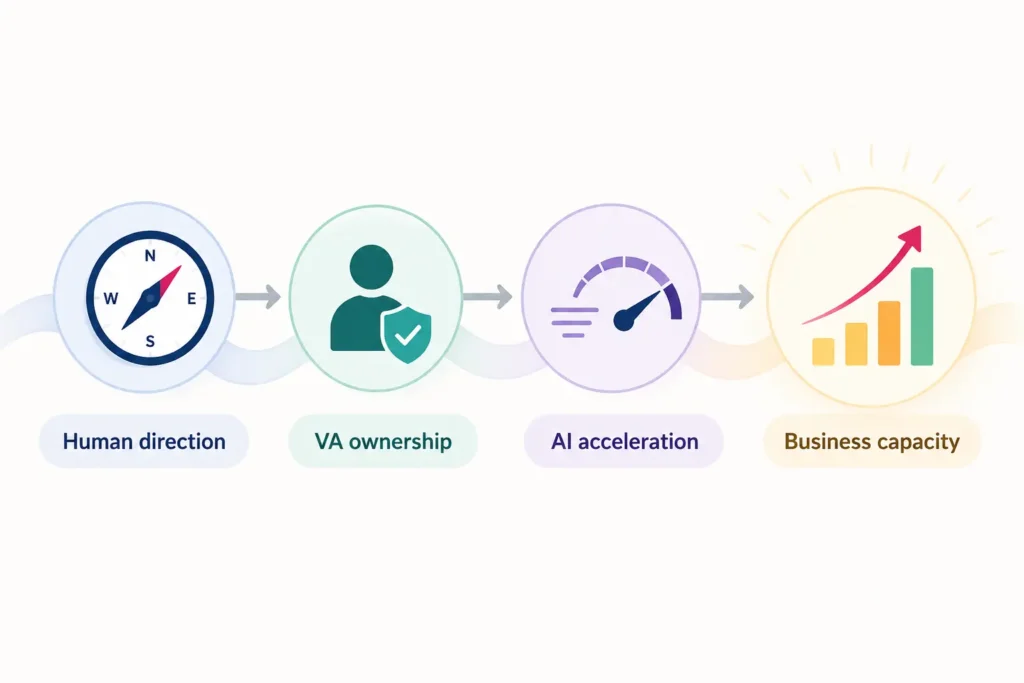
A weak workflow does not become scalable because AI has been added to it.
If nobody knows which source is authoritative, what a correct result looks like, which decisions require approval or how errors should be handled, faster output can simply create mistakes faster.
This is why the 2026 VA discussion is increasingly about human + AI execution, rather than AI versus human support.
For more context, see the analysis of virtual assistant industry trends in 2026.
4. Give Your VA Ownership of Recurring Outcomes
Scaling becomes difficult when a VA receives a stream of disconnected instructions directly from the founder.
“Update this.”
“Research that.”
“Can you post this?”
“Remind me about this tomorrow.”
Individual tasks may get completed, but the founder remains the routing system for the entire workload.
A better model is to create recurring ownership.
For example:
Scattered task model
Research these 20 companies today.
Ownership model
Maintain the approved prospect list each week, check new companies against our qualification criteria, record the evidence, update the status and flag anything that cannot be verified.
The second version creates continuity.
The VA knows what the responsibility is, when it happens, what information controls the work and when a question needs to come back to you.
This does not mean giving unlimited authority.
Good ownership still needs:
an expected outcome;
a source of truth;
clear decision boundaries;
a deadline or operating rhythm;
an escalation path;
an agreed review method.
If those pieces are missing, use the Boost VA task-brief method for giving clear instructions before expanding the role.
When bringing someone into the business for the first time, the virtual assistant onboarding guide covers access, kickoff, early training and responsibility expansion in more detail.
5. Expand Access Deliberately as the Role Grows
A VA who begins with research may eventually need access to your CRM.
Someone supporting content may later need WordPress access.
An operations VA may gradually need project-management systems, shared files, email tools or vendor accounts.
Do not respond to that growth by sharing every credential you have.
Access should grow with responsibility.
Where the software allows it:
create an individual user rather than sharing a master account;
grant only the permissions needed for the responsibility;
remove old access when a tool or responsibility is no longer needed;
keep sensitive approvals with the appropriate owner;
enable multifactor authentication;
maintain a record of important systems the person can access.
The U.S. Cybersecurity and Infrastructure Security Agency specifically recommends requiring MFA wherever possible, including systems such as email, file storage and remote access, with particular attention to administrative and sensitive accounts.
CISA’s multifactor-authentication guidance is a useful starting point for strengthening account access.
The objective is not to make delegation difficult. It is to make additional capacity possible without giving broader access than the work requires.
6. Measure Capacity, Not Just Hours Worked
A VA can be busy for 20 hours and still fail to create meaningful capacity.
The better question is:
What can the business now handle more reliably because this responsibility has moved?
Useful indicators depend on the work, but you can often look at:
Founder or manager time released: Are you spending less time executing or checking this work?
Backlog: Are recurring jobs being completed instead of accumulating?
Cycle time: Is work moving from request to completion faster?
Rework: Is the output accurate enough that delegation does not create another review burden?
Throughput: Can the business process more leads, content, records, projects or recurring activities without the same increase in founder effort?
Follow-through: Are necessary updates and repeated operational jobs happening consistently?
Do not expect every VA role to improve revenue directly.
A database-cleanup responsibility, for example, may create value through better data rather than immediate sales.
A WordPress support role may reduce maintenance backlog.
Research support may allow a strategist to spend more time interpreting information instead of collecting it.
The metric should match the responsibility.
The virtual assistant performance review guide provides a deeper method for evaluating completed work, reliability, communication and improvement.
Boost VA also has a marketing agency VA case analysis that examines a provider-reported example of substantial capacity gains while explaining why a single case should not be treated as a universal productivity promise.
The VA Scaling Capacity Ladder
You do not need to build a large outsourced team on day one.
A more controlled approach is to expand support only after the previous level works.
| Stage | Business situation | VA model | What proves you are ready to advance |
|---|---|---|---|
| 1. Remove one bottleneck | Important recurring execution still depends on the founder | One VA owns one defined responsibility | Work is completed reliably with manageable review |
| 2. Expand the lane | The first responsibility is stable and adjacent work is accumulating | Add related responsibilities or additional hours | The VA can handle greater volume without quality or communication breaking down |
| 3. Add AI-assisted execution | Parts of the process are repetitive, research-heavy or document-heavy | VA uses approved AI or automation with human review | Output becomes faster or easier without lowering accuracy |
| 4. Add specialization | The function requires deeper platform or domain knowledge | Add a specialized VA or reshape the existing role | Specialized work can be handled without inappropriate escalation or excessive training |
| 5. Change the staffing model when necessary | The work now requires permanent authority, full-time ownership, advanced expertise or deeper integration | Employee, specialist freelancer, additional VA, or hybrid team | The structure matches the actual responsibility rather than forcing the VA model further |
The important rule is simple:
Do not move up the ladder because the business feels busy. Move up when the existing support lane is stable and there is a clear next capacity constraint.
That prevents scaling support from creating a second problem: more people and tools to manage without a clear reason for adding them.
Know When a VA Is Not the Right Way to Scale
Virtual assistants are useful because the model is flexible.
That flexibility does not make the model suitable for every responsibility.
An employee may make more sense when the business requires:
full-time continuing ownership;
substantial internal authority;
tightly controlled working arrangements;
deep institutional knowledge;
constant availability within the team;
responsibilities that genuinely form a permanent position.
A specialist freelancer or professional may be better when you need a defined outcome that depends on expertise rather than recurring execution.
Examples include advanced development, legal work, regulated financial advice, specialist design, complex technical implementation or another job where professional depth is the main thing you are purchasing.
There is also work the founder should usually continue to own, even when preparation can be delegated.
That may include major strategic choices, important client relationships, final financial commitments, sensitive personnel decisions and decisions where the founder’s judgment is itself part of the value.
Scaling is not about removing the founder from everything.
It is about making sure the founder is not required for everything.
How I Support Growing Businesses Through Boost VA
At Boost VA, I provide ongoing and project-based virtual assistant support for founders, agencies and online businesses that need reliable execution without immediately building another full-time role.
Depending on the business, that can include research, outreach support, WordPress work, social content operations, CRM and spreadsheet updates, data handling, reporting preparation, administrative support and other recurring backend work.
The most useful starting point is not a long list of tasks.
It is one clear answer to this question:
What important work keeps getting delayed, interrupted or pushed back onto you because nobody currently owns the execution?
Start there.
Build a reliable lane around it. Measure whether that lane creates real capacity. Then expand only when the next bottleneck becomes clear.
If you have a recurring workload or defined project that is ready for reliable execution, explore the virtual assistant support available through Boost VA and tell me what you need help moving forward.