


Virtual Assistant Performance Review: How to Evaluate and Coach Your VA
Your virtual assistant is completing tasks. Deadlines mostly look fine. The work is moving.
But if someone asked, “How is your VA actually performing?” could you answer with evidence, or would you mostly be relying on a feeling?
That is the problem a virtual assistant performance review should solve.
A quality check asks whether one specific deliverable is correct. Feedback tells your VA what should continue or change after a piece of work. A performance review steps back and looks across repeated work to identify patterns, strengths, gaps, causes, and what should happen next.
You don’t need a complicated employee appraisal system to do that. You need clear expectations, evidence from the work, useful measures, a direct conversation, and a way to check whether agreed improvements actually happened.
General performance-management research offers useful principles for this process, but much of that research comes from employee and workplace settings rather than outsourced VA relationships. The framework below adapts those principles cautiously to a client and human-VA working relationship.
Start With the Work the VA Is Actually Responsible For
A fair review needs a fair baseline.
Before deciding that performance is good or poor, ask what the VA was actually expected to deliver.
What was the outcome? What counted as complete? Which decisions could the VA make independently? Which deadlines mattered? Which quality standards had already been established?
If those things were never clear, part of the problem may be the assignment rather than the person completing it.
My guide on how to set clear expectations before reviewing VA performance covers that upstream stage in more detail.
Once the standard exists, you can compare the work against it.
Separate execution quality from business outcomes
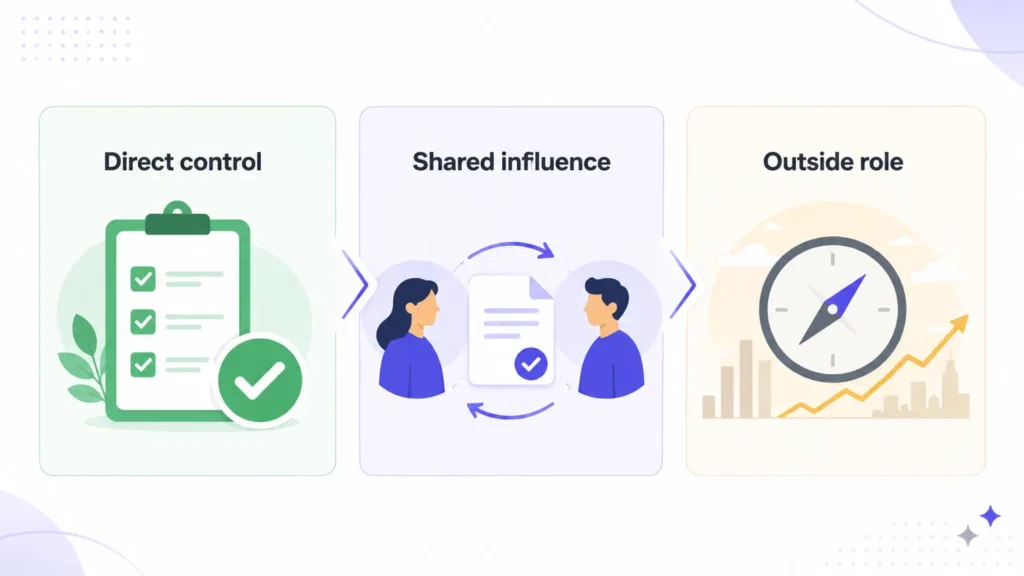
One of the easiest ways to create an unfair VA review is to judge someone by an outcome they only partially control.
Imagine a marketing VA who correctly uploads approved content, checks the supplied links, schedules every post on time, reports exceptions, and follows the agreed process.
If campaign revenue falls, does that automatically mean the VA performed badly?
No. Revenue may also depend on the offer, pricing, targeting, strategy, budget, creative direction, market conditions, approvals, and other decisions outside the VA’s role.
The same principle applies outside marketing.
A research VA may control whether records meet the supplied criteria. They don’t necessarily control whether those prospects later become customers.
A WordPress VA may control whether supplied content is formatted correctly. They don’t automatically control rankings or organic traffic.
This is why my guide to working with a marketing virtual assistant separates execution accountability from broader campaign results.
Where possible, review a VA primarily on outcomes and behaviors that are substantially within the role’s control.
Choose a few role-relevant measures
You don’t need ten KPIs just because an article about VA metrics gave you ten.
The CIPD’s performance-management guidance notes that performance can be assessed through both results and behaviors, and that measures should be necessary and relevant rather than targets that become counterproductive when overemphasized.
For VA work, useful evidence depends on the responsibility.
| Work type | Possible evidence | Important caution |
|---|---|---|
| Data entry or CRM work | QA errors, rework, correctly completed records, missing information flagged | Don’t reward speed that creates avoidable errors |
| Lead research | Valid records, source completeness, rejected records, turnaround | Quantity alone can hide weak qualification |
| WordPress support | Formatting accuracy, link checks, deadlines, issues caught before review | Traffic or ranking may depend on factors outside the VA’s scope |
| Admin support | Agreed deadlines, backlog movement, correct escalation | Separate VA delays from waiting on client approval |
| Marketing execution | Deliverables completed, approved assets used, deadlines, exceptions raised | Revenue and conversions may not be controlled by the VA |
The right question isn’t “What are the standard KPIs for every VA?”
It is: What evidence would tell me whether this particular responsibility is being handled well?
Review Evidence, Not Memory or “Vibe”
A performance conversation becomes much easier when you can point to actual work.
Depending on the role, your evidence might include:
completed deliverables;
quality checks or corrections;
deadline history;
rework required;
documented blockers;
questions that were escalated correctly;
previous feedback and whether it was applied;
agreed KPIs or acceptance criteria;
examples of work that met the expected standard.
A virtual assistant weekly report can provide part of this evidence by making completed work, blockers, decisions, and next actions visible.
The report itself isn’t the performance review.
It tells you what happened. The performance review asks what those results mean.
Look for a pattern before labeling performance
One mistake is evidence of one mistake.
It isn’t automatically evidence that your VA is unreliable, careless, or bad at the role.
Ask whether the issue has appeared across comparable work.
Was it already discussed?
Was the same standard in place each time?
Did requirements change?
Was the VA still learning the responsibility?
If the relationship is still in the early ramp-up stage, the virtual assistant onboarding process is a better framework for judging early learning and applying corrections.
An ongoing performance review becomes more useful once you have enough repeated work to identify a pattern.
Give Feedback the VA Can Actually Act On
Feedback doesn’t automatically improve performance.
A large meta-analysis by Kluger and DeNisi found that feedback interventions improved performance on average, but more than one-third of the interventions they reviewed reduced performance. Their analysis also found weaker effects when attention moved away from the task and toward the self.
That is a useful warning.
“Your work has been sloppy lately” makes the person the subject of the criticism.
“Six records in Thursday’s batch were approved without the required source field” gives the person something observable to work with.
For a practical structure, the Center for Creative Leadership’s Situation-Behavior-Impact model is useful.
Use Situation, Behavior, Impact, then name the next action
The original SBI framework contains three parts:
Situation: Where and when did it happen?
Behavior: What observable action occurred?
Impact: What happened because of it?
For a VA review, I recommend adding two practical elements:
Next action: What should continue or change?
Review date: When will you check it again?
Those last two elements are a practical adaptation for this guide. They aren’t part of the original CCL SBI model.
Here is a fictional corrective example:
In Friday’s prospect sheet, 12 records were marked qualified without the required source URL. I had to re-check those rows before outreach. For the next batch, keep the status as “Review” until the source URL is added. I will check the next 25 records on Tuesday.
Notice what isn’t there.
There is no “you are careless.”
There is a situation, an observable behavior, an impact, a specific change, and a follow-up point.
Recognition should be specific too
Positive feedback becomes more useful when the VA knows what to repeat.
Instead of:
Great job on the report.
Try:
In Tuesday’s report, you flagged the missing analytics data before submitting the final version. That prevented an incomplete report from reaching review. Please keep using that pre-send check.
That tells the VA exactly which behavior was valuable.
You don’t need to hide correction inside a mandatory feedback sandwich
You may have heard the advice to structure every difficult message as praise, criticism, then more praise.
You don’t need to force every review into that formula.
Be respectful. Recognize good work when it exists. But make both praise and correction specific enough to stand on their own.
If something needs to change, the VA shouldn’t leave the conversation wondering which part of the message actually mattered.
Turn the Review Into a Two-Way Coaching Conversation
A review isn’t just you presenting a score.
The CIPD describes good performance management as an ongoing, two-way process involving discussion about progress toward objectives. Its current performance-review guidance also distinguishes regular conversations from more structured reviews rather than treating them as competing approaches.
That translates well to VA work.
Routine feedback can happen when something needs recognition or correction.
A broader review can happen once enough work exists to discuss patterns.
The exact cadence depends on the relationship. A recurring, high-volume responsibility may justify more frequent review. A project-based VA may be better reviewed at meaningful milestones. New or high-risk work may need shorter feedback loops than a stable recurring process.
A practical review conversation can cover four things:
Wins: What is working and should continue?
Gaps: Where is the work falling short of the agreed standard?
Causes: What might be contributing to the gap?
Next actions: What changes, who owns it, and when will you review it?
Then ask for the VA’s view.
They may know about context you can’t see from the finished deliverable.
Was the source unclear?
Did access fail?
Did another dependency arrive late?
Has the workload changed?
Was an instruction interpreted differently?
Did the scope quietly expand without the time or process changing with it?
Listening to that context doesn’t mean lowering the standard. It helps you diagnose the right problem.
Diagnose the Gap Before You Call It a Performance Problem
When the same problem keeps appearing, it is tempting to jump directly to:
“My VA isn’t performing.”
Sometimes that conclusion will be justified.
But a recurring gap can come from several different places.
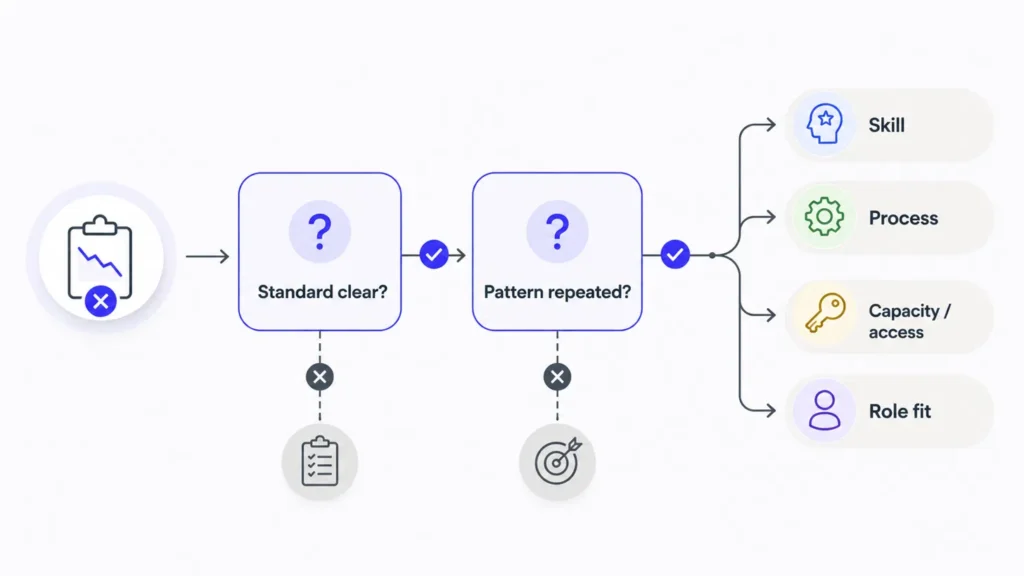
Instruction or standard problem
Ask:
Was the expected result actually defined?
Did the VA have the current instructions?
Was the quality standard clear?
Did the requirement change?
Were decision boundaries defined?
If “good” was never clear, coaching the VA to “do better” won’t fix the underlying ambiguity.
Skill or judgment problem
Sometimes the standard is clear and the work repeatedly misses it.
Perhaps the VA needs more training, an approved example, more practice, or a narrower responsibility while the skill develops.
Look at whether feedback is being applied.
If the same correction has been explained clearly, the process is stable, the necessary support exists, and comparable errors continue, you now have stronger evidence of a performance or fit problem.
Workload, dependency, access, or process problem
A good VA can still produce a poor outcome inside a bad process.
For example:
required access is missing;
another person consistently delays approval;
workload has grown beyond the agreed capacity;
two instructions conflict;
the source data is unreliable;
a tool or process creates unnecessary rework;
a responsibility depends on information the VA receives too late.
In those situations, telling the VA to “be more careful” may not address the cause.
The review should separate what the VA needs to improve from what the client or system needs to change.
Agree on One Improvement You Can Review Again
A review has limited value if it ends with:
“Please improve this.”
Make the next change observable.
Instead of:
Be more accurate with prospect research.
Try:
For the next 25 prospects, don’t mark a company as qualified until the required source URL and country check are complete. Put uncertain records in “Review.” We will assess those 25 records on Tuesday.
Now both sides know:
what should change;
where the rule applies;
what evidence will be reviewed;
when the follow-up happens.
That follow-up matters because the goal isn’t merely to deliver feedback.
The goal is to find out whether anything changed.
Use a Virtual Assistant Performance Review Scorecard
The scorecard below turns the review into a record you can revisit.
It is a practical Boost VA template created for this guide, not a scientifically validated performance-rating instrument.
You also don’t need to turn every responsibility into a 1-to-5 score.
For many small VA relationships, three simple statuses may be enough:
On track: evidence currently meets the agreed standard.
Needs attention: there is enough evidence to identify a gap that needs action.
Not enough evidence: you can’t judge fairly yet.
Use one scorecard entry per meaningful responsibility or workstream rather than giving the entire VA role one vague rating.
| Scorecard field | What to record |
|---|---|
| Review period | The dates or body of work being reviewed |
| Responsibility / workstream | The specific part of the VA’s role being assessed |
| Agreed standard or KPI | What good performance was supposed to look like |
| Evidence reviewed | Deliverables, QA results, deadlines, reports, or other relevant evidence |
| Status | On track / Needs attention / Not enough evidence |
| Strength to continue | A specific behavior or result worth repeating |
| Gap observed | What differs from the agreed standard |
| Possible cause to check | Instruction, skill, judgment, capacity, dependency, access, process, or role fit |
| Agreed next action | What should change next |
| Support / owner | Who needs to provide training, access, clarification, approval, or another fix |
| Review date | When the action will be assessed |
| Follow-up result | What happened after the agreed change |
Example scorecard entry
Review period: August 10 to August 21
Workstream: Prospect research
Standard: Each qualified record includes the required source and passes the supplied criteria
Evidence: 50 reviewed records
Status: Needs attention
Strength: Turnaround met the agreed deadline
Gap: Several approved records had no source URL
Possible cause: Process/checking step
Next action: Add a pre-submission check before marking records qualified
Owner: VA completes check; client confirms any ambiguous criteria
Review date: August 28
Follow-up result: Complete after the next review
The important part isn’t the status label.
It is the chain from standard → evidence → gap → cause → action → follow-up.
That gives you something more useful than “I think performance is better.”
What If Performance Doesn’t Improve?
A review system isn’t supposed to create endless coaching.
If a clear gap continues after the standard, support, process, and follow-up have been addressed, you have several possible decisions.
Rescope the responsibility
A VA may be reliable in most of the role but poorly matched to one responsibility.
Moving specialist work elsewhere can make more sense than treating the entire working relationship as a failure.
Retrain or provide a better reference
If the issue is a learnable skill and the relationship otherwise works, additional training or an approved example may solve it.
Change the process
If the same failure keeps appearing because information, approvals, tools, or dependencies are broken, fix the system rather than repeatedly coaching around it.
Reconsider the fit
If expectations are clear, the VA has the required access and support, the same important gap persists across comparable work, feedback has been understood, and agreed improvements still don’t happen, it may be time to reconsider whether the role and VA are a good match.
That decision should be based on the evidence and your actual working arrangement, not a universal number of warnings or failed reviews.
This guide is operational guidance, not employment or legal advice. Contract terms, agency arrangements, worker classification, notice requirements, and termination rules can vary, so contractual decisions should follow the arrangement that actually governs the relationship.
A Good Review Should Change What Happens Next
A useful VA review should leave both sides knowing four things:
What is working.
What needs to change.
What support or process change is required.
When the result will be checked again.
That is more useful than monitoring every hour, waiting until frustration builds, or judging performance from memory.
Start with the work the VA actually owns. Review evidence. Give specific feedback. Diagnose the cause of recurring gaps. Agree on one observable improvement. Then come back and see whether it happened.
If you already have a defined workload and the bigger need is dependable execution rather than another management framework, you can explore my ongoing and project-based virtual assistant support and see whether Boost VA fits the work you need to keep moving.