

Three Months After Google I/O: What Actually Changed for Small-Business SEO
The biggest SEO lesson from Google I/O 2026 is not that every small-business website needs to be rewritten for AI.
Google did make some major changes to Search on May 19. Gemini 3.5 Flash became the default model in AI Mode globally. Google introduced a new AI-powered Search box designed for fuller descriptions and multimodal inputs. Searchers can continue from an AI Overview into a conversation with AI Mode, and Google also announced Search agents that can monitor information or help with certain actions. Google’s I/O Search announcement lays out the changes in detail.
But Google’s own SEO guidance makes another point just as clearly: generative AI Search still relies on its core Search ranking and quality systems. Google does not tell website owners to replace SEO with a completely new discipline.
For a small business, that creates a more useful question than “How do I optimize for AI?”
What has actually changed about how customers discover, evaluate and act on information, and what should your SEO strategy do differently because of it?
Google Changed How People Can Ask and What Search Can Do
Traditional keyword searches are not disappearing, but Google is giving people more room to describe what they actually need.
The Search Box Is Becoming More Conversational and Multimodal
Google’s redesigned Search box can expand for longer descriptions and accept text, images, files, video and Chrome tabs as inputs. It can also suggest ways to formulate a question that go beyond traditional autocomplete.
A searcher no longer has to reduce a complicated problem to a short phrase such as “best accountant near me.” They may be able to describe their situation, constraints and intended outcome in considerably more detail.
That suggests a change in content planning.
Instead of creating pages around every possible wording of a long conversational query, focus on understanding the underlying customer problem and answering the important decisions around it. Google itself warns against creating separate content for every query variation simply to influence rankings or generative responses.
Search Is Moving From Answers Toward Actions
Google also used I/O to push Search further beyond finding information.
Its information agents were announced as background agents that can monitor information across the web and provide synthesized updates. Google also announced expanded agentic booking capabilities and said people in selected U.S. categories such as home repair, beauty and pet care would be able to ask Google to call businesses on their behalf.
Those features were announced for summer rollout, so they should not be treated as universally available to every user or business yet.
Still, the direction matters.
If Search increasingly helps a customer move from “find a provider” to “check availability” or “take the next action,” accurate service information and working booking, contact and purchase paths become more important parts of the customer journey.
The Surprising Part: Google Says This Is Still SEO
There is plenty of new language around AEO, GEO and AI-search optimization. Google’s position is much simpler.
Its current generative AI Search guidance says that SEO best practices remain relevant because AI Overviews, AI Mode and related experiences are rooted in Google’s existing Search ranking and quality systems.
That means crawlability, indexability, useful content, technical structure and reliable information have not suddenly become obsolete.
Query Fan-Out Changes Retrieval, Not the Need for Useful Pages
One important difference is something Google calls query fan-out.
For a complex question, the system can generate several related searches behind the scenes, retrieve useful information from those results, and combine what it finds into a response.
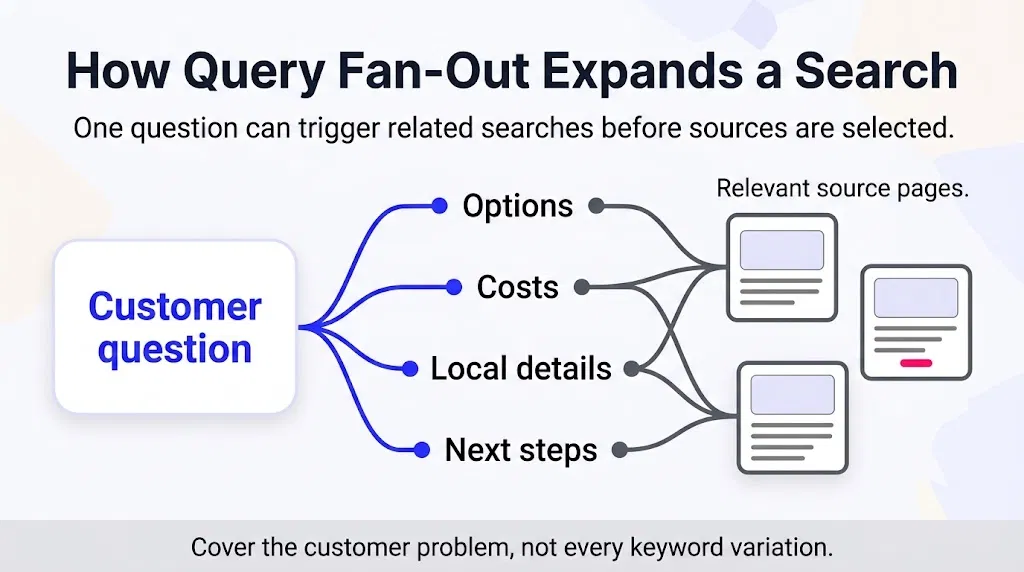
This helps explain why visibility in an AI answer may not map perfectly to the ordinary ranking for the exact query the user typed.
Third-party research from Ahrefs illustrates the difference. In a March 2026 analysis of 863,000 search-result pages and about four million AI Overview citation URLs, roughly 37% of cited URLs also ranked in the ordinary organic top ten for the identical query. That is a snapshot from Ahrefs rather than a Google ranking rule, but it supports the idea that fan-out can widen the source set beyond the obvious first-page results. Ahrefs’ citation analysis explains its methodology.
The practical response is not to create hundreds of near-duplicate pages.
It is to build useful coverage around the customer’s actual problem, including the details and related decisions someone may need before they are ready to act.
You Don’t Need an AI-Writing Formula
Some AI-SEO advice makes the process sound much more complicated than Google does.
Google currently says:
there is no requirement to break content into tiny “AI-friendly” chunks;
you don’t need to rewrite pages in a special style just for generative AI;
you don’t need every variation of a long-tail query;
LLMS.txt does not help Google Search visibility or rankings;
there is no special schema markup required for generative AI Search.
Structured data can still be useful for its normal SEO purposes, and a concise Q&A section can still improve a page when readers genuinely need it. Those are different claims from saying Google requires a special format to understand your content.
The better standard is the familiar one: make the page useful, distinctive, reliable and easy for people to understand.
What Changes When Search Can Answer Before the Click
The bigger business challenge may not be ranking. It may be what happens after your information appears.
Independent research already suggests that AI summaries can change click behavior.
Pew Research Center examined browsing activity from 900 U.S. adults during March 2025. On visits where a Google AI summary appeared, users clicked a traditional search result 8% of the time, compared with 15% on pages without a summary. Links cited directly inside the AI summary were clicked in only 1% of visits containing a summary. The study predates the I/O 2026 changes, so it should not be treated as a universal post-I/O click rate, but it provides useful evidence of the direction of travel. Pew’s browsing-behavior study provides the methodology and results.
Ahrefs reached a similar directional conclusion using a different method. Its February 2026 analysis estimated that the presence of an AI Overview correlated with an approximately 58% lower average click-through rate for the position-one page compared with its counterfactual estimate. Because this is observational SEO data rather than a controlled experiment, the figure should not be treated as a guaranteed traffic loss for every query or website.
Visibility and Click Volume Are No Longer the Same Outcome
This does not mean rankings or traffic have stopped mattering.
A visit to your website is still valuable because that is where a customer can read more, enquire, book, subscribe or buy.
What changes is the assumption that search visibility and website traffic are always the same result.
A page might help Google answer a searcher’s question without receiving the click it once would have earned. In other cases, the searcher may still need your website because the next step requires more detail, trust or action.
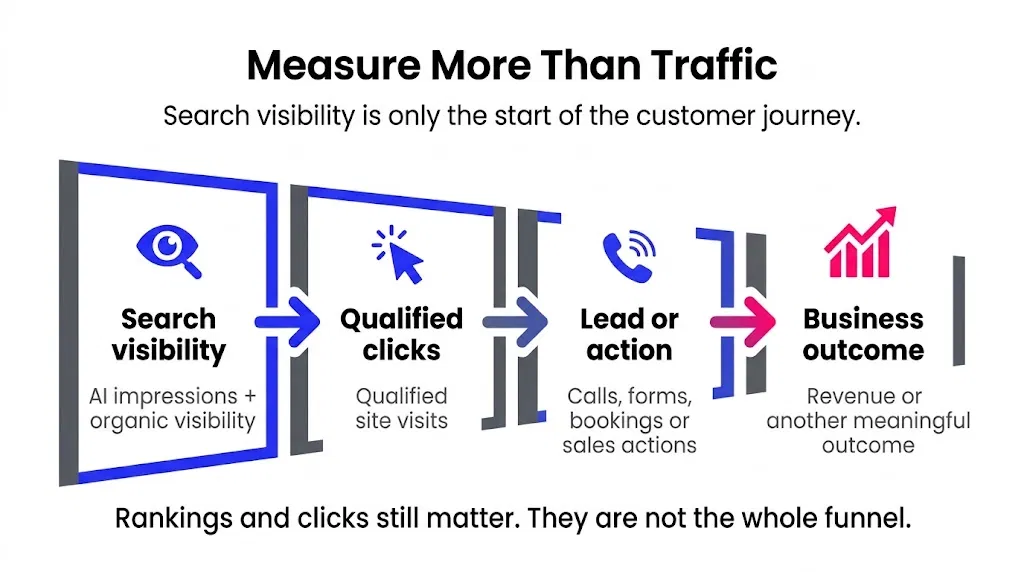
That is why businesses may need to evaluate SEO across a wider chain:
visibility → click → lead or action → business outcome
Being visible matters. Getting the right visitor matters more. Turning that attention into a useful business result matters most.
The Right SEO Response Depends on What the Customer Is Trying to Do
There is no single AI Search tactic that fits every small business.
A useful way to decide what deserves attention is to separate searches by the job the customer is trying to complete.
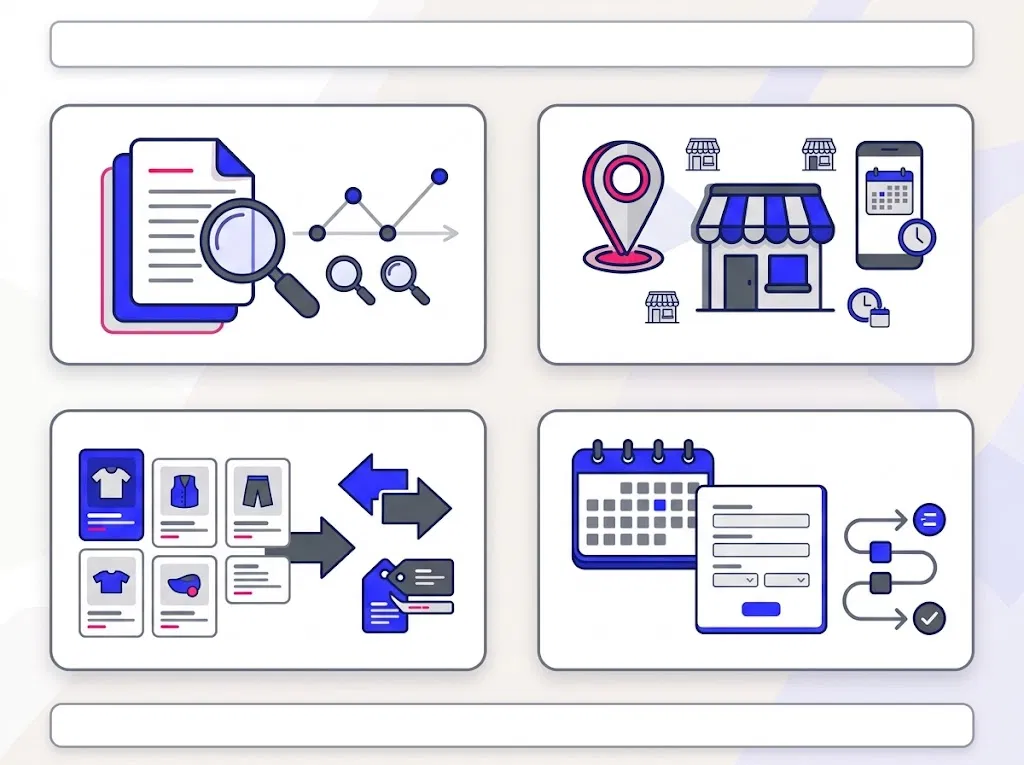
Small-Business AI Search Impact Map
| Search scenario | What AI Search may change | Business asset that matters most | Immediate priority | Metric to watch | What not to over-optimize |
|---|---|---|---|---|---|
| Research or “How do I…?” | Search may synthesize useful information before the person visits a site | Expert article, useful guide, original evidence | Add distinctive expertise and complete context | AI visibility where available, qualified clicks, conversions | Forced Q&A pages or hundreds of query variations |
| Local service | Search may combine business facts and increasingly help users take actions | Google Business Profile, service pages, location pages and accurate public information | Verify services, hours, contact information and booking details | Calls, leads, bookings and AI visibility where available | “Knowledge panel” hacks |
| Product or comparison | Search may combine product details and recommendations | Product pages and Merchant Center data | Keep product and feed information complete and current | Qualified product visits and sales | Claims that special AI schema guarantees visibility |
| Action or booking | Agents may increasingly interact with providers or websites | Booking, order and contact flows | Make important actions reliable and accessible | Completed actions | Experimental agent protocols pursued purely for ranking |
For informational content, Google’s strongest advice is not “write for the machine.” It is to create material that adds something the web does not already have. That may be first-hand expertise, original examples, useful comparisons, clearer evidence or a genuinely helpful point of view.
For a local business, information accuracy becomes especially important. Google’s guidance points businesses toward complete Business Profile information for local visibility. That makes keeping your Google Business Profile accurate more than routine housekeeping. Services, opening hours, contact details, location information and booking links need a reliable source of truth.
If several locations are involved, the operational problem grows. A controlled process for keeping location data consistent at scale helps prevent one outdated field from spreading across pages, profiles, citations and internal records.
For ecommerce businesses, Google also points to accurate Merchant Center information alongside useful website content. The principle is similar: make the product easy to understand and keep the underlying facts current.
Measure AI Search Without Replacing Business Metrics With Vanity Metrics
Google is beginning to give website owners better visibility into generative Search itself.
On June 3, Google announced dedicated Search Console reports for generative-AI visibility, including AI Overviews and AI Mode. The reports can show impressions, pages, countries, devices and dates.
There is an important limitation: Google said the new reports were initially rolling out to a subset of websites, so you should not assume the dedicated report is already available in every Search Console property.
When the report is available, use it as another layer of SEO measurement rather than a replacement for the numbers that already matter.
A sensible measurement chain is:
Search visibility: Where are your pages appearing in ordinary and generative Search?
Qualified clicks: Which pages and queries still bring people to the site?
Leads or actions: Are visitors calling, submitting forms, booking or buying?
Business results: Are those actions contributing to useful outcomes?
That distinction matters because an increase in AI impressions is not automatically an increase in customers.
The reverse is also true. Lower click volume on some informational searches does not automatically mean an SEO campaign has stopped creating value.
For local businesses, reporting should also include an accuracy check. Periodically review important business facts and the search experiences around branded and high-value local queries. If Google is presenting incorrect information, investigate the underlying pages, profile data and reputable public sources rather than assuming there is a single “AI citation” switch to fix.
Routine work such as Search Console exports, listing checks, approved page updates and reporting can sit within a broader set of recurring local SEO tasks once the strategy and approval boundaries are already clear.
What Small Businesses Should Prioritize Now, and What Can Wait
The safest response to Google’s AI Search shift is not to rebuild your SEO program around every new term.
Start with the work that remains useful whether a customer sees a blue link, an AI Overview, AI Mode or an emerging agentic experience.
1. Protect the SEO fundamentals.
Make sure important pages can be crawled and indexed, technical problems are not blocking discovery, and the site clearly communicates what the business offers.
2. Keep business and product information accurate.
Review the facts customers depend on: services, locations, hours, prices where appropriate, contact details, availability, product information and action links.
3. Make content harder to replace with a generic summary.
Add expertise, original evidence, first-hand examples, useful comparisons, visuals or decision support when you genuinely have something valuable to contribute.
4. Expand measurement beyond rankings and sessions.
Watch visibility, qualified traffic, leads and completed actions. Use Google’s generative-AI reporting when it becomes available in your property.
5. Treat agent readiness as a relevant next step, not a ranking shortcut.
If bookings, orders or other online actions are important to the business, reliable and accessible interaction flows deserve attention. Google itself presents agentic preparation as something to explore when it is relevant and you have additional time, not as a prerequisite for ordinary Search visibility.
The durable lesson from Google I/O is therefore less dramatic than the “SEO is dead” headlines, but more important operationally.
Keep the SEO fundamentals. Widen your definition of visibility. Make your business easy for Google and customers to understand, verify and act on.
If your strategy is already defined and the recurring implementation is the part slowing things down, Boost VA provides ongoing and project-based SEO and content support for work such as approved content updates, research, local-data checks, citation work, Search Console exports and WordPress execution.