


Local SEO Tasks to Outsource to a Virtual Assistant: A Practical Checklist
Local SEO has an awkward split. Some decisions need strategy and specialist judgment, but a large part of the weekly workload is recurring execution.
Someone still has to compare business details, check directory listings, collect local search queries, enter approved page updates, monitor reviews, research competitors, and document what changed.
Those are often the local SEO tasks to outsource to a virtual assistant.
The important part is the boundary. A VA can keep the execution organized and accurate, while the business owner, account manager, or SEO lead keeps control of strategy, sensitive changes, and final approvals.
Google says local results are mainly based on relevance, distance, and prominence. It also recommends keeping business information complete and accurate. A VA does not control those ranking systems, but they can help keep the information and recurring work behind your local SEO process in better order.
Set Two Rules Before You Hand Anything Off
Before assigning local SEO work, give your VA two things.
1. One approved source for business information.
This might be a client-approved spreadsheet, CRM, location database, or another internal record. It should contain the details the VA is allowed to use, such as the business name, address, primary phone number, website and location-page URLs, opening hours, services, approved descriptions, and target locations.
If two sources disagree, the VA should flag the conflict rather than decide which version is correct.
2. Clear escalation rules.
Define which changes can be completed independently and which ones need approval. That keeps a simple execution task from quietly turning into a strategic or compliance decision.
For agencies managing several locations, a controlled source of truth becomes even more important. I cover that wider operating system in this multi-location SEO workflow.
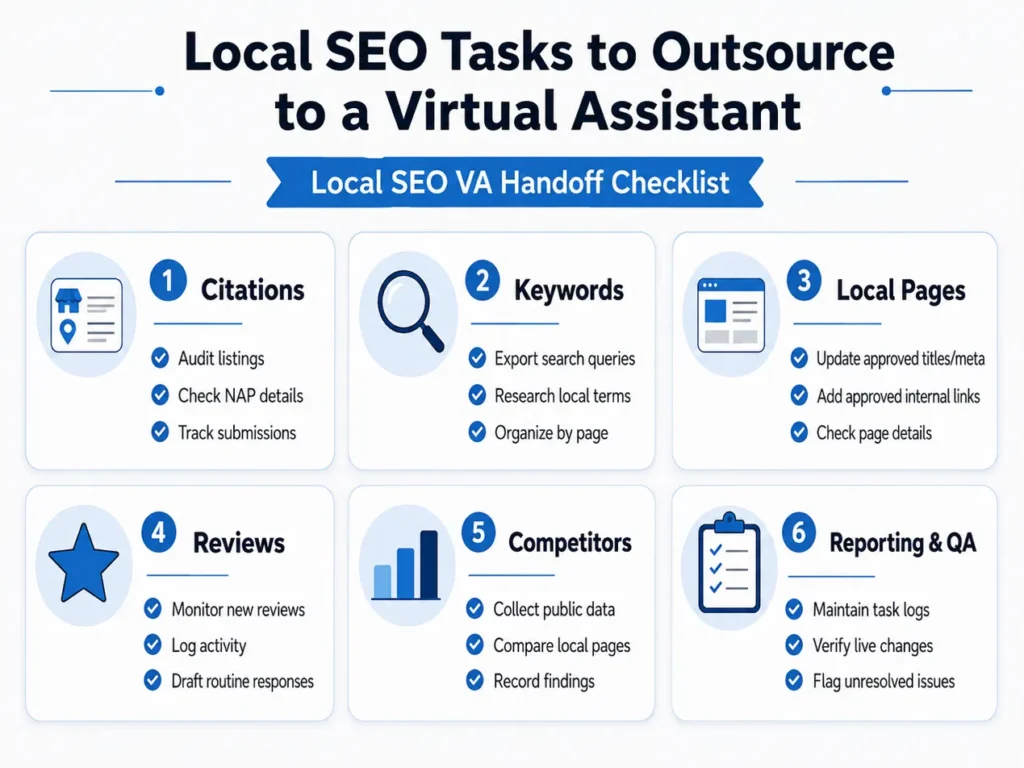
Local SEO Tasks to Outsource: The Handoff Checklist
| Workstream | Tasks a VA can handle | Useful output | Escalate when |
|---|---|---|---|
| Citations and listings | Audit listings, check details, find duplicates, submit approved citations, track status | Citation tracker with URLs, status, dates, and notes | Business details conflict or a listing requires ownership or legal verification |
| Local keyword research | Export Search Console queries, collect service-and-location variations, organize keyword ideas by page | Keyword research sheet grouped by service, location, and page | Choosing the final keyword strategy or changing page architecture |
| Local page updates | Enter approved titles and meta descriptions, update approved copy, add internal links, check basic page elements | Change log with edited URLs and before-and-after notes | Content needs rewriting, technical SEO decisions, redirects, canonicals, or schema strategy |
| Reviews | Monitor new reviews, log them, draft routine replies, flag sensitive reviews, prepare approved review-request materials | Review log and response draft queue | Complaints, legal or safety issues, policy questions, or unusual negative reviews |
| Competitor research | Collect public competitor data, compare pages, listings, and reviews, record recurring patterns | Competitor comparison sheet | Drawing strategic conclusions or changing campaign direction |
| Reporting and QA | Export data, maintain task logs, check live updates, summarize issues and completed work | Monthly execution report and unresolved-issues list | Data anomalies, tracking problems, or issues requiring specialist diagnosis |
1. Citation and Local Listing Work
Citation work is one of the clearest local SEO responsibilities to delegate because the process is repetitive, documentable, and easy to verify.
BrightLocal defines local citations as third-party mentions or listings of a business’s core information, usually including its name, address, and phone number. Its current local citations handbook also emphasizes keeping listings accurate and up to date.
Build a citation inventory
A VA can create or maintain a spreadsheet containing the directory or platform name, listing URL, business information shown, listing status, last checked date, and any issue notes.
This gives you one place to see what exists before creating anything new.
Check NAP and other business details
NAP means name, address, and phone number, but the audit can go further.
A VA can compare each listing against the approved business record and flag old phone numbers, previous addresses, misspelled business names, incorrect website links, duplicate listings, outdated hours, wrong categories, or closed locations still shown as active.
The VA should not guess when something conflicts. The useful output is the discrepancy itself, the source URL, and the information that needs a decision.
Submit and clean up approved listings
Once the correct information is confirmed, a VA can handle routine submissions and updates on approved directories.
That may include creating a missing listing, correcting an existing listing, submitting a duplicate-removal request where the platform allows it, adding the approved website URL, recording verification steps, and tracking pending or live submissions.
BrightLocal also recommends using a structured record to track citation status, including information such as listing URLs, dates, accuracy, and current status.
That is exactly the kind of repeatable record-keeping a VA can maintain.
2. Local Keyword Research Support
Keyword strategy should not be handed to someone who has not been given the authority or context to make it.
Keyword research support, however, can be delegated.
The difference is simple: the VA gathers and organizes the evidence. The SEO lead decides what the business should target.
Pull first-party query data
If the business has Google Search Console access, a VA can export the queries already bringing impressions and clicks to the site.
Google’s Search Console documentation explains that the Performance report can group data by queries and pages. That gives the VA a useful starting point for questions such as:
Which location terms already trigger impressions?
Which service terms appear for each location page?
Are people using city names, neighborhood names, or broader regional terms?
Which relevant queries have impressions but weak click-through rates?
The VA can collect the data without deciding the final optimization strategy.
Build a location-modifier list
A VA can also create structured combinations around services, cities, neighborhoods, counties or regions, common service synonyms, and customer questions.
The point is not to force every variation into a page. It is to give the decision-maker a cleaner research set.
Organize the findings by page
Instead of returning one huge keyword list, ask the VA to group findings by existing location page, service page, proposed page, search intent, priority for review, and potentially overlapping terms.
This turns raw research into something an SEO lead can evaluate quickly.
3. Simple On-Page Updates for Local Pages
Once an SEO lead has approved the change, a VA can handle many basic WordPress or CMS updates without making the underlying strategy.
Apply approved title and meta description changes
A VA can enter approved title tags and meta descriptions into the CMS or SEO plugin, then record the change.
Google explains that it may use a page’s meta description when it provides a useful description for a search result, although Google can also generate a different snippet from the page content. Its snippet guidance recommends descriptions that accurately summarize the specific page.
That makes title and meta work a good example of execution that can be delegated after the wording and keyword direction have been approved.
Check location-page basics
A VA can run a simple page checklist and flag missing or inconsistent items such as the page title, H1, business name, address, phone number, opening hours, service information, contact link, map or directions, internal links, image alt text, and meta description.
This is a QA task, not permission to rewrite the page or make technical SEO decisions.
Add approved internal links
If the SEO lead has already chosen the source page, target page, and anchor direction, a VA can add the link in WordPress and verify that it works on the live page.
The same applies to routine formatting, image replacement, and other approved content changes.
The boundary matters. Canonicals, indexation decisions, redirect mapping, advanced schema, or technical diagnosis should stay with the person responsible for technical SEO.
4. Review Monitoring and Response Preparation
Reviews are important to local visibility and customer trust, but they also involve brand voice and occasionally sensitive situations.
That makes review management a good assisted task rather than something to hand over without rules.
Google recommends responding to customer reviews and notes that positive reviews and helpful replies can help a business stand out in local results. It also prohibits incentives in exchange for reviews. Google’s review guidance
Monitor and log new reviews
A VA can check approved platforms on a defined schedule and record the review date, platform, public reviewer name, star rating, main topic, response requirement, response status, and issue level.
This prevents reviews from being missed while giving the owner or marketing lead one queue to review.
Draft routine responses
For straightforward positive reviews, a VA can draft replies using an approved tone and response framework.
For negative reviews, the VA can prepare a draft but should flag anything involving refunds, legal threats, health or safety claims, employee accusations, discrimination complaints, confidential customer information, or serious service failures.
Those need human judgment before anything is published.
Support compliant review requests
A VA can also handle the operational side of an approved review-request process, such as preparing a customer list, sending an approved request, or sharing the correct review link.
Google says businesses can remind customers to leave reviews, but incentives such as free or discounted goods or services in exchange for a review are prohibited.
The VA should follow the approved process rather than invent a new incentive or screening system.
5. Competitor Research Without Handing Over Strategy
Competitor research becomes time-consuming when someone has to repeat the same checks across several markets.
A VA can collect the public information. Your strategist decides what it means.
Capture public competitor signals
Give the VA a predefined competitor list or a rule for identifying comparable businesses, then ask them to record items such as:
competitor website;
location-page URL;
main services shown;
title and H1;
locations targeted;
directories where the business appears;
review count and rating at the time checked;
notable page sections;
recurring content topics;
visible calls to action.
For multi-location campaigns, the same template can be repeated market by market.
Keep the output descriptive, not strategic
A useful VA report might state that one competitor has dedicated pages for three nearby service areas while another uses one general location page, then provide the URLs and page elements recorded.
Jumping from that observation to “we should build three new pages” is different.
That second step needs SEO judgment, broader evidence, and a decision-maker.
Keeping those two responsibilities separate allows the VA to produce useful research without quietly taking ownership of strategy.
6. Reporting, QA, and Issue Tracking
Local SEO creates a lot of small status information.
If nobody records it, the same directories get checked twice, old issues return, completed page updates become hard to verify, and the person reviewing the campaign has to rebuild the history every month.
Maintain an execution log
A VA can keep a simple record of the task, location, source and target URLs, assignment date, completion date, current status, approval status, live URL, QA result, and issue notes.
This is especially useful when several locations or clients are involved.
Prepare a monthly summary
Depending on the tools available, a VA can compile Search Console clicks and impressions, query changes, location pages updated, citation submissions completed, listings still pending, review activity, unresolved NAP conflicts, competitor checks completed, and outstanding approvals.
The VA does not need to turn every number into a strategic recommendation. A clean report can make the strategist’s review much faster.
Run live QA
After a listing or page update, ask the VA to verify the result instead of marking the task complete immediately.
For a page, that can mean checking that the correct page was edited, the new text is visible, links work, mobile formatting still looks normal, and no unrelated content disappeared.
For a listing, it can mean checking whether the update is live or pending, the correct phone number appears, the website link works, and no duplicate was created.
A simple rule helps here: published is not the same as verified.
Which Local SEO Tasks Should Stay With Your SEO Lead?
A VA can handle a useful amount of local SEO execution, but some work should stay with the business owner, SEO strategist, developer, or another specialist.
Keep local SEO strategy, final keyword targeting, location-page architecture, advanced technical SEO diagnosis, canonical and indexation decisions, redirect planning, advanced schema strategy, link-building strategy, major Google Business Profile eligibility decisions, suspension work, compliance-sensitive review responses, and final decisions about conflicting official business information with the appropriate specialist or decision-maker.
A VA can gather the information those decisions depend on. They should not be expected to make the decision simply because they found the issue.
A Simple Brief You Can Hand to Your VA
You can adapt this into a task description or SOP.
Goal: Keep recurring local SEO execution accurate, documented, and ready for review.
Use as the source of truth:
[Insert approved business-information sheet or system]
Tasks you may complete:
audit and update the citation tracker;
compare listing information with the approved source;
submit approved citation changes;
export and organize local query data;
enter approved title and meta changes;
add approved internal links;
monitor and log reviews;
draft routine review responses;
collect approved competitor data;
update the monthly execution report;
complete live QA after changes.
Stop and ask for approval when:
two official sources conflict;
a change affects the business name, address, or primary phone number;
a review contains a serious complaint;
a page needs more than the approved edit;
a technical SEO decision is required;
a platform requests ownership, identity, legal, or policy-sensitive information;
you are unsure whether the task changes strategy rather than execution.
Completion standard:
Every completed task should have a status, source, live URL where applicable, completion date, and QA note.
That is enough structure to make the role useful without turning every small task into another meeting.
How Boost VA Can Support the Execution Layer
At Boost VA, I can support this type of hands-on SEO execution, including manual citation research and submissions, NAP consistency checks, location-page review, WordPress updates, internal-link implementation, structured reporting, and discrepancy flagging.
The strategy and final decisions can stay with you or your SEO lead. My role is to help keep the approved work moving and make the recurring workload easier to manage.
If you already know what needs to be done but the local SEO backlog keeps growing, you can learn more about ongoing and project-based virtual assistant support and send me the tasks you want to take off your plate.