Multi-Location SEO Workflow: A Practical Agency System
-
 Rahman Salami

A Practical Multi-Location SEO Workflow for Agencies
Managing local SEO for one business location is already a recurring responsibility. Managing it across dozens, hundreds, or thousands of locations is a different type of challenge.
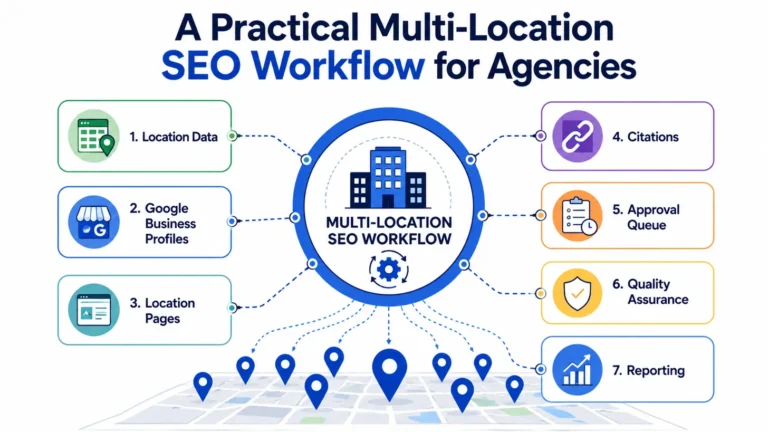
At that scale, the difficulty is not simply knowing which local SEO tactics to use. It is creating a multi-location SEO workflow that keeps business information, Google Business Profiles, location pages, citations, approvals, quality checks, and reporting aligned.
A change to one location may affect its website page, Business Profile, directory listings, tracking setup, campaign targeting, reporting record, and internal documentation. When these updates are handled through separate messages and disconnected spreadsheets, inconsistencies become much more likely.
Google explains that local visibility is mainly influenced by relevance, distance, and prominence. It also tells businesses to provide complete and accurate information. Those instructions sound straightforward until a team must maintain them across a large location network.
This is why multi-location SEO should be treated as an operating system rather than a collection of isolated tasks.
Ignite Visibility provides a useful public example. Its local and franchise SEO materials repeatedly connect centralized control with localized execution, Google Business Profile management, location pages, citations, reporting, and brand governance. Its published case studies also show how quickly the workload grows when a campaign covers hundreds of pages or thousands of locations.
The company does not publish every detail of its internal processes, so this article does not attempt to recreate them. Instead, it uses the visible work as a starting point for a practical framework agencies can adapt to their own accounts.
Why Multi-Location SEO Becomes an Operations Problem
A single location record can contain dozens of important fields:
- Business name
- Address
- Phone number
- Website URL
- Location-page URL
- Opening hours
- Holiday hours
- Primary and secondary categories
- Services
- Service areas
- Appointment links
- Tracking numbers
- Business status
- Opening or closure date
- Google Business Profile URL
- Citation URLs
- Local contact details
- Approval status
Now multiply those fields by 50, 100, or 1,500 locations.
The result is not just a larger SEO campaign. It is a data-management and coordination environment.
Google’s Business Profile guidelines require businesses to represent themselves accurately and use precise addresses or service areas. A small mistake in the source data can therefore spread into multiple public assets.
For example, an outdated phone number might appear in the master spreadsheet, a location page, a directory listing, a report, and a publishing queue. Correcting only the Google Business Profile would leave the wider system inconsistent.
The same problem appears with location closures, relocations, temporary hours, franchise ownership changes, tracking numbers, service updates, and page redirects.
At scale, accuracy depends on knowing:
- Which record is authoritative.
- Who is allowed to change it.
- Which assets are affected by the change.
- Who must approve the update.
- How completion will be verified.
- Where the change will be documented.
Without those answers, teams may complete a large amount of work while still leaving the account unreliable.
HeaderWhat Ignite Visibility’s Published Work Reveals About Scale
Ignite Visibility describes local SEO as a connected service involving Google Business Profile management, local listings, location-level content, links, schema, and reporting.
Its franchise SEO service adds another layer: national strategy must support individual locations without removing the flexibility needed to compete in different markets.
Three published examples are especially useful for understanding the operational workload behind this type of work.
Centralized control with local flexibility
In an Orangetheory case study, Ignite Visibility describes moving more than 1,500 studio sites into a centralized branded environment.
The system still allowed location-specific content and local schedule or promotion updates, but controlled templates helped maintain brand consistency. The published results included a 25% increase in organic traffic, a 10% increase in conversion rate, and faster site performance.
The important lesson is not simply that a centralized platform was used.
It is that centralization and localization were designed to work together.
Complete central control can slow local updates and make every small request dependent on one team. Complete local freedom can create inconsistent pages, messaging, tracking, and SEO implementation.
A scalable model needs controlled flexibility. Local teams or account managers should be able to request necessary changes, while the system protects the fields and templates that should remain consistent.
Local SEO requires several connected production systems
Another home-services franchise case study describes work involving:
- Google Business Profile optimization
- Localized geo-area pages
- Targeted content
- Local link building
- Citation and directory management
- Customer portal management
- Keyword tracking
- Reporting dashboards
The engagement included 129 optimized local pages and produced 332 page-one keyword rankings, a 24% year-over-year increase in organic sessions, and a 207% increase in impressions.
Each of those activities creates its own tasks, data points, reviews, and completion records. More importantly, the activities affect one another.
A location page may need to match the Business Profile. The Business Profile may need to match the master record. Citation work may uncover conflicting information. Keyword tracking may reveal weak markets that need new page updates. Reporting may create the next month’s priority queue.
The campaign therefore becomes a feedback system rather than a list of deliverables.
Content scale creates a quality-control requirement
Ignite Visibility also published an AI-search case study involving more than 5,000 blog posts.
The work included content scoring, structured improvement roadmaps, AI-friendly summaries, visual updates, production consolidation, and workflow changes. The published outcomes included a 458% increase in AI visibility, a 20% increase in leads, and 60% faster content deployment.
Regardless of the tools used, updating thousands of articles requires more than generating copy.
It requires:
- Defining what qualifies for an update
- Prioritizing pages
- Recording their current status
- Applying consistent formatting rules
- .Preserving important page elements
- Reviewing claims and links
- Publishing safely
- Checking the live result
- Measuring whether the update helped
That is an operations system.

Start With One Controlled Source of Truth
A multi-location SEO workflow should begin with one authoritative location database.
This does not have to be expensive software. A well-designed spreadsheet or database can work, provided that the team agrees it is the primary source and controls how it is updated.
A useful master record might include the following groups.
| Data group | Example fields | Main purpose |
|---|---|---|
| Identity | Location ID, business name, status, owner | Distinguishes each location clearly |
| Contact information | Address, phone, email, website | Maintains public information accuracy |
| Operating details | Hours, holiday hours, services, service areas | Supports profiles and local pages |
| Search assets | GBP URL, location page, citation records | Connects the main local SEO properties |
| Tracking | Call tracking, campaign tags, reporting group | Protects measurement accuracy |
| Workflow | Request date, approval owner, update status | Controls changes and accountability |
| Verification | Checked date, reviewer, issue notes | Creates a quality-control record |
The location ID is particularly important. Business names and addresses can change, but a stable internal identifier helps teams maintain continuity.
The source of truth should also record where each piece of information came from. A phone number supplied by a franchise owner may conflict with the corporate website or existing Business Profile. The team needs a rule for resolving that conflict rather than choosing whichever number appears first.
A practical hierarchy could be:
- Approved corporate or client database.
- Written approval from the authorized location contact.
- Official location page.
- Verified Business Profile.
- Trusted secondary listings.
- Unverified directories or scraped information.
The exact order may differ between clients, but it should be documented before production begins.
Turn Requests Into Controlled Update Queues
Location changes often arrive through email, chat messages, meeting notes, forms, or support tickets.
Publishing directly from those messages creates risk. The request may be incomplete, the requester may not have approval authority, or the same change may affect several assets.
Instead, every request should enter a controlled queue.
A basic status system can include:
- Received: The request has been recorded.
- Needs information: A required field or supporting document is missing.
- Needs approval: The change has been prepared but cannot be published yet.
- Approved: The responsible person has authorized the update.
- In progress: The affected assets are being updated.
- Published: The updates have been completed.
- QA required: The live assets must still be checked.
- Verified: The published information has been confirmed.
- Blocked: An access, ownership, platform, or policy issue is preventing completion.
This creates visibility for everyone involved.
An account manager can see which items are waiting for a client. A specialist can see which issues need technical input. A support person can continue approved execution without guessing. A manager can identify recurring bottlenecks.
Every completed request should also record:
- What changed
- Which locations were affected
- Which assets were updated
- Who approved the change
- Who completed it
- When it was published
- When it was checked
- Any unresolved issue
That record becomes valuable when a client asks why a field changed or when an old value reappears.
Separate Strategy From Recurring Execution
Text
A reliable workflow does not delegate every task to the same person.
The work should be divided according to the judgment, expertise, access, and approval it requires.

Strategic work
Strategic work establishes the direction of the campaign.
Examples include:
- Market prioritization
- Location-page architecture
- Keyword strategy
- Brand positioning
- Budget allocation
- National and local campaign alignment
- Performance targets
- Expansion or consolidation decisions
This work should remain with agency leads, senior strategists, or client decision-makers.
Specialist work
Specialist work requires deeper channel or technical expertise.
Examples include:
- Technical SEO diagnosis
- Canonical and indexation decisions
- Advanced schema planning
- Complex redirect mapping
- Analytics and attribution configuration
- Paid-media optimization
- Conversion testing
- Recovery from profile suspension
- High-risk website deployments
A general support role should not replace the specialist responsible for these decisions.
Delegatable recurring execution
This layer includes structured work that follows an approved process.
Examples include:
- Maintaining location spreadsheets
- Validating contact information
- Preparing update queues
- Gathering citation opportunities
- Completing approved citation submissions
- Formatting location-page content
- Uploading approved content to WordPress
- Preparing Google Business Profile posts
- Recording live URLs
- Checking links and page elements
- Compiling reports
- Monitoring task statuses
- Flagging inconsistencies
This is where a capable digital marketing virtual assistant can support an agency without taking ownership of its strategy.
Approval-dependent work
Some tasks can be prepared by a support person but should not be published without approval.
Examples include:
- Changes to business names, addresses, or phone numbers
- New service claims
- Compliance-sensitive wording
- Final location-page copy
- Review responses involving complaints
- Large redirect changes
- Major category changes
- Campaign budget adjustments
- Responses to profile suspensions
- Changes affecting several brands
The preparation and the decision are separate responsibilities.
This distinction prevents delegation from turning into loss of control.
A Monthly Multi-Location SEO Workflow
The following workflow can be adapted to a franchise, healthcare network, home-services group, fitness brand, retail chain, or any business with several local markets.
1. Collect changes and performance signals
Bring new information into one intake process.
Sources may include:
- Client requests
- Location-manager forms
- Google Business Profile notifications
- Citation audit findings
- Website QA
- Review activity
- Search Console
- Rank tracking
- Call tracking
- Analytics
- Account-manager notes
Do not publish directly from the intake message.
Record the request, location ID, source, date, affected assets, and required approval.
2. Validate the source data
Compare the request against the authoritative record.
Check for:
- Missing information
- Conflicting phone numbers
- Address formatting differences
- Incorrect location URLs
- Duplicate location records
- Closed or relocated locations
- Tracking numbers being mistaken for primary numbers
- Temporary hours being entered as permanent hours
- Unsupported service claims
Issues should be flagged rather than silently resolved through assumption.
3. Identify every affected asset
One change can affect several systems.
For example, a relocation may require updates to:
- The master location record
- Google Business Profile
- The location page
- Website navigation
- Local schema
- Citation listings
- Tracking configuration
- Paid campaign targeting
- Internal links
- Reporting groups
An impact checklist prevents partial updates.
4. Prepare the work and obtain approval
Draft or stage the required changes.
Attach the supporting source, explain any conflict, and identify the person responsible for approval.
The approver should be able to see:
- The current value
- The proposed value
- Why the change is needed
- The assets that will be affected
- Any risk or limitation
This is more efficient than asking someone to approve a vague request without context.
5. Publish through a documented process
The person completing the work should follow a task-specific checklist.
For a location page, that might include:
- Page title
- H1
- Address and phone number
- Hours
- Services
- Map or directions
- Calls to action
- Internal links
- Metadata
- Schema
- Mobile formatting
- Indexation settings
For a Business Profile, it might include:
- Name
- Address or service area
- Phone
- Hours
- Categories
- Services
- Website link
- Appointment link
- Photos
- Posts
- Attributes
Google provides bulk profile management for eligible businesses managing multiple locations. Bulk tools can make publishing faster, but they do not correct inaccurate source data. A bulk upload can spread the same error across an entire account if the spreadsheet is not checked first.
6. Complete post-publishing QA
Do not mark an item complete immediately after pressing Update or Publish.
Check the live result.
For website updates, confirm:
- The page loads correctly
- The intended change is visible
- Links work
- Tracking remains active
- The page is indexable when appropriate
- Mobile formatting is intact
- No unrelated content was removed
- The correct location was edited
For profiles and listings, confirm:
- The platform accepted the change
- The public record shows the intended value
- No duplicate was created
- The destination URL works
- The phone number routes correctly
- The update did not affect another location
Where platforms delay publication or send changes for review, record the item as pending rather than verified.
7. Feed the results into the next work cycle
Reporting should create the next priority queue.
A useful report should show performance and operational status by location or market group, not only at account level.
Useful fields may include:
- Organic sessions
- Local conversions
- Business Profile calls
- Direction requests
- Website clicks
- Review volume and rating changes
- Citation issues
- Page-one visibility
- Location-page conversions
- Open requests
- Completed updates
- Blocked items
- Locations requiring specialist review
Averages can hide weak locations. A network may show overall growth while several markets have broken pages, inaccurate information, or declining visibility.
The report should therefore answer two questions:
- What happened?
- What should be worked on next?

Use Automation Without Removing Human Review
Automation can reduce repetitive work inside a multi-location SEO workflow.
It may help with:
- Normalizing address formats
- Identifying blank fields
- Finding duplicate records
- Comparing spreadsheets
- Categorizing issues
- Drafting standard updates
- Generating report summaries
- Checking page templates
- Producing publishing queues
- Monitoring completion dates
AI can also assist with content summaries, formatting, classification, and first-pass quality checks.
However, automation should not make unsupported decisions about official business information, compliance-sensitive wording, technical changes, or strategic priorities.
The better approach is to use AI intentionally rather than treating it as an overnight miracle.
A controlled AI-assisted process should define:
- What information the tool may access
- Which fields it may change
- Which outputs require human review
- Which claims must be checked
- Who approves publication
- How errors will be recorded
- When the process should stop and request help
Speed is useful only when the system protects accuracy.
Delegate the Execution Layer Without Losing Visibility
Agency owners sometimes delay delegation because they fear that assigning work will create more checking, more explanations, and more mistakes.
That usually happens when the task is delegated without its surrounding system.
Before assigning recurring local SEO work, provide:
- A clear objective
- An authoritative data source
- A written procedure
- Access boundaries
- Naming conventions
- Examples of correct output
- Approval rules
- A completion definition
- A QA checklist
- An escalation process
- A reporting format
Begin with a limited group of locations or one task type. Review the results, improve the instructions, and then increase volume.
The goal is not to eliminate oversight. It is to make oversight focused and predictable.
Instead of checking every small action, the manager reviews exceptions, approvals, samples, and performance trends. This is how agency owners can buy back time by delegating recurring work without becoming disconnected from delivery.
Where Boost VA Fits Into the Workflow
At Boost VA, I support agencies that already have their strategy and specialist direction in place but need reliable help keeping recurring execution organized.
Depending on the project, that support can include:
- Organizing source-of-truth spreadsheets
- Researching and validating location information
- Recording data conflicts
- Preparing update queues
- Supporting citation research and submissions
- Formatting approved content
- Completing WordPress updates
- Checking internal links
- Recording live URLs
- Preparing Google Business Profile content
- Maintaining project trackers
- Compiling reports
- Performing checklist-based QA
- Flagging issues that require specialist or client review
The agency remains responsible for strategy, technical decisions, and final approvals. My role is to help keep the approved process moving and make the execution layer easier to manage.
The System Must Scale With the Campaign
Multi-location SEO does not become manageable simply because the team adds more tools.
It becomes manageable when the work has:
- One trusted source of data
- Clear ownership
- Controlled update queues
- Defined approval boundaries
- Repeatable publishing procedures
- Post-publication verification
- Location-level reporting
- A process for turning issues into the next set of tasks
Ignite Visibility’s published work is useful because it shows the scale involved in coordinating pages, profiles, content, citations, localized activity, and reporting across large location networks.
The broader lesson applies to agencies of different sizes.
A multi-location SEO campaign can only scale reliably when its operating system scales with it.
Independent analysis:
This article is based on publicly available information reviewed on July 30, 2026. Boost VA is not affiliated with, sponsored by, employed by, or endorsed by Ignite Visibility.
If your agency already has its local SEO strategy in place but needs dependable help with research, location data, WordPress updates, citation work, project tracking, QA, or report preparation, explore ongoing and project-based support through Boost VA.