


6 Common Myths About Virtual Assistants and the Reality Behind Them
Hiring a virtual assistant can sound simple until you start thinking about what the relationship actually requires.
Can someone working remotely handle more than basic admin? Will time zones slow everything down? Is a VA really more affordable once you compare the full costs? What happens when that person needs access to your website, business accounts, or internal information?
Those are reasonable questions.
The problem is that many discussions about myths about virtual assistants go too far in the other direction. Every concern gets labelled false, and the answer quickly becomes a list of reasons you should hire a VA.
Reality is more useful than that.
Some common concerns are mostly based on outdated assumptions. Some depend heavily on the person, role, and working arrangement. Others point to genuine risks that should be controlled rather than dismissed.
This article looks at six of the most common objections and asks a better question: what does the evidence support, and what should you verify before hiring?
Before the Myths: What Does “Virtual Assistant” Actually Tell You?
The term “virtual assistant” doesn’t describe one fixed skill level.
It mainly tells you that support is being delivered remotely. The actual work can vary significantly from one person to another.
Upwork’s current guidance on virtual assistant roles includes traditional responsibilities such as scheduling and communication, but it also lists market research, project management, content management, social media, and other specialized work.
That doesn’t mean every VA can perform all of those tasks.
It means the label alone is not enough information.
A VA may be a general administrative assistant, someone focused on research and data, a marketing assistant, a WordPress support VA, or someone working across several recurring business processes.
The same distinction appears when you compare a virtual assistant, freelancer, and employee. The better question is not which label sounds more capable. It is whether the person’s experience and working model match the responsibility you need handled.
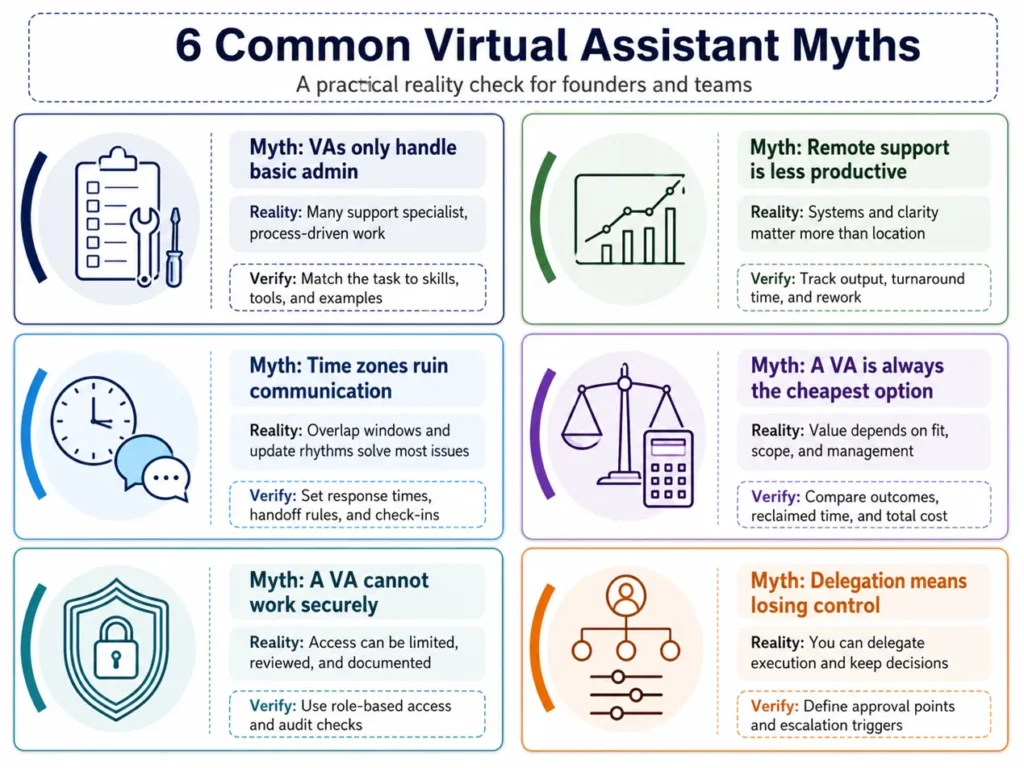
Myth 1: Virtual Assistants Only Handle Basic Admin
Verdict: Mostly false
Calendar management, inbox support, data entry, and scheduling are legitimate VA responsibilities, but they don’t define the limits of virtual assistance.
As Upwork’s role guidance shows, specialized VA work exists across areas such as research, content, project support, and social media.
The important distinction is between what can be performed remotely and what a particular VA is actually qualified to do.
For example, research work can include collecting competitor information, validating records, preparing structured datasets, and assembling recurring reports. My guide to research tasks a virtual assistant can prepare also shows why execution and preparation can often be separated from final interpretation and business decisions.
That creates a more realistic middle ground.
A VA doesn’t have to be limited to basic administration, but the title “virtual assistant” doesn’t automatically make someone an SEO specialist, developer, accountant, strategist, or expert in every tool you use.
What this myth gets right: Skill matters. Some work genuinely requires specialist expertise.
What to verify: Ask about experience with the actual task, tools, output, and workflow you need. Look for relevant examples rather than assuming capability from the job title.
Myth 2: A Remote VA Will Be Less Productive or Reliable
Verdict: Unsupported as a blanket rule
Reliability is important, but physical distance by itself doesn’t establish whether someone will perform well.
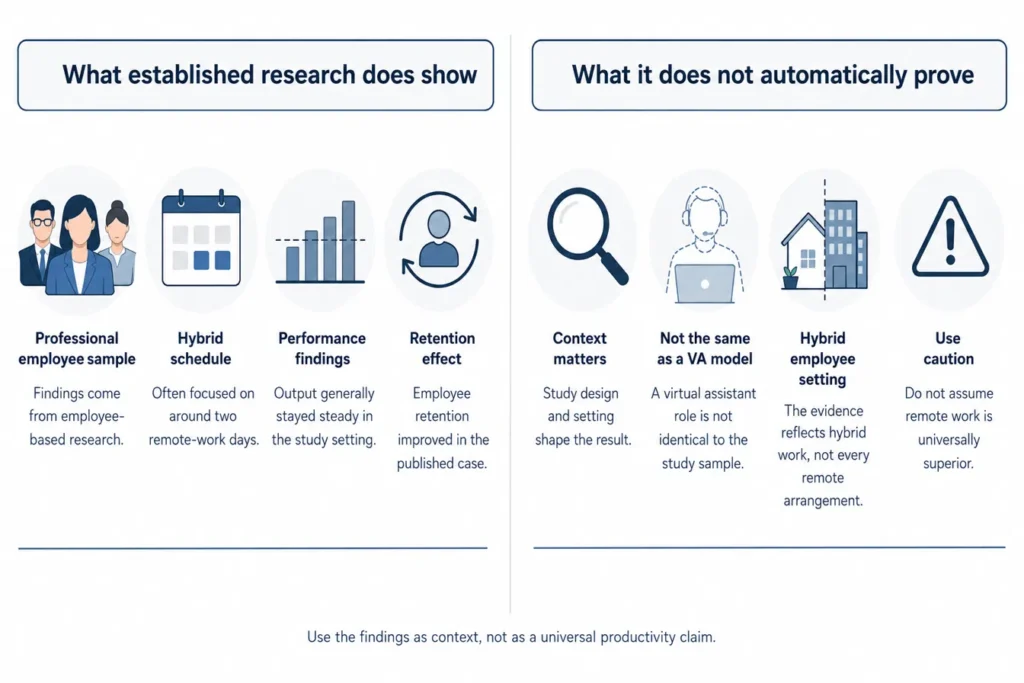
A randomized hybrid-work study published in Nature followed 1,612 employees at a Chinese technology company. Employees assigned to work from home two days per week had no reduction in subsequent performance grades, while quit rates fell by one-third.
That is useful evidence against the assumption that working away from an office automatically damages performance.
But there is an important limit.
This was a study of hybrid employees, not virtual assistants. It doesn’t prove that VAs are more productive than office employees, and it doesn’t prove that every remote worker will be reliable.
A VA can still miss deadlines, communicate poorly, misunderstand instructions, or produce weak work. An employee sitting in the same building can do the same.
Reliability is better evaluated through relevant experience, communication, instruction-following, realistic availability, work quality, and how the person responds when something is unclear.
If you are preparing to hire, the guide to virtual assistant hiring mistakes covers why choosing only by price, expecting instant productivity, and skipping proper onboarding can create problems regardless of where the person works.
What this myth gets right: Remote work can make weak communication or poor accountability more visible.
What to verify: Look at how the person communicates, reports progress, handles uncertainty, meets deadlines, and works within your process.
Myth 3: Communication and Time Zones Make VA Collaboration Too Difficult
Verdict: Depends
Time-zone differences are real. Pretending they never matter would be just as misleading as saying they always ruin remote work.
The better question is whether your work actually requires everyone to be available at exactly the same time.
Atlassian’s guidance on asynchronous communication highlights trade-offs on both sides. Real-time communication is useful when an immediate discussion is needed, while asynchronous communication can make work easier to document and continue across different schedules. Both approaches can also create problems when used badly.
That makes communication design more important than geography alone.
A routine research task may not require a meeting at all. A same-day client issue may require immediate overlap. A WordPress content update may work perfectly with written instructions and a review deadline. A sensitive campaign decision may need a live conversation.
When I explain how to work with a marketing virtual assistant, the same principle applies: use communication for the things that genuinely require it instead of turning every status update into a meeting.
What this myth gets right: A major time-zone gap can become a genuine problem when the role requires immediate responses throughout your working day.
What to verify: Agree on expected response times, required overlap hours, the main communication channel, how urgent issues are escalated, and when progress updates should be sent.
Myth 4: Hiring a Virtual Assistant Is Too Expensive
Verdict: Depends on the comparison
“Too expensive” needs a second question: compared with what?
Comparing a VA’s hourly rate with an employee’s hourly wage can produce a misleading answer because an employee’s wage is only one part of the employer’s cost.
For example, March 2026 U.S. Bureau of Labor Statistics compensation data reported average private-industry employer compensation of $46.60 per hour. Wages and salaries represented $32.60, while benefits averaged $14.01, or 30.1% of total compensation.
That doesn’t prove a VA will save you money.
The BLS figures describe U.S. employee compensation, not VA return on investment. VA pricing also varies according to experience, location, skills, scope, hours, provider, and working arrangement.
A more useful comparison asks:
How many hours of support do you actually need?
Is the workload continuous enough for a full-time position?
Does the work require specialist expertise?
What onboarding and management will each option require?
Are you buying recurring capacity, one specialist outcome, or permanent organizational ownership?
A VA may make economic sense when you need recurring remote support but don’t have enough work or responsibility to justify a comparable permanent role. A specialist freelancer may provide better value for a narrow deliverable. An employee may be the stronger investment when you need full-time availability, deep internal ownership, or permanent authority.
The detailed virtual assistant vs freelancer vs employee comparison goes deeper into those trade-offs.
What this myth gets right: A poorly matched VA can absolutely become expensive when weak work creates revisions, supervision, or repeated explanations.
What to verify: Compare the total working arrangement and required capacity, not one hourly number.
Myth 5: Hiring a VA Means Handing Over Passwords and Sensitive Access
Verdict: The risk is real, but the conclusion is wrong
Giving another person access to business systems creates risk. That part should not be dismissed.
What doesn’t follow is the assumption that remote assistance requires unrestricted access to everything.
NIST’s principle of least privilege is straightforward: a user should receive only the access to systems and data needed to complete their job.
Many business platforms support that idea directly.
For example, WordPress user roles and capabilities let site owners control what different users can do rather than giving everybody full administrative authority.
Google Business Profile provides another practical example. You can delegate Google Business Profile tasks without sharing your Google password by inviting another user with an appropriate access level.
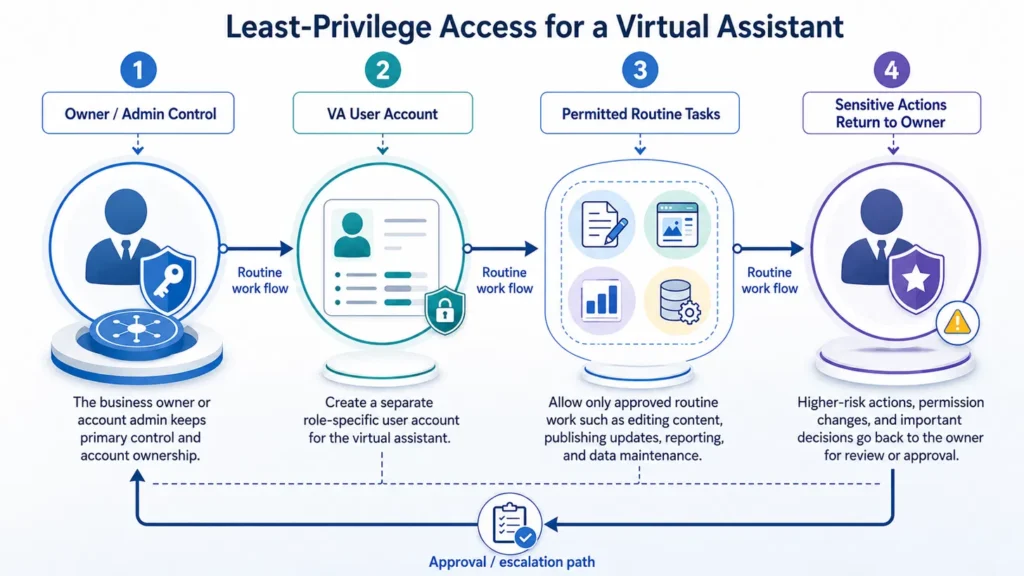
The exact controls will depend on the systems you use, but the principle is transferable:
access should match responsibility.
An assistant preparing reports may only need viewing access. Someone publishing approved website content may need editing permissions. Account ownership, payment controls, user management, or other sensitive functions may remain with the business owner.
What this myth gets right: External access needs to be managed carefully, reviewed, and removed when it is no longer required.
What to verify: Check whether your tools support separate users or roles, decide what information the VA genuinely needs, keep important accounts under business ownership, and have a clear process for changing or revoking access.
Myth 6: Delegating to a VA Means Losing Control
Verdict: Mostly false when authority is designed deliberately
Delegation and surrender are not the same thing.
A business owner can delegate execution without delegating every decision.
Think about three different levels of responsibility:
Execute: Complete an approved task according to established instructions.
Recommend: Research or prepare an option, then send it for review.
Approve: Make the final decision or authorize a sensitive change.
Those responsibilities don’t need to sit with the same person.
A VA might collect competitor data without deciding your pricing strategy. They might prepare a WordPress post without changing site configuration. They might draft an outreach list while you retain the final criteria for who should be contacted.
That separation can also reduce unnecessary micromanagement. Instead of reviewing every minor action, you decide in advance which work can move forward independently and which actions require approval.
What this myth gets right: Delegation without clear boundaries can create uncertainty. If nobody knows who can decide what, the owner may either lose visibility or end up checking everything.
What to verify: Define what the VA can execute, what should be recommended for review, which decisions remain with you, and what situations must be escalated.
What These Myths Get Partly Right
A skeptical reader shouldn’t leave this article believing that every concern about VAs is imaginary.
A VA is not automatically the right answer.
If the role requires permanent internal ownership, fixed full-day availability, extensive on-site work, authority over staff or budgets, or deep integration into the organization, an employee may be more appropriate.
If you need a narrowly defined specialist deliverable, a freelancer with deep expertise in that exact area may make more sense.
If the work requires access that cannot be restricted safely, the security concern deserves serious attention.
And if you can’t define the work well enough for another person to understand the expected result, changing the person’s location won’t solve the problem.
The useful distinction is between an inherent limitation of the VA model and a role-fit or management problem that needs to be designed properly.
Use This Virtual Assistant Myth Reality Check Before You Decide
Use this table to test the objection rather than automatically accepting or dismissing it.
| Myth | Verdict | Reality | When the concern is valid | What to verify before hiring |
|---|---|---|---|---|
| “VAs only handle basic admin.” | Mostly false | Specialized VA roles exist, but individual skills vary. | Your work requires expertise the candidate doesn’t have. | Ask for task-specific experience, examples, and tool familiarity. |
| “Remote VAs are less productive or reliable.” | Unsupported as a blanket rule | Location alone doesn’t establish performance or reliability. | The candidate has weak work habits, accountability, or communication. | Check references or evidence, deadlines, reporting habits, and working process. |
| “Time zones make communication too difficult.” | Depends | Sync and async communication can both work when matched to the task. | The role requires constant immediate availability during your working day. | Define overlap, response times, channels, and escalation rules. |
| “A VA is too expensive.” | Depends on the comparison | Price should be evaluated against workload, capacity, expertise, and alternative hiring models. | The VA requires excessive management or is a poor fit for the workload. | Compare total engagement cost and expected output, not only the hourly rate. |
| “Hiring a VA means unsafe access.” | Partly true risk, wrong conclusion | Access creates risk, but unrestricted access isn’t always necessary. | Your systems can’t provide suitable permissions or the role truly requires sensitive access. | Check separate users, roles, account ownership, and revocation procedures. |
| “Delegation means losing control.” | Mostly false | Execution can be separated from final authority and approval. | Responsibilities and decision boundaries are unclear. | Define what can be executed, recommended, approved, and escalated. |
The goal isn’t to talk yourself into hiring a VA.
It is to make sure you are rejecting or choosing the model for the right reasons.
Judge the Work, Not the Stereotype
“Virtual assistant” is not a guarantee of low skill, high skill, reliability, affordability, security, or business fit.
It is only part of the picture.
Look at the person, the work, the required expertise, the communication structure, the access controls, the level of authority, and the amount of capacity you actually need.
If you are still choosing between different working models, start with my guide to comparing a virtual assistant, freelancer, and employee.
If recurring or project-based remote execution turns out to be the right fit, you can also explore my ongoing and project-based virtual assistant support at Boost VA.