


Research Tasks to Delegate to a Virtual Assistant: 5 Practical Deliverables
The strategy may already be decided.
You know the types of prospects you want to find, which competitors you need to watch, which CRM fields matter, or which KPIs belong in your weekly report. But someone still has to find, check, clean, and organize the information behind those decisions.
That is where many research tasks to delegate to a virtual assistant make sense.
The strongest candidates are not open-ended questions such as “Which market should we enter?” They are tasks with defined criteria, acceptable sources, a reviewable output, and a clear point where uncertain or important decisions come back to you.
If you are looking beyond research and data work, this broader guide covers other tasks you can delegate to a virtual assistant.
The line between research support and research judgment
Research support works best when the question has already been narrowed down.
A VA can often handle the production layer: collecting information, recording it consistently, checking required fields, organizing sources, cleaning existing records, formatting results, and flagging exceptions.
The handoff becomes less suitable when the person doing the research is expected to invent the criteria, make high-stakes interpretations, resolve legal or compliance questions, or decide what the business should do with the findings.
For example, there is a meaningful difference between preparing a table of current competitor prices and deciding what your own pricing strategy should be.
The same applies to prospect research. Building a sourced list from an approved customer profile is different from deciding which market your company should target next.
If you are unsure where a task sits, a delegation matrix can help you assess how much specialized judgment it requires.
5 research tasks to delegate to a virtual assistant
1. Prospect and company research
Finding prospects can look simple until you have to check dozens or hundreds of companies against the same criteria.
A defined research task might be: find companies in a particular industry and country, within an approved size range, then identify the relevant role and record the evidence used to qualify each company.
Define: Give the VA your target industry, geography, company-size range, relevant roles, exclusions, mandatory fields, and approved source rules.
Useful return: A structured prospect dataset could include the company name, website, relevant contact or role where appropriate, qualification fields, source URL, date checked, and an exception field for anything uncertain.
A source trail matters because it lets you review where an entry came from instead of receiving a spreadsheet full of unsupported answers.
LinkedIn can be one research source when it is used within the platform’s rules. For example, Sales Navigator supports lead and account searches using filters such as geography, company, seniority, function, industry, headquarters location, and company headcount.
That does not mean “scrape LinkedIn” should become an instruction. LinkedIn’s User Agreement says members should keep personal account access private and prohibits the automated scraping and copying methods described in its terms.
Check: Make sure required fields are complete, duplicates have been handled consistently, each researched record has supporting evidence where required, and uncertain entries have been flagged rather than guessed.
Keep with you: Changes to your ideal customer profile, strategic prioritization, outreach messaging, and decisions about how collected contact information may be used.
2. Competitor pricing and offer tracking
“Research our competitors” is too broad to produce a consistent result.
“Check these eight competitors every month and record their published plan names, standard prices, billing periods, promotional offers, and source pages” is much easier to delegate and review.
Define: Specify the competitors or inclusion criteria, which products or plans matter, the fields you want recorded, the relevant geography and currency, and how often the information should be checked.
Useful return: A dated comparison table might contain:
competitor;
product or plan;
published price;
billing period;
temporary promotion;
important included features;
source URL;
date checked;
notes or exceptions.
The source and date are especially useful for pricing because offers can change. A table that says “$49” without showing where and when that price was found becomes difficult to trust later.
Check: Every recorded price should have a source and date. If the competitor says “contact sales,” the dataset should say exactly that rather than filling the gap with an estimate. Temporary discounts should also be kept separate from normal pricing.
Keep with you: Competitive interpretation, positioning, your own pricing, and decisions about how the information should influence your offer.
3. CRM cleanup and structured record enrichment
CRM cleanup is more than copying information from one column to another.
A useful cleanup project needs rules for identifying records, deciding which source takes priority, standardizing fields, and handling conflicts.
HubSpot provides one example of why those rules matter. Its deduplication guidance explains that different identifiers can be used to recognize duplicate records, including email addresses, company domains, Record IDs, and properties configured with unique values.
The exact rules depend on the CRM you use, but the principle is broader: your VA needs to know what uniquely identifies a record before making bulk changes.
Define: Provide the field definitions, authoritative source for each important value, unique or duplicate key, formatting standards, duplicate-handling rules, and a list of fields that should never be overwritten without approval.
Useful return: The result might be an updated set of records plus a separate exceptions list containing duplicates, missing values, conflicting information, and uncertain merges that need your review.
Before giving someone access to an important system, it also helps to define the source of truth and approval boundaries as part of the wider onboarding process.
Check: Review unique identifiers before bulk operations and sample higher-risk changes before applying them across the full database.
Keep with you: Redesigning the CRM structure, changing pipeline definitions, resolving ambiguous merges, and interpreting what the cleaned data means for the business.
4. Email-list hygiene and suppression-ready cleanup
Email-list hygiene is another task where precise wording matters.
The useful work is not “make every email deliverable.” No VA or cleaning process can responsibly promise that.
A better handoff is to organize an existing audience according to the statuses and rules already used by your email platform.
For example, Mailchimp describes cleaned contacts as addresses that have hard bounced or repeatedly soft bounced and are considered invalid within its system.
Define: Identify the authoritative audience export, duplicate rules, suppression rules, existing contact-status definitions, and which platform or record should take priority when statuses conflict.
Useful return: The cleaned working file might separate active records from duplicates, missing-data issues, invalid or bounced addresses, unsubscribed or suppressed contacts, and records that require review.
Check: Suppression or unsubscribe information should not be casually overwritten just to make a list larger. Bounce status, data completeness, and permission to send marketing messages are separate issues.
Rules also vary by jurisdiction and intended use. In the United States, the FTC’s CAN-SPAM guidance covers requirements for commercial email. UK ICO guidance on collecting information for direct marketing also addresses information obtained from other sources.
The fact that contact information can be found publicly does not by itself settle whether or how it should be used for marketing. This is operational guidance, not legal advice.
Keep with you: Contact-acquisition policy, consent and legal decisions, re-engagement rules, and campaign strategy.
5. Recurring report preparation
A weekly or monthly report may require the same preparation every time:
collect the current numbers, make sure each metric uses the correct date range, update the reporting table, refresh simple summaries, identify missing information, and flag anything that looks inconsistent.
That preparation can often be separated from the interpretation of the results.
Define: Give the VA the approved KPI names and definitions, source systems, reporting period, comparison period, reporting template, and rules for missing or unusual data.
Useful return: A prepared report could contain refreshed figures, consistent date ranges, source references, simple summaries or charts where appropriate, and clear flags for missing or unusual values.
Tools such as Google Sheets pivot tables can help summarize and filter structured source data, and the pivot table can refresh when its underlying source cells change.
Check: Verify the date range, metric definition, source consistency, and important formulas. Comparing the refreshed report with the previous period can also reveal obvious breaks that need investigation.
Keep with you: Explaining why performance changed, deciding what action to take, changing targets, and carrying out specialist attribution or statistical analysis.
Give your VA one research and data brief before work starts
The quality of the handoff often depends on what is defined before the first row is collected.
Instead of sending “research these companies” or “clean this database,” create a short research and data brief that describes what a finished result should look like.
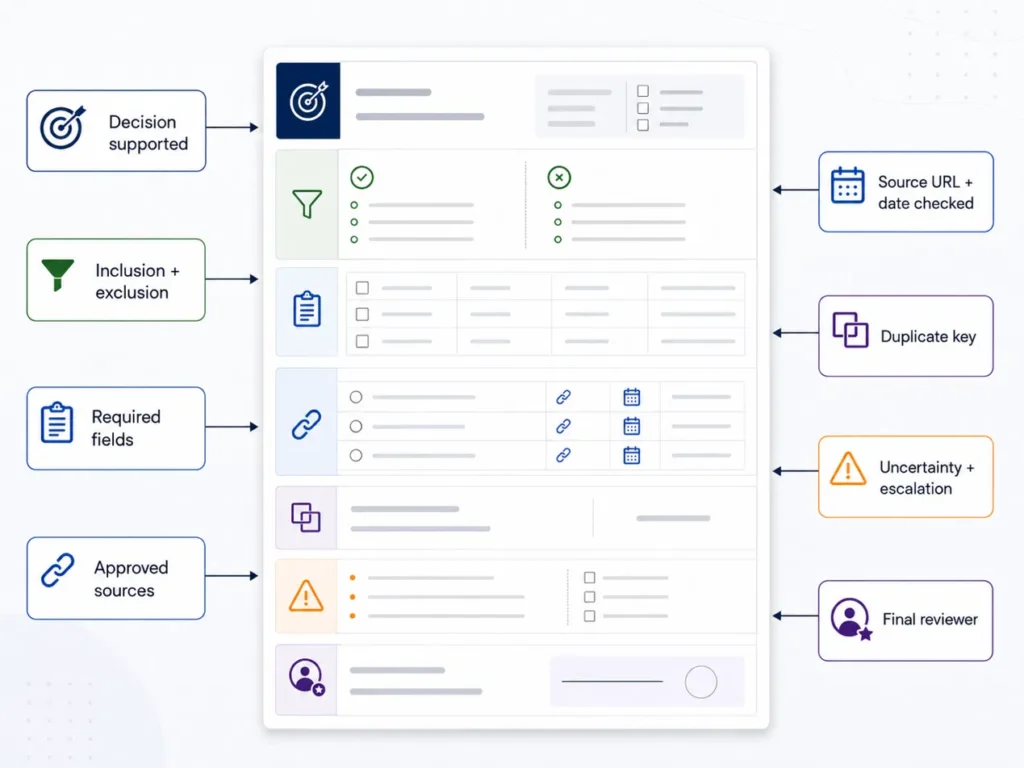
| Brief field | What to define |
|---|---|
| Decision this data supports | Why the information is being prepared, without asking the VA to make the final decision |
| Inclusion criteria | What must be true for an item or record to belong |
| Exclusion criteria | What should automatically be left out |
| Required fields | The columns or values needed before a record counts as complete |
| Approved sources | Sources that may be used and which source takes priority |
| Disallowed sources or methods | Sources, access methods, or collection methods that should not be used |
| Source URL | Where each important finding came from |
| Date checked | When changeable information was last verified |
| Normalization rules | How names, dates, currencies, categories, phone numbers, or other fields should be formatted |
| Unique or duplicate key | The field or combination used to identify repeated records |
| Uncertainty or exception status | How incomplete, conflicting, or unclear findings should be recorded |
| Escalation trigger | The situations in which the VA should stop and ask rather than guess |
| Final reviewer | Who approves uncertain cases and makes the decision supported by the data |
This creates a source-traceability trail rather than leaving you with a spreadsheet that is difficult to verify later.
It also gives the person doing the research permission to say “uncertain,” “not available,” or “needs review” instead of forcing every row into a confident answer.
Start with one defined deliverable
Pick one dataset or research deliverable you are still assembling manually.
Define the fields, acceptable sources, source-of-truth rule, quality checks, and the situations that should come back to you. Then delegate the preparation rather than the decision the information is meant to support.
At Boost VA, I support structured research, data entry, CRM and database cleanup, validation, light reporting, lead sourcing, and company, contact, competitor, and market-data collection. If you already have a defined outcome in mind, tell me what you need prepared and I can help you scope the handoff.