


A virtual assistant can manage an inbox, but that is only one small part of the role.
The more useful question is: what kind of work do you actually need someone to take ownership of?
One business may need help keeping WordPress content moving. Another may have a CRM full of outdated records. An agency may need someone researching prospects, preparing outreach, updating project boards, or organizing recurring reports. A founder may simply need the administrative work around meetings, documents, vendors, and follow-ups to stop interrupting the day.
That is why it is more useful to think about virtual assistant services as categories of remote business support rather than one generic job description. Outsource Accelerator describes virtual assistant services in similarly broad terms, including scheduling, research, marketing support, and data entry.
This guide breaks that range into 15 practical service areas so you can identify the kind of support that best matches the work already sitting on your plate.
What Virtual Assistant Services Cover in 2026
Virtual assistants are still strongly associated with administrative work, but the role has expanded into marketing execution, project operations, research, data, sales support, customer service, website work, and other recurring business processes.
That is visible in Wishup’s 2026 Virtual Assistant Industry Report. Based on 1,259 internal surveys covering its US business-owner clientele, Wishup reported that its 2025 VA workloads were led by Executive/Admin at 31.7% and Marketing & Social at 31.1%, followed by Project & Operations at 13.4% and Research & Data at 9.5%.
Those figures describe Wishup’s own customer data, not every virtual assistant or every business. They are still a useful illustration of how varied modern VA work has become.
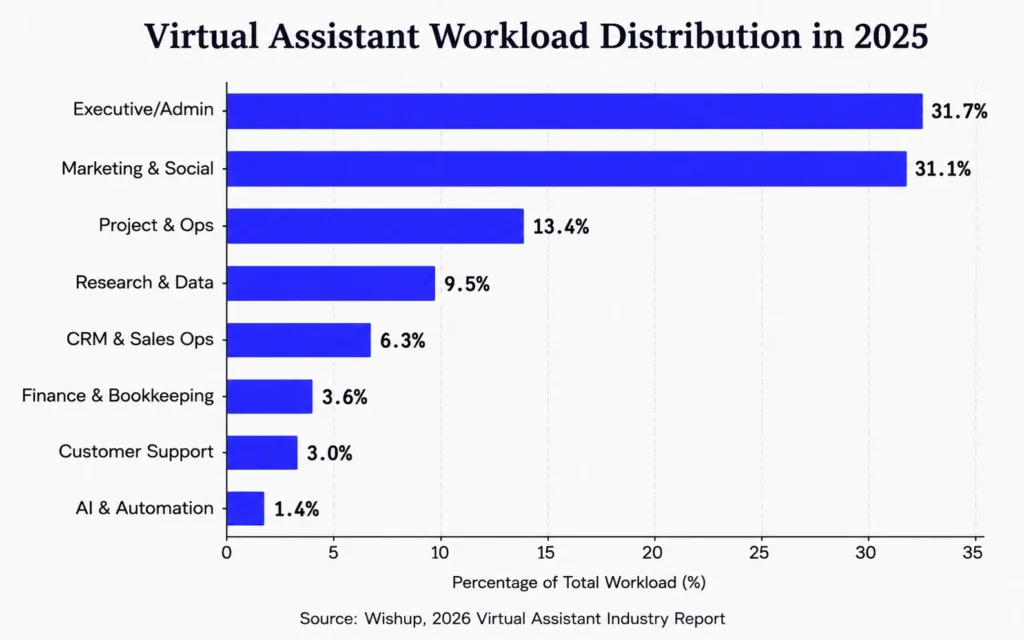
Wishup’s reported 2025 VA workload distribution across Executive/Admin, Marketing & Social, Project & Operations, Research & Data, CRM & Sales Ops, Finance & Bookkeeping, Customer Support, and AI & Automation.
A broader Fact.MR virtual-assistant-services market analysis also lists administrative services as its largest 2025 service segment. That report includes AI-powered, human-powered, and hybrid assistant models, however, so its market segmentation should not be treated as a direct measure of how a human VA will spend their working hours.
The practical lesson is simpler: do not hire around the label “VA.” Define the work first.
Administrative and Executive Support
1. Inbox Management
Inbox support can range from basic organization to maintaining a repeatable system for routine communication.
A virtual assistant might:
-
label and organize incoming messages;
-
separate newsletters and low-priority messages;
-
flag conversations that need your attention;
-
track unanswered emails;
-
draft routine replies from approved information;
-
record follow-ups;
-
archive completed conversations.
The important part is establishing rules. Your assistant needs to know what is urgent, what may be handled independently, what may only be drafted, and what must always come back to you.
Where the platform supports it, use delegated or role-based access rather than casually sharing a primary password. For example, Gmail provides delegated inbox access that can allow another person to read, send, and delete email without giving them control of the account password.
2. Calendar and Meeting Coordination
Calendar support is useful when scheduling involves more than accepting the first empty time slot.
A VA can coordinate availability, schedule or reschedule meetings, add meeting links, manage time-zone differences, maintain agreed buffers, collect agenda items, and make sure the calendar reflects confirmed arrangements.
You still decide which meetings deserve your time. The assistant executes the scheduling rules you establish.
This works especially well when you can state simple preferences such as protected focus hours, preferred meeting windows, minimum notice, travel buffers, and which types of meetings require approval.
3. Travel and Reservation Coordination
Travel support remains a legitimate VA service, particularly when the work is research-heavy.
A virtual assistant can compare approved flight or accommodation options, prepare an itinerary, record reservation details, monitor confirmed plans, research local transport, and organize the information needed before a trip.
The assistant does not need unrestricted authority to make every purchase. For higher-value bookings, a safer workflow may be for the VA to research suitable options and prepare the details while you approve the final transaction.
This keeps the useful part of the old “travel arrangements” service without assuming every client should hand over complete purchasing control.
4. Document and General Administrative Support
A surprising amount of operational work lives in documents rather than dedicated business software.
A VA may help with:
-
organizing folders and files;
-
formatting documents;
-
transferring approved information between systems;
-
maintaining simple trackers;
-
preparing meeting material;
-
updating recurring documents;
-
setting up accounts;
-
maintaining contact records;
-
collecting information needed by another team member.
This is also where a generalist VA can be especially useful. The tasks may not belong to one specialist department, but they still need to be completed accurately and consistently.
At Boost VA, this kind of work sits within my broader admin and operational support, alongside CRM updates, document handling, account setup, and recurring business administration.
Marketing and Growth Support
5. Social Media Operations
A virtual assistant can keep an approved social-media process moving without taking over your entire marketing strategy.
Support may include preparing posts for scheduling, organizing assets, adapting approved copy to platform formats, maintaining a content calendar, checking that scheduled posts went live, recording URLs, monitoring routine engagement, and gathering recurring audience questions.
That is different from asking a VA to independently decide your positioning, advertising strategy, crisis response, or major public messaging.
If social execution is one of your main bottlenecks, my guide to marketing tasks you can outsource to a virtual assistant goes deeper into the work that can sit behind a marketing campaign.
6. Content Operations
Content work contains many jobs beyond writing the first draft.
A content-focused VA can help organize source material, prepare research, format supplied copy, maintain content calendars, prepare internal links, organize images, add metadata, repurpose approved material, maintain publishing trackers, and coordinate the steps between draft and publication.
For agencies, this can also mean collecting assets from specialists, updating project statuses, checking whether required components are present, and preparing material for the person responsible for final approval.
The distinction matters: the VA can support the production system without automatically becoming the strategist, subject-matter expert, or final editor.
7. SEO Support
SEO includes strategic decisions, but it also includes a large amount of repeatable execution.
Depending on experience and instructions, a VA may support:
-
keyword and competitor research;
-
on-page updates;
-
metadata preparation;
-
internal-link research;
-
citation work;
-
backlink prospecting;
-
directory submissions;
-
content uploads;
-
basic audit support;
-
recurring SEO reporting.
At Boost VA, SEO and outreach are established areas of practical support, including research, on-page work, prospecting, outreach, local citations, and WordPress-related execution.
The appropriate scope depends on the task. A VA following an approved SEO process is different from expecting a general assistant to independently design a technical SEO strategy.
8. Lead Generation and Outreach Support
Lead generation usually contains two different jobs: deciding who you want to reach, and doing the research required to build and maintain the pipeline.
The second part is often a strong fit for virtual-assistant support.
A VA can research companies against defined criteria, identify suitable contacts, verify publicly available information, remove duplicates, maintain CRM records, prepare outreach lists, collect relevant personalization details, record source URLs, and track approved follow-ups.
The quality of the result depends heavily on the qualification criteria you provide. “Find 100 companies” is a weak brief. Industry, location, company type, exclusions, decision-maker roles, required fields, and acceptable sources create a much more useful assignment.
Website and Publishing Support
9. WordPress Support
A WordPress VA can take recurring website work off the backlog without being positioned as a custom developer.
Depending on their experience and access level, the work might include:
-
uploading and formatting approved content;
-
updating titles and SEO fields;
-
adding internal and external links;
-
compressing and uploading images;
-
checking forms and links;
-
making approved content changes;
-
performing routine core or plugin updates;
-
recording maintenance actions;
-
flagging errors that require technical attention.
WordPress itself uses defined user roles and capabilities. Its official roles and capabilities documentation is useful when deciding how much access someone actually needs.
An assistant who publishes articles, for example, may not need unrestricted administrator permissions.
For a more detailed maintenance-oriented list, see my guide to WordPress tasks you can outsource to a virtual assistant.
Research, Data, and Operational Support
10. Structured Online Research
“Do some research” is too broad to be a useful assignment.
Research becomes much easier to delegate when the final deliverable is defined.
A VA can research competitors, companies, products, suppliers, tools, pricing, public contact information, locations, events, or market options and return the findings in an agreed structure.
A good research brief explains:
-
what qualifies;
-
what does not qualify;
-
which fields are required;
-
which sources are acceptable;
-
how current the information must be;
-
how conflicting information should be handled;
-
what the final file should look like.
The assistant can collect and organize evidence while you retain responsibility for the business decision that follows.
My guide to research tasks to delegate to a virtual assistant includes examples of structured research deliverables rather than open-ended “find me some information” requests.
11. Data Entry and CRM Maintenance
Data work is rarely difficult because of one individual record. It becomes difficult because hundreds of small inconsistencies accumulate.
Virtual-assistant support may include:
-
spreadsheet updates;
-
CRM data entry;
-
duplicate checks;
-
standardizing names and fields;
-
updating contact records;
-
transferring approved data;
-
validating required fields;
-
cleaning databases;
-
recording source information;
-
preparing light operational summaries.
The VA should have a rule for uncertainty rather than silently filling gaps.
If two sources disagree, for example, the brief should explain which source takes priority or require the conflict to be flagged.
Clean data is not simply data that looks complete. It is data whose origin and status are understandable.
12. Vendor, Supplier, and Product Research
Some business research is less about analysis and more about finding a practical option that meets defined requirements.
A VA can research vendors, fulfillment partners, software providers, products, contractors, venues, or suppliers against criteria such as:
-
location;
-
budget;
-
availability;
-
specifications;
-
delivery timing;
-
service coverage;
-
contact method;
-
minimum requirements.
The VA can organize the options, contact providers using an approved brief where appropriate, collect quotations, and prepare a comparison.
The business owner or responsible specialist still makes the commercial decision.
This service is a more useful business version of the old article’s separate “online shopping” and “gift buying” sections.
13. Project Coordination and Recurring Reporting
A project does not necessarily need another manager. Sometimes it needs someone to keep the operational information current.
A VA can update project boards, record owners and deadlines, collect status information, track recurring deliverables, maintain supporting documents, assemble weekly updates, flag missing information, and identify blockers that need a decision.
The value here is visibility.
You should be able to open the project system or report and understand what is finished, what is moving, what is late, and what requires your attention.
The software matters less than maintaining one clear system. If task instructions, updates, files, and decisions are scattered, see my guide to tools for managing a virtual assistant.
Customer and Finance Administration
14. Customer Support Triage and Follow-Up
Not every customer interaction requires the business owner or a specialist.
A VA can often handle the predictable layer around customer service:
-
categorizing incoming enquiries;
-
answering approved routine questions;
-
sending status updates;
-
recording requests;
-
routing technical issues;
-
following up on unresolved cases;
-
scheduling support calls;
-
flagging urgent complaints.
The key requirement is an escalation system.
A virtual assistant should know which questions have approved answers and which situations need to be transferred immediately.
This is more realistic than assuming a remote assistant can automatically provide unrestricted customer support around the clock.
15. Finance Administration and Records Preparation
A virtual assistant does not need to become your accountant to make financial administration easier to manage.
Administrative support can include collecting receipts, renaming and organizing files, recording approved transaction information, preparing invoices from supplied details, tracking whether invoices were sent, recording payment status, sending approved reminders, and preparing organized material for an accountant or bookkeeper.
Keep tax treatment, accounting judgment, payroll decisions, financial approvals, and other professional decisions with the appropriately qualified person.
The VA’s role is to keep the records and recurring administrative process organized.
How to Choose the Right Virtual Assistant Service
You do not need to hire for all 15 services.
Start with the work that already exists.
Look at the last two or three weeks and identify tasks that repeatedly required your attention. Then separate the work into three groups:
Execution: The decision is already made. Someone needs to carry it out.
Preparation: Someone needs to collect, organize, check, or format information before you make a decision.
Decision-making: The work requires strategy, professional judgment, authority, or a decision that should remain with you or a specialist.
Virtual assistants are usually strongest in the first two groups.
If you want to go task by task rather than service category by service category, use my 10 tasks to delegate to a virtual assistant checklist.
Once you know what you want to hand over, document the expected result and the situations that require your approval. My guide to giving clear instructions to a virtual assistant covers that next step.
Virtual Assistant Service-Matching Matrix
Use this as a quick way to translate a business problem into the type of VA support you may need.
| What keeps happening? | Service area to consider | Useful first input to provide |
|---|---|---|
| Your inbox and scheduling repeatedly interrupt focused work | Inbox + calendar support | Priority rules, meeting preferences, escalation rules |
| Approved marketing work is consistently late | Social media + content operations | Content plan, approved assets, publishing process |
| SEO execution keeps falling behind strategy | SEO support | Current SEO plan, SOPs, target pages, reporting requirements |
| Your lead pipeline lacks researched prospects | Lead generation + outreach support | Ideal prospect criteria, exclusions, required data fields |
| Website content and maintenance remain in the backlog | WordPress support | Access level, approved update process, publishing requirements |
| Decisions are delayed because information has not been collected | Structured research | Research question, criteria, sources, required output |
| CRM or spreadsheet information cannot be trusted | Data management | Field definitions, source priority, validation rules |
| You spend too much time comparing suppliers or products | Vendor/product research | Requirements, budget, location, comparison criteria |
| Nobody has a reliable picture of project status | Project coordination | Project board, statuses, deadlines, reporting expectations |
| Routine customer requests keep reaching senior staff | Customer support triage | Approved answers, response rules, escalation path |
| Receipts, invoices, and records are consistently disorganized | Finance administration | Existing process and professional/accounting requirements |
The table is not a hiring specification by itself.
It is a starting point for defining what you want another person to own.
Build the Role Around the Work You Actually Need
A useful virtual-assistant role does not need an impressive list of responsibilities.
It needs a clear purpose.
One client may need five hours of recurring data and research support. Another may need ongoing WordPress, SEO, and content operations. Another may need a mixture of inbox management, vendor coordination, reporting, and general administration.
At Boost VA, I support founders, agencies, and online businesses across SEO and outreach, social and content operations, WordPress, admin and operations, data management, research, and lead generation.
The best starting point is not choosing the longest service list. It is identifying the work that repeatedly slows you down and deciding what a reliable handoff would look like.
If several of the services above already match work sitting on your weekly list, explore the support available through Boost VA and tell me what you need help with. We can then determine whether it makes more sense as ongoing support or a defined project.