
The client report is corrected on Friday. By the following Friday, the same column needs fixing again. Meanwhile, someone has chased the same missing update for the third time, and a spreadsheet has been copied into another system because nobody trusts the original.
Each repair looks small. The problem is that the work returns without anyone dealing with why it happens.
That pattern is a useful way to understand process debt: extra work caused by weak or outdated processes that nobody has properly resolved. A process debt audit helps you spot it by logging repeated fixes, tagging the type of problem and deciding whether to retire the work, fix its cause, assign ownership, automate it or delegate the legitimate task that remains. Not every recurring task is debt.
What process debt means, and what it doesn’t
The idea borrows from software development. Ward Cunningham introduced the technical-debt metaphor for shortcuts in software that may demand more work later. The Agile Alliance distinguishes poor processes from technical debt and calls that separate problem process debt.
For a small business, the useful question is not whether a task repeats. It is whether a missing rule, unclear handoff, duplicated step or outdated workaround forces people to keep repairing the same issue. The extra time spent on those repairs is like interest on a debt that has not been paid down. This is a practical analogy, not an accounting measure.
The terms describe different things. Technical debt concerns software design or code choices. Process debt concerns how work is carried out. Steve Blank’s organizational debt refers more broadly to people and culture compromises made as a startup grows. These problems can interact, but they are not interchangeable.
What doesn’t count as process debt
Payroll, backups and scheduled client reporting are supposed to happen again. When they have clear owners, reliable inputs and an appropriate workflow, their repetition alone is not evidence of process debt.
The same goes for a deliberate temporary workaround that still serves a useful purpose and is periodically reviewed. It becomes worth auditing when the original obstacle has disappeared but everyone continues doing the extra steps, or when the shortcut creates repeated corrections elsewhere.
Look for avoidable repeat repairs, not simply a long list of routine responsibilities. That distinction prevents an audit from treating necessary operational work as a problem to eliminate.
Five signs that recurring work may be process debt
The following table connects a visible symptom to a possible cause. None of the symptoms proves process debt by itself; use the first question to test what is happening before choosing a remedy.
| What keeps happening | Possible cause | First question to ask |
|---|---|---|
| The same follow-up gets sent | The next step has no owner or trigger | What should have happened without another reminder? |
| Someone re-fixes the same result | The upstream input or rule remains wrong | Where does the error first enter the workflow? |
| Information is entered more than once | Systems or records lack an agreed source | Which entry should be authoritative? |
| Work stops unless one person intervenes | Knowledge or permission lives with one person | What exactly can no one else access or decide? |
| The temporary workaround never ends | No one revisited the original obstacle | Is the workaround still needed? |
1. Follow-ups you keep repeating
The same person gets chased for an update, an approval or a handoff, often after everyone thought the request was settled. The immediate fix is another message. The possible underlying issue is that nobody owns the next action or knows what should trigger it.
For meeting follow-through, turn notes into owned action items rather than relying on whoever remembers to ask. When a decision genuinely belongs to the founder, a founder decision queue addresses the pending decision; it does not authorize someone else to make it.
2. Manual fixes that come back
One recurring report requires the same cell correction before it can go to a client. Fixing the visible result may be necessary today, but it leaves the input rule or source discrepancy untouched for next week.
Trace the issue to its first occurrence. Where numbers differ for legitimate reasons, the answer may be consistent reporting definitions rather than forcing one figure to match another. My guide to a client reporting source of truth covers that more specific situation.
3. The same data entered twice or more
One contact change gets typed into a CRM, pasted into a spreadsheet and then corrected in a reporting tool. Sometimes the repetition serves a valid purpose. Other times, nobody has agreed which record is authoritative or who can change it.
Asana’s Anatomy of Work research summary describes duplicative work as part of “work about work.” Its figures come from vendor-sponsored survey research, not a fresh measurement of your business or a current-year estimate. Test the duplication in your own workflow before assuming it can be eliminated. For CRM-specific rules, see CRM field ownership and safe duplicate-record cleanup.
4. Work only one person can do, including you
The task waits whenever a particular colleague is unavailable. Perhaps that person alone knows which source is correct, has the approved access or understands what exception needs sign-off. Sometimes this is appropriate authority, not debt. The warning sign is repeated avoidable waiting for knowledge or routine access that could be shared safely.
Identify the missing knowledge or handoff first. Documenting a repeatable task helps when the issue is know-how. If the problem is coverage when a VA is absent, use the separate virtual assistant backup plan rather than turning this audit into an absence procedure. Restricted approvals should stay with an authorized decision-maker.
5. “Temporary” workarounds that became permanent
The team exports a file, rearranges its columns and imports it into another tool every week because the original integration broke months ago. That may have been a sensible response at the time, but no one has checked whether the obstacle still exists.
Workarounds are not automatically bad. In his 2014 paper Theory of Workarounds, Steven Alter examines how people adapt work systems to overcome obstacles. Ask what problem the workaround solves today, what happens if it stops and whether there is now a simpler safe route.
How to run a lightweight process debt audit
You do not need a new project-management system. Start with recurring repairs that are already visible in messages, reports, handoffs and calendars.
Log what comes back
Try a two-week observation window as a starting point. This should catch many weekly repeats, but not all monthly or seasonal problems. Add those from recent records and calendar history. Record the repair each time it happens, not every ordinary recurring task.
Use this six-field Process Debt Log in a spreadsheet or your existing task system:
| Item or repeat repair | Signal (1–5) | Frequency | Minutes each time | Who catches it | Current owner |
|---|---|---|---|---|---|
| Recheck the same report field | 2 | Once a week | 12 | Account lead | None identified |
| [Describe recurring item] | [1–5] | [Daily / weekly / monthly] | [Minutes] | [Person or role] | [Name / none] |
The first row is illustrative. Keep the log short. Its job is to reveal a pattern and an ownership gap, not to become another permanent tracker.
Estimate the “interest” you keep paying
For a rough comparison, multiply occurrences by minutes per occurrence over the same period. Four corrections taking 12 minutes each add up to roughly 48 minutes of repair work in that four-week period. This estimate excludes interruptions, waiting and downstream rework, so treat it as a ranking aid, not a financial or scientific metric.
Then look at who catches each issue. Forty-eight minutes of founder intervention or a repeated client-facing error may deserve attention before a larger but harmless internal inconvenience. Record the impact in a note if needed, rather than inventing a precise numerical weight for the person involved.
Ask why it returns before choosing the fix
Take your highest-interest items and ask, “What makes this happen again?” If the answer is “someone forgot,” ask once more what was missing: a trigger, a source, a decision, a permission or a maintained instruction.
Be careful not to blame the person who discovers the error. They may be compensating for an unreliable process. Once the cause is clearer, you can choose the smallest change likely to stop the repeat repair.
Decide what to do: retire, fix, own, automate or delegate
Use this sequence as a default decision ladder, not as a rule that overrides business judgment or security requirements. Move to the next option only if the previous one does not solve the actual problem.
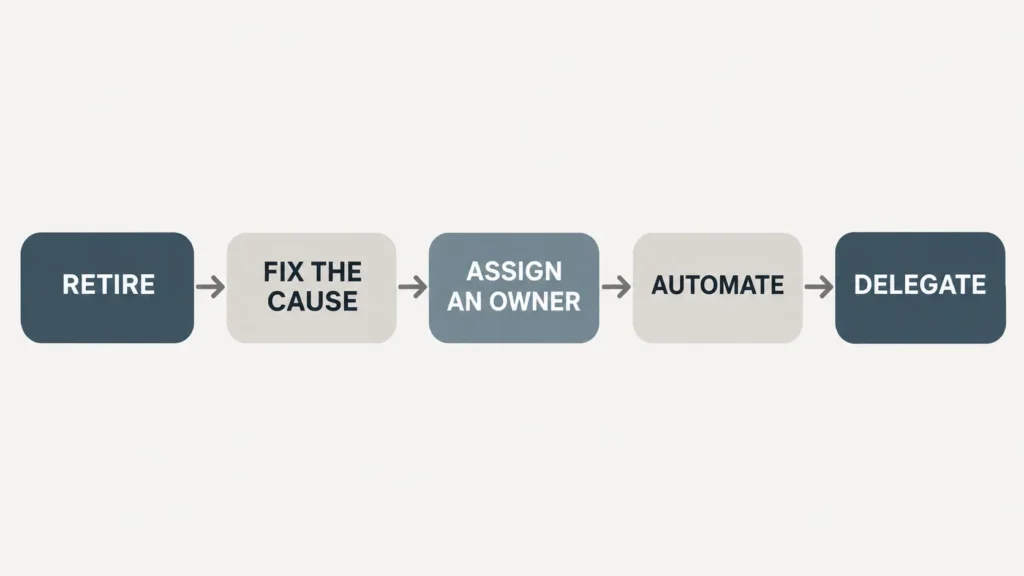
- Retire it. Does this activity still need to exist? Stop outdated reports, duplicate approval loops or checks that no longer protect anything. Confirm that removing the step will not break a dependency or obligation.
- Fix the cause. Can you repair the source, rule, integration or handoff that keeps producing the extra work? Correcting the origin is usually better than speeding up repeated cleanup.
- Assign an owner. Does the necessary process exist but nobody is responsible for its result or maintenance? Name who keeps it current, then use the separate guide to task owners and assignees if the role boundaries need clarification.
- Automate it. Once the process is stable, is a predictable, repeatable step suitable for automation with checks and exception handling? The guide to automating versus delegating covers that choice in depth.
- Delegate what remains. When the work is necessary, rule-based and difficult to eliminate, it may be suitable for retained operational support. Use the delegation matrix for the downstream handoff decision. My Admin & Operations and Data Management support can cover agreed routine execution, follow-ups, validation and maintenance while business decisions and final approvals stay with the client.
Delegating the recurring correction without addressing the source may simply move the process debt from one person’s calendar to another’s. The useful outcome is not a longer delegation list. It is less avoidable repair work and clearer handling of what genuinely remains.
Keep the same problems from returning
After acting on your first few items, check whether the repair actually stopped. If it still appears, reconsider the suspected cause instead of quietly adding a new workaround.
For processes worth keeping, update the relevant instructions and put them somewhere the team can find them. An organized SOP library can help prevent the fix from becoming knowledge that only one person remembers. Consider repeating a short audit quarterly or after a major tool or team change, rather than maintaining the log indefinitely.
Start with the three repeat repairs costing the most time or creating the most risk. Decide whether each should be retired, fixed, owned, automated or delegated, then review what actually changed this month.
If that leaves recurring, rule-based admin or data work that you want handled consistently, tell me what keeps coming back. We can discuss the remaining tasks and what support would be appropriate.