


Hiring a virtual assistant for small business support can be a smart move, but being busy is not enough reason to hire one.
You may genuinely need more capacity. You may also have a process that should be automated, a one-off problem that needs a specialist, or a responsibility that has grown into a real employee role.
The useful question is not simply, “Do I need help?”
It is:
What kind of help does this work actually require?
A virtual assistant is a remote professional who can take ownership of suitable administrative, operational, research, content, website or other digital responsibilities. The model works best when the work can be transferred clearly, completed remotely and reviewed without requiring you to make every decision along the way.
Before hiring, start with the work itself.
Start with the bottleneck, not the job title
Small-business owners often reach the hiring question because something is repeatedly falling behind.
Maybe customer or vendor information is not being updated.
Perhaps research is waiting because client work always comes first.
Your WordPress publishing queue may keep growing.
Your inbox, CRM, scheduling, spreadsheets or routine follow-ups may be taking attention away from work that genuinely requires you.
Those are useful signals, but they still do not prove that a VA is the answer.
The first step is to identify the bottleneck precisely.
Ask:
-
What keeps getting delayed?
-
Who owns it now?
-
How often does it happen?
-
What happens when it is not completed?
-
Could somebody else understand the expected result?
-
Can the work be completed remotely?
-
Can you check whether it was done correctly?
-
Does it require your judgment every time?
Recurring work with a visible result is usually a much stronger delegation candidate than an occasional responsibility requiring extensive explanation.
The guide to signs you may need a virtual assistant goes deeper into the workload symptoms. If you want to compare VA fit across different types of businesses, the businesses that need virtual assistants guide looks at the underlying work rather than simply listing industries.
Good first responsibilities for a small-business VA
A useful first responsibility normally combines three things:
-
It creates a real bottleneck today.
-
It can be transferred without giving away inappropriate authority.
-
The finished result is easy enough to review.
That often makes recurring operational work a better starting point than a vague instruction such as “help me run the business.”
Depending on the person’s proven skills, examples might include:
-
inbox and calendar organization;
-
recurring web research;
-
company, lead or vendor research;
-
CRM updates and data cleanup;
-
spreadsheet maintenance;
-
document organization;
-
content scheduling;
-
approved WordPress publishing;
-
routine website updates;
-
outreach preparation;
-
recurring reporting preparation;
-
project and status tracking;
-
collecting information for decisions you will make.
The important part is not whether a task appears on a generic “VA tasks” list.
It is whether that particular responsibility matches the person’s capabilities and can be handed over sensibly.
The delegation matrix can help you sort work according to business importance and the level of specialist judgment required.
Look for responsibility, not random task fragments
A weak first assignment might be:
“Help me whenever I get busy.”
A stronger assignment is:
“Every Thursday, update the CRM with this week’s new contacts, check for duplicates, flag incomplete records and send me a short status note when finished.”
The second example has:
-
a trigger;
-
a defined output;
-
a repeatable pattern;
-
a visible completion point;
-
a clear boundary.
That makes it easier to transfer and easier to review.
A VA relationship generally becomes more useful when the person can own an understandable piece of recurring execution instead of waiting for unrelated instructions throughout the day.
Work that should stay with you or a specialist
Delegation should not be measured by how much you manage to hand over.
Some responsibilities should remain with the business owner, another internal decision-maker or an appropriately qualified professional.
Examples include:
-
major business strategy;
-
final pricing decisions;
-
high-stakes financial authorization;
-
legal advice;
-
tax decisions;
-
final hiring or firing decisions;
-
specialist technical judgments beyond the VA’s proven capability;
-
decisions that could materially change the direction or risk profile of the business.
A VA may still support these areas without owning the final decision.
For example, a VA can gather market research without choosing which market your business enters.
They can organize financial information without making a tax decision.
They can coordinate documents without giving legal advice.
They can collect candidate information without making the final hiring decision.
That distinction is important enough to define before work begins. The guide to tasks you should not delegate to a virtual assistant alone provides more examples.
VA vs freelancer vs employee vs automation
Once you know what work needs help, you can compare support models.
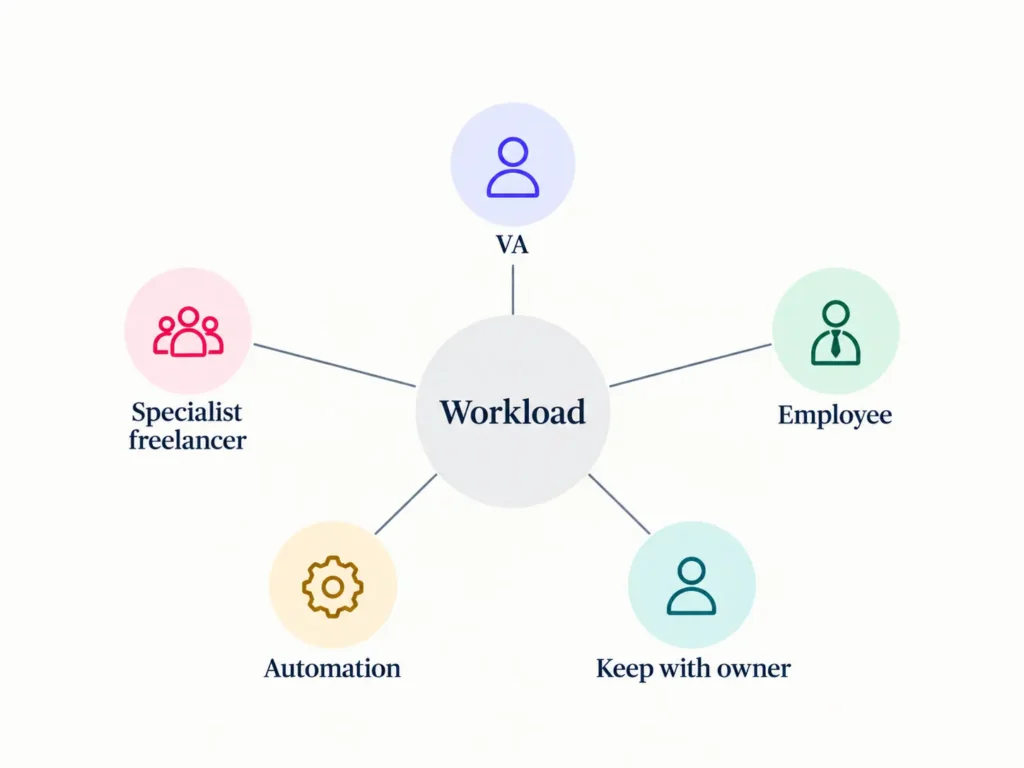
There is no universally best option.
A virtual assistant may fit when
The work is recurring, remote and reviewable, and you want continuity around a group of related execution responsibilities without immediately creating a full-time internal role.
Examples might include ongoing admin, research, data, WordPress, content operations, outreach preparation or project coordination.
A specialist freelancer may fit when
You primarily need a defined outcome that requires deeper specialist expertise.
Examples could include a specific design project, advanced development work, legal drafting, specialist accounting or a technically complex marketing project.
You may not need an ongoing support relationship once the deliverable is complete.
An employee may fit when
The workload is sustained enough to justify a permanent role and the position requires close integration, fixed availability, continuing internal responsibility or significant control over how and when the work is performed.
That is a different relationship from buying flexible external support.
Automation may fit when
The work follows stable rules and software can perform the repetitive steps safely.
Examples may include standard reminders, simple data transfers, recurring notifications or other predictable actions.
Before paying someone to repeat a process manually, ask whether the manual step still needs to exist.
Keeping the work yourself may still be correct
Some responsibilities genuinely need your judgment.
If handing them over would require constant review, repeated explanation or inappropriate authority, transferring them may create more management rather than useful capacity.
For a broader comparison, see virtual assistant vs freelancer vs employee.
What “cost-effective” should actually mean
The old way of comparing support is often:
VA hourly rate vs employee hourly wage.
That comparison is too simple.
A better cost decision includes:
-
how many hours of work actually exist;
-
how predictable the workload is;
-
the experience required;
-
how much supervision is needed;
-
the cost of mistakes or rework;
-
continuity requirements;
-
software and access costs;
-
recruitment and onboarding;
-
employment obligations where applicable;
-
whether the work creates enough value to justify any new support at all.
Employee compensation can also include substantial costs beyond wages.
For context, U.S. Bureau of Labor Statistics employer-compensation data for March 2026 reported average private-industry compensation of $46.60 per hour, consisting of $32.60 in wages and salaries and $14.01 in benefits.
That figure does not mean a VA will save your business a particular percentage. It simply demonstrates why the real cost of an employee is broader than the wage alone.
A small business with ten hours of recurring remote work each week may reach a very different decision from a business that already has enough ongoing responsibility for a fully integrated role.
Cost-effectiveness therefore means choosing the support model that fits the actual workload and gives you appropriate quality and capacity for the total cost involved.
Do not assume “VA” means independent contractor
There is also an important classification issue.
The words “virtual assistant” describe the work arrangement broadly. They do not automatically determine legal employment status.
In the United States, IRS worker-classification guidance looks at factors including behavioral control, financial control and the type of relationship.
Other countries use their own rules.
This is not legal or tax advice. The practical lesson is simply that you should not build your business case around the assumption that every VA arrangement automatically has the same legal classification.
Are you ready to manage access and review?
Having delegable work is only one part of readiness.
You also need a workable way to give another person the information and access required to perform it.
Start with four questions.
1. Can you explain the expected result?
You do not need a perfect manual.
But you should be able to explain:
-
what triggers the work;
-
what information should be used;
-
what the expected output is;
-
what “done correctly” looks like;
-
what should be escalated instead of guessed.
If you cannot recognize a correct result yourself, delegating the responsibility will be difficult.
2. Can access be limited sensibly?
A VA working remotely may need access to email, documents, WordPress, a CRM, spreadsheets, project-management systems or other accounts.
That does not mean every account should receive unrestricted permissions.
The NIST principle of least privilege is a useful security standard: access should be restricted to the minimum necessary to perform assigned tasks.
In practice, that can mean:
-
using a separate user account;
-
sharing a selected folder instead of an entire drive;
-
assigning the WordPress role needed for publishing rather than full server control;
-
removing access when the responsibility ends.
3. Can you review the early work?
The first few assignments are part of the learning process.
If you have no time or willingness to review the initial output, clarify misunderstandings or provide useful feedback, even a capable VA may struggle to learn your business-specific requirements.
The goal is not permanent micromanagement. It is enough early review to establish what correct work looks like.
4. Can the VA work without asking you about every step?
A responsibility that comes back to you for approval every few minutes may not create much useful capacity.
Define which decisions the VA can make, which actions require approval and which situations should be escalated.
If you proceed with a hire, the virtual assistant onboarding process covers accounts, permissions, first responsibilities, communication and early review in more detail.
Start with one controlled responsibility
You do not need to transfer half the business on the first day.
A controlled first responsibility gives you a better way to test whether the relationship works.
Choose something that:
-
genuinely needs to be done;
-
happens repeatedly or has a clear project boundary;
-
has a visible output;
-
does not require excessive access;
-
matches the person’s demonstrated capability;
-
can be checked within a reasonable amount of time.
Then define:
-
the intended result;
-
the source information;
-
the deadline or cadence;
-
what the person can decide;
-
what requires approval;
-
how completion will be reported.
Run the responsibility long enough to see whether the arrangement reduces the execution bottleneck without creating excessive correction or supervision.
If it works, expand gradually.
If it does not, diagnose why before simply adding more tasks.
The problem may be the person, the task, the handoff, the support model or the process itself.
Starting small is valuable because it lets you distinguish between those possibilities.
First Support Hire Decision Matrix
Use this matrix before deciding that your next hire should automatically be a VA.
| Decision factor | VA | Specialist freelancer | Employee | Automation | Keep with owner |
|---|---|---|---|---|---|
| Recurring remote execution | Strong fit | Possible | Possible | Possible if rules-based | Usually inefficient |
| One-off specialist deliverable | Weak to moderate | Strong fit | Usually excessive | Depends on task | Possible |
| High specialist judgment | Only with proven specialist capability | Strong fit | Strong if ongoing | Usually weak | Strong when owner expertise is required |
| Need for continuity | Strong | Moderate | Strong | Strong for stable rules | Depends on workload |
| Variable hours | Often strong | Strong for projects | Less flexible | Strong when automatable | Can overload owner |
| Employee-level integration/control | Usually weak | Usually weak | Strong | Not applicable | Owner retains control |
| Stable repetitive rules | Possible | Usually unnecessary | Usually unnecessary | Strong fit | Usually inefficient |
| Sensitive access | Possible with controlled permissions | Possible with controlled permissions | Possible | Depends on system | Safest for highly sensitive judgment |
| Easy to review output | Strong fit | Strong fit | Strong | Strong | Delegation becomes easier |
| Unclear definition of done | Poor starting point | Poor starting point | Training still required | Poor fit | Clarify process first |
The matrix is not a scientific score or legal classification test.
It is a way to force the hiring decision back onto the actual work.
If most of your need consists of recurring remote execution, the output is reviewable, access can be controlled and you do not need employee-level authority or specialist judgment, a VA may be a sensible first support layer.
If the need is mainly a specialist project, hire the specialist.
If the responsibilities have become permanent, integrated and employee-like, investigate an employee role.
If software can reliably remove the manual work, automate it.
And if nobody can yet define what another person should own, improve the process before hiring.
Make the support decision from the work
Hiring help can be a smart move for a small business. Hiring the wrong type of help can create another problem to manage.
Start with the bottleneck.
Identify the responsibilities that are recurring, transferable and reviewable.
Protect decisions that belong with you or qualified specialists.
Compare a VA against the actual alternatives.
Consider total value rather than relying on percentage-saving claims.
Make sure access and review are practical.
Then test one controlled responsibility.
For a broader look at the trade-offs and benefits of VA support, see the guide to hiring a virtual assistant.
At Boost VA, I support founders, small teams, agencies and online businesses with defined recurring execution and project work across areas such as admin, research, WordPress, data, outreach and backend operations.
If you can already identify a recurring responsibility or defined project that is ready to move, you can tell me what you need help with through Boost VA and we can determine whether it is a sensible fit for VA support.