


A full inbox, a long to-do list, or a busy week does not automatically mean you need a virtual assistant.
The more useful question is whether recurring work that someone else could execute is consistently consuming your attention, delaying important responsibilities, or forcing routine tasks into evenings and weekends.
That distinction matters because the strongest signs you need a virtual assistant are not simply signs that you are busy. They are signs that you have a recurring capacity problem and that at least part of the work is suitable for remote, delegated execution.
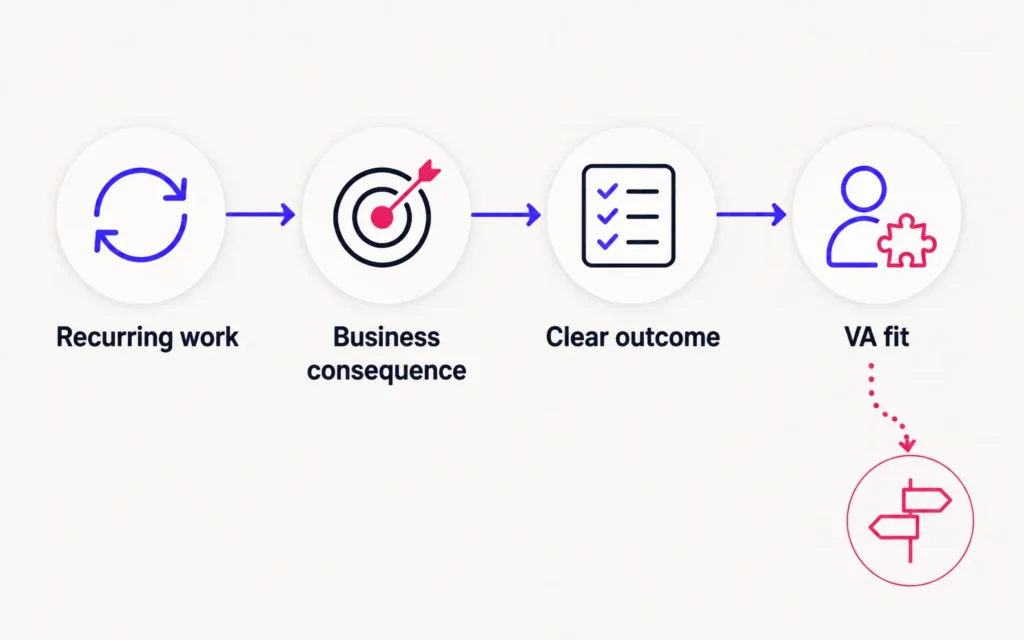
Before hiring anyone, look at three things: what keeps repeating, what consequence it is creating, and whether another person could complete it to a clear standard without taking over decisions that still belong to you.
Before You Hire: Is the Problem Capacity, Clarity, or the Wrong Kind of Work?
Needing help and needing a virtual assistant are not quite the same decision.
A VA is usually most useful when work continues week after week, can be completed remotely, follows an explainable process, and produces something you can review. If the problem is a one-off specialist project, a badly designed workflow, or work that should simply be automated, another solution may make more sense.
If you are still deciding what type of support the work requires, it can help to compare a virtual assistant, freelancer, and employee before choosing a role.
What makes recurring work a good VA candidate?
A task does not need a perfect SOP before you hand it over. It does need enough clarity that another person can understand what starts the task, what result is expected, what information they should use, and when something should come back to you for approval.
Strong candidates often have several of these characteristics:
-
they happen repeatedly;
-
the outcome is clear;
-
the work can be completed remotely;
-
completing it does not require a major business decision every time;
-
correctness can be checked;
-
the workload is important but does not require permanent full-time ownership.
Examples might include inbox triage, calendar coordination, CRM updates, recurring research, data cleanup, content scheduling, WordPress publishing, outreach preparation, reporting, or maintaining structured project information.
If you already know that recurring work is ready to move, this guide to tasks you can delegate to a virtual assistant goes further into specific handoffs.
When another fix may be better
Before adding a person to the workflow, ask whether the work itself should exist in its current form.
A repetitive task may need to be simplified. A manual step may be suitable for automation. A one-time technical problem may require a specialist. A role that needs fixed daily availability, permanent authority, or close integration with an internal team may be closer to an employee position.
Hiring a VA to absorb a poorly defined process can simply move the confusion from one person to another.
The goal is not to delegate as much as possible. It is to move the work that is genuinely ready to move.
Signs You May Be Ready for a Virtual Assistant
No single item below proves that hiring a VA is the correct decision. The case becomes stronger when several signals appear together and the underlying work is recurring and delegable.
Recurring admin and coordination are displacing work only you can do
Look at what occupies your actual workday, not just what appears on your job title.
If you regularly postpone client work, strategic decisions, sales conversations, creative work, or specialist responsibilities because you are updating spreadsheets, scheduling calls, collecting information, organizing files, or checking routine messages, you may have a capacity mismatch.
The important distinction is not that administrative work is “low value.” Many operational tasks are essential. The issue is whether they require your attention every time.
When a necessary task follows a repeatable process and repeatedly pushes aside work that depends on your judgment, it becomes a reasonable delegation candidate.
Follow-ups, responses, or routine deadlines keep slipping
A growing backlog is often easier to diagnose than a general feeling of being overwhelmed.
Look for patterns such as:
-
customer or prospect messages waiting longer than intended;
-
routine follow-ups being forgotten;
-
meeting preparation happening at the last minute;
-
CRM records falling behind;
-
invoices, reports, uploads, or scheduled content repeatedly being delayed;
-
routine project updates depending on someone reminding you.
These problems do not automatically mean a VA will fix them. First identify why they are happening.
If the cause is unclear priorities or a broken process, address that first. If the process is reasonably clear but there is simply not enough execution capacity to keep up, delegated support becomes a stronger option.
Small operational tasks repeatedly fragment the workday
Some work does not consume hours in one obvious block. Instead, it interrupts the day in dozens of small pieces.
Checking an email, moving a meeting, answering a routine question, looking up a figure, updating a record, and chasing a status may each take only a few minutes. The cost becomes more visible when those small actions repeatedly break focused work.
Microsoft’s analysis of workplace interruptions illustrates how intense that fragmentation can become. Among the top 20% of users by ping volume in its dataset, the average interval between meetings, emails, or chat pings during an eight-hour workday was about two minutes.
That is not a universal statistic for founders or business owners. It does show why a day filled with short coordination tasks can feel busy without producing much uninterrupted working time.
If many of your interruptions come from routine activities that follow established rules, consolidating some of them under one responsible person may reduce unnecessary switching.
Client work or growth initiatives wait because execution capacity is full
Another warning sign appears when useful work is consistently ready to begin but routine execution keeps pushing it back.
Perhaps approved articles are waiting to be uploaded. A prospect list is sitting unfinished. A CRM cleanup has been postponed for another month. Research you need for a decision never gets organized. A recurring marketing process stops whenever client work becomes busy.
The important question is whether the bottleneck is strategy or execution.
If you do not know what should happen next, hiring more execution capacity will not solve that problem.
If you know exactly what needs to happen but cannot consistently make time to do it, support may be appropriate.
The same work keeps returning and you can explain what “done” means
Recurring work becomes much easier to delegate when the finished result is visible.
“Help with my inbox” is vague.
“Review the inbox twice each workday, archive newsletters, flag messages from these clients, draft replies to routine requests, and list anything requiring my decision” is much easier to hand over.
The same principle applies to research, WordPress, spreadsheets, reporting, scheduling, outreach, and other operational work.
You do not need to document every possible exception before you begin. You should be able to describe the normal result and identify situations where the assistant should stop and ask.
You have become the bottleneck for routine updates and approvals
A founder or manager should still own the decisions that genuinely require their authority.
Problems appear when routine execution also stops until that same person touches every minor step.
Ask yourself what is actually waiting for you.
Is a project waiting for your judgment, or only for you to copy information into a system?
Does a client response require a sensitive decision, or does someone simply need to prepare the approved information?
Does a report need your interpretation, or are you spending time gathering and formatting the data before you can interpret it?
A VA can be useful when the bottleneck is routine preparation or execution rather than the decision itself.
Work is repeatedly spilling into time you intended to protect
Occasionally finishing something after hours is not, by itself, a hiring signal.
A repeated pattern is more useful to examine.
If evenings or weekends are regularly being used to catch up on inboxes, scheduling, updates, reports, research, publishing, or other recurring work, record what is actually causing the spillover.
The World Health Organization’s description of occupational burnout relates burnout to chronic workplace stress that has not been successfully managed. Hiring a VA should not be treated as a health intervention or a guaranteed way to reduce stress.
However, recurring work consistently pushing beyond your available capacity is still a practical reason to investigate the workload and decide what can be changed, removed, automated, delegated, or handled by another type of professional.
Signs You Need Help, but Not Necessarily a Virtual Assistant
One of the easiest hiring mistakes is identifying a genuine problem and then choosing the wrong type of help.
These situations deserve a different response.
The work is a one-off specialist deliverable
If you need a brand identity, custom software integration, legal review, technical audit, high-level copywriting project, or another specialist result with a clear end point, you may need a freelancer or qualified specialist rather than ongoing VA support.
A VA can support the surrounding process, but that does not mean a generalist assistant should replace specialist expertise.
The role requires fixed on-site presence, close control, or permanent ownership
Some roles need someone who is deeply embedded in the business, available at specific times every day, responsible for internal decisions, supervising other people, or taking permanent ownership of a function.
That starts to look less like flexible remote assistance and more like an employment-shaped role.
Choose the working model around the responsibility, not around whichever label sounds cheaper or easier to hire.
The task should be removed, simplified, or automated first
Delegating an unnecessary process does not make the process better.
Before handing off repetitive work, ask:
Can this step be removed?
Can the information be collected automatically?
Can two approval stages become one?
Can a template eliminate repeated formatting?
Can software handle the predictable part while a person reviews exceptions?
Human support is most valuable where execution, judgment within defined boundaries, communication, research, quality control, and exception handling still matter.
You cannot yet describe the outcome or review the work
If you cannot explain what a correct result looks like, you will struggle to judge whether someone else completed the task well.
That does not mean you need a 20-page SOP.
It may simply mean spending a little time clarifying:
-
what starts the task;
-
what information should be used;
-
what the final output should contain;
-
what the assistant may decide;
-
what requires approval;
-
what should be escalated.
If the role is still vague, define the first responsibilities before hiring. The guide to mistakes to avoid when hiring a virtual assistant covers this preparation in more detail.
Use a VA-Fit Evidence Table for Five Working Days
Instead of relying only on how busy you feel, observe an ordinary working week.
For five working days, record the recurring tasks that interrupt your day, the consequence each one creates, and whether the work could realistically be handed over.
This is a planning aid, not a scientific test or guaranteed hiring formula.
| Signal to watch | What to record | What the evidence may suggest | Work a VA could potentially own | When another fix may be better |
|---|---|---|---|---|
| Routine work displaces owner-only work | Task, frequency, and what important responsibility was delayed | Capacity mismatch | Scheduling, research, CRM updates, reporting, publishing, coordination | Remove or automate unnecessary work |
| Follow-ups keep slipping | Type of follow-up, age of queue, and why it was delayed | Execution or process bottleneck | Tracking, reminders, approved routine responses, status updates | Clarify sales, service, or escalation rules first |
| The day is fragmented | Repeated low-level interruptions and their source | Coordination burden | Inbox triage, calendar work, status collection, routine updates | Notification or workflow changes may solve part of it |
| Projects repeatedly wait | What project was delayed and what consumed the available capacity | Execution bottleneck | Defined production, admin, research, or publishing steps | Use a specialist if the project requires deeper expertise |
| The same task keeps returning | Frequency, trigger, expected result, and common exceptions | Stronger delegation readiness | Repeatable remote responsibilities | Clarify the process if “done” cannot be identified |
| After-hours catch-up becomes routine | Which work is creating the spillover | Broader workload problem | Recurring delegable workload | Workload, management, staffing, or other issues may also need attention |
At the end of the five days, do not total the rows into an arbitrary score.
Look for patterns.
A stronger VA case exists when the same work keeps returning, the consequence is visible, the result can be explained, and someone could execute it remotely without taking over the decisions that still belong to you.
If you mostly recorded one-off specialist projects, undefined responsibilities, or tasks that should not exist at all, solve those problems first.
What to Do Once the Evidence Points to a VA
Once you can identify the recurring work, the next step is not to hand over your entire business.
Start with a small, clear responsibility.
-
Choose one to three recurring responsibilities. Pick work that has a visible result and is currently creating a real bottleneck.
-
Define the outcome and approval boundary. Explain what “done correctly” looks like, where the source information lives, and what should be brought back to you.
-
Choose the support model around the work. Recurring remote execution may suit a VA. A specialist deliverable may suit a freelancer. Permanent integrated responsibility may require an employee.
-
Give only the access the work requires. The cybersecurity principle of least privilege is a useful standard: access should be limited to what is necessary for the assigned responsibility.
-
Review the first work before expanding the scope. A successful first handoff gives you real evidence about communication, accuracy, instructions, and process fit.
This sequence makes it easier to improve the working relationship without creating a large, unclear role on day one.
Move the Work That Is Actually Ready to Move
The decision to hire a virtual assistant should not start with a magic number of hours or a generic promise that delegation will transform the business.
Start with the work.
If recurring operational responsibilities are repeatedly delaying important work, the consequences are visible, and you can explain what a correct result looks like, you have a much stronger case for adding VA capacity.
If the task should be eliminated, automated, handled by a specialist, or defined more clearly first, do that instead.
At Boost VA, I support founders, agencies, and online businesses with recurring execution and defined projects across areas such as admin, research, WordPress, data, outreach, and backend operations.
If your five-day review has identified work that is genuinely ready to move, explore the ongoing and project-based virtual assistant support available through Boost VA and start the conversation with the specific responsibilities you want help with.