Wanting to make your virtual assistant feel part of the team is a good instinct. Someone who understands what the business is trying to accomplish, knows their work is noticed and feels comfortable raising a concern is usually in a better position to contribute than someone treated like an anonymous task processor.
That instinct needs one important qualifier when your VA is an independent contractor or works through an outside provider. Inclusion should strengthen the relationship without turning into employee-style control. Recognise specific work, share useful context, invite participation where it helps, and respect the independence built into the arrangement.
For a contractor VA, the useful principle is simple: invite, recognise, inform and respect rather than require, control and absorb them into employee-only arrangements.
This article provides general information, not legal or tax advice. Worker classification depends on the whole relationship and the laws that apply in the relevant jurisdiction.
Why “Part of the Team” Needs a Qualifier for a Contractor VA
Most virtual assistants are not simply remote versions of an employee sitting in another building. Many work independently, serve several clients or provide services through an agency or service business.
That distinction matters because worker status is based on more than the label in a contract.
For U.S. federal tax purposes, the IRS worker-classification guidance considers behavioral control, financial control and the type of relationship between the parties. It also makes clear that no single factor decides the answer. Its remote-worker guidance focuses on whether the business has the right to control what is done and how the services are performed.
HMRC’s Employment Status Manual makes a similarly useful distinction in the UK context: being part of a team is not automatically the same as being an integral part of the organisation.
Being included in the work, therefore, doesn’t require copying the way you manage employees. The better question is whether each practice helps the VA do good work while still fitting the actual engagement.
If you are still deciding which working model you need, start with the comparison of a virtual assistant, freelancer and employee.
Why Belonging Still Matters When Someone Works Remotely
Contractor status doesn’t make the human side of remote work irrelevant.
Gallup’s State of the Global Workplace 2026 found that 30% of exclusively remote employees were engaged, the highest figure among the work-location groups in its 2025 data. At the same time, 24% of exclusively remote employees said they had experienced loneliness a lot of the previous day, compared with 18% of on-site employees whose jobs could be done remotely.
Those figures describe employees, not virtual assistants, so they shouldn’t be presented as VA-specific evidence. They do show something useful about remote work more broadly: engagement and physical separation can exist at the same time.
For a VA working alone or across several clients, small signals of context and recognition may help the relationship feel less transactional. That doesn’t require creating a company-culture programme around them.
Recognition can be much simpler: explain why a responsibility matters, acknowledge useful judgment, reply when a blocker genuinely needs you, and make it clear when good work has helped the wider business.
Invite, Don’t Require: What Inclusion Looks Like With a Contractor VA
Useful inclusion gives the VA enough connection to understand the work without assuming that every employee ritual, schedule or internal expectation should apply to them.
Team Meetings and Calls
Invite your VA to meetings that genuinely help them do the work.
If a campaign kickoff changes what they need to research, a short invitation may save several rounds of messages. If a client call has no bearing on their responsibilities, attending simply to “feel included” may waste their time.
Relevant meeting time should also be handled clearly. Agree whether it is billable, whether attendance is required for the contracted work and what should happen if the VA cannot join.
Meeting attendance doesn’t need to be the default way someone stays informed. Notes, recordings, project updates and written decisions can often provide the context with less scheduling pressure, especially when you are working across different time zones.
Context, Not Control
Share the reason behind the work.
Knowing that a spreadsheet will be used for a sales handoff, for example, helps the VA understand why duplicate records or missing source information matter. Knowing that a WordPress update must be approved before a campaign launches explains why one deadline is more important than another.
Clear outcomes, source material, deadlines and decision boundaries are useful instructions. Dictating every step, maintaining unnecessary surveillance or controlling how every hour is spent is different.
Where decisions carry risk, use clear authority rules rather than turning every task into either complete freedom or constant supervision.
Shared Channels and Access
Give your VA access to the conversations, files and systems required for the agreed responsibility.
Access should follow the work. Someone handling approved WordPress publishing may need the content workflow and relevant site permissions. They don’t automatically need every leadership channel, financial account or internal discussion.
Where a shared channel contains a mixture of relevant work and sensitive information, create a more appropriate project channel or narrow the access instead of assuming full inclusion is necessary.
The same principle applies when selecting tools for managing a virtual assistant: use the systems that help the work move rather than making the VA copy every part of your internal stack.
Invite vs Require
Use this table as a practical review of the habits around your current VA.
| Area | Relationship-building approach | Employee-like signal to review |
|---|---|---|
| Meetings | Invite the VA when their input or context is useful; share notes when attendance isn’t needed | Requiring attendance at broad internal meetings unrelated to the contracted work |
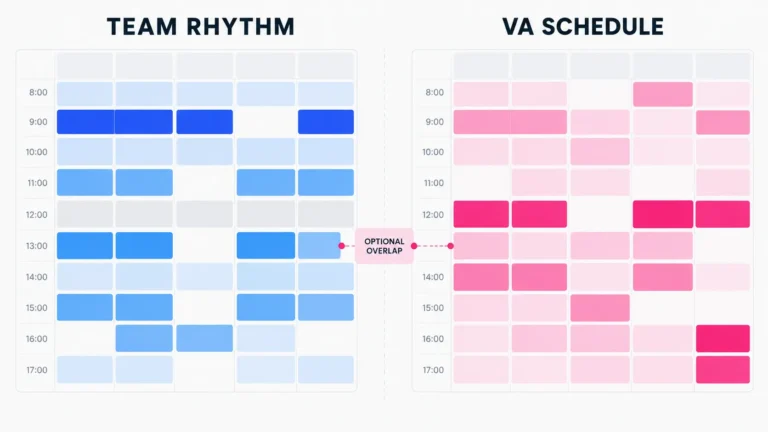
| Hours | Agree deadlines, response expectations and any genuinely necessary overlap | Controlling the full working day when the work doesn’t require it |
| Methods | Define the outcome, quality standard, source of truth and important constraints | Dictating unnecessary procedures simply to control how every part of the work is performed |
| Recognition | Thank the VA for specific work, judgment or improvement | Treating recognition as access to employee-only status or benefits |
| Gifts and bonuses | Use occasional, properly documented business payments or gifts when appropriate | Creating recurring benefit-style arrangements without considering their wider implications |
| Training | Provide the information needed to understand your systems and requirements | Prescribing extensive employee-style training and methods beyond what the contracted result requires |
| Tools and access | Provide the permissions needed for the agreed responsibilities | Giving broad organisational access solely to make the person feel like staff |
| Time off | Respect agreed availability, notice periods and planned absences | Informally creating paid-leave or other employee-benefit arrangements without reviewing the relationship |
The right-hand column isn’t a classification test. It is a prompt to review whether good intentions are turning into a different type of working relationship.
Appreciation That Works for a Contractor Relationship
Appreciation doesn’t need to resemble an employee rewards programme.
Specific Recognition Beats Generic Praise
Generic praise is pleasant, but specific recognition tells the VA what you actually valued.
Specific feedback might sound like: “Catching those duplicate records before the import saved us from creating another cleanup job. Thank you for flagging them instead of guessing.”
That message does more than say “good job.” It identifies the judgment you want repeated.
Keep recognition tied to real work. Mention an improvement, a thoughtful question, reliable follow-through, a useful warning or a result that made the next stage easier.

Bonuses, Gifts and Thank-You Payments
Money and gifts need more care because the legal and tax treatment can depend on the arrangement and jurisdiction.
IRS Publication 1779 identifies employee benefits such as insurance, pension and paid leave as one factor that can indicate employment, while also stressing that no single fact provides the answer.
That doesn’t mean a one-off thank-you payment or small gift automatically turns a contractor into an employee. It means you shouldn’t build recurring employee-style benefits casually and assume the label “contractor” settles everything.
Treat any additional payment properly within the business relationship. Keep it consistent with the contract, document it appropriately and check the accounting or tax treatment when needed.
If you already use a written agreement, the virtual assistant contract template explains the kinds of working and payment terms that should be made explicit.
The Quiet Forms of Respect Matter More
Paying invoices when agreed may do more for the relationship than a branded gift box.
Respect also means giving reasonable notice when priorities change, not assuming evenings or weekends are automatically available, answering decisions that only you can make and recognising that another client’s deadline may exist alongside yours.
If your VA has a planned holiday or period of unavailability, handle the work through a backup and coverage plan rather than treating time away as a loyalty problem.
Keep Feedback Separate From Recognition
Recognition and evaluation serve different purposes.
Use praise to acknowledge work worth repeating. Use corrective feedback to explain an observable problem and the change required. Use a more formal review when you need to evaluate patterns across repeated work.
If you need a structured review process, use the guide to virtual assistant performance reviews. For ongoing conversations, the weekly check-in questions can help surface workload, blockers and unclear priorities without repeating a status report.
If the problem is the wording of everyday messages rather than the review process itself, see the examples for clearer messages to your virtual assistant.
Special Cases Need Slightly Different Boundaries
Some VA relationships don’t fit a simple one-client, one-contractor setup.
Your VA Works for Other Clients
Serving more than one client is normal for many independent service providers.
That doesn’t mean your work should be treated casually. Deadlines, response expectations and any required overlap should still be agreed clearly.
Set the expectations the work actually needs rather than assuming continuous availability. If a recurring responsibility genuinely requires a fixed daily window, make that requirement explicit before the engagement begins and consider whether the overall arrangement still fits the support model you intended.
Your VA Comes Through an Agency
Agency-provided support can add another layer to the relationship.
Check your agreement before creating separate arrangements around bonuses, hours, leave, access or changes in responsibility. The agency may already define how scheduling, payment, feedback and changes to the VA’s role should be handled.
You can still recognise good work directly. Just avoid creating side arrangements that conflict with the provider’s terms or blur who is responsible for the working relationship.
When to Get Professional Advice
Culture tips aren’t enough when the real question is whether the arrangement has moved toward employment.
Consider appropriate local legal or tax advice when several of these features are present together:
- You control the VA’s working hours beyond what the work reasonably requires.
- You prescribe detailed methods instead of mainly defining outcomes and necessary standards.
- Attendance at broad internal meetings is routinely mandatory.
- The VA receives employee-style benefits.
- The relationship is open-ended, highly integrated and difficult to distinguish operationally from an employee role.
- The VA performs work central to the business under close continuing control.
- The contract says “independent contractor,” but the day-to-day reality looks materially different.
U.S. businesses should also check current rules rather than relying on an old article. The Department of Labor’s 2026 independent-contractor rulemaking illustrates why classification guidance can change over time.
Classification depends on the whole relationship. One meeting, one gift, one deadline or one contract clause doesn’t decide it by itself.
Keep the Relationship Warm and the Boundary Clear
The goal isn’t to keep a contractor at arm’s length. It is to avoid confusing belonging with control.
Invite your VA into conversations that help the work. Share the context they need. Recognise specific contributions. Respect agreed availability and the fact that an independent VA may have other clients. Keep employee-only benefits and unnecessary control out of the relationship unless the working model itself is meant to change.
That combination can create a relationship that feels human and collaborative without pretending the VA is something they aren’t.
If recurring research, admin, WordPress, data, content or outreach work is ready for dependable execution, you can see how my virtual assistant support works.