


Your virtual assistant sends a weekly report. The task board is up to date. You can already see what’s finished, what’s waiting, and what needs your approval.
Then your weekly call starts, and you spend 20 minutes going through the same information.
The report has done its job. The meeting hasn’t.
A useful weekly check-in should uncover things that don’t always show up in a written update: instructions your VA is quietly trying to interpret, decisions they’re waiting for, work that no longer fits their available hours, or small process problems that keep slowing them down.
These 26 virtual assistant check-in questions are designed to help you have that conversation without turning it into another reporting exercise.
There’s a reason to think carefully about what happens during these meetings. In Gallup’s research on meaningful manager conversations, only 16% of nearly 15,000 employees described their last conversation with their manager as extremely meaningful.
That research studied employees, not independent virtual assistants. Still, its emphasis on priorities, recognition, collaboration, and useful feedback offers a sensible starting point for an ongoing VA relationship.
You don’t need to ask all 26 questions. Pick a small set that suits your work, then rotate the others when something needs attention.
Why a Weekly Check-In Shouldn’t Repeat the Weekly Report
If your VA already provides written updates, you probably don’t need them to read those updates aloud.
A virtual assistant weekly report should already make progress, blockers, decisions, and next steps visible.
The check-in has a different purpose.
| The weekly report shows | The check-in can uncover |
|---|---|
| A task is waiting for approval | Whether the VA knows what to do if approval is delayed |
| Three assignments are still in progress | Whether their priorities are competing |
| A task took longer than expected | Whether the instructions or process caused unnecessary work |
| A deliverable was corrected | Whether the feedback was understood |
| Next week’s tasks are listed | Whether the work fits the agreed hours and available resources |
For example, a report might show that your VA spent extra time updating CRM records.
You could simply acknowledge the additional hours. Or you could ask what made the work take longer.
Perhaps several records contained conflicting information. Perhaps the instructions didn’t cover an exception. Or perhaps the required data was scattered across multiple files.
Those are different problems, and each calls for a different response.
The value of the conversation is discovering which problem actually exists.
The same principle appears in the current Scrum Guide, which emphasizes inspecting progress and adapting work rather than requiring a fixed question format. Scrum.org also explains why the older three-question Daily Scrum format was removed: it could encourage mechanical meetings.
A weekly VA check-in isn’t a Daily Scrum, but the lesson is useful. The questions should serve the conversation, not become another script to complete.
How to Use These Questions Without Creating a Long Meeting
For many ongoing VA arrangements, a 15–30 minute weekly conversation is a reasonable starting point.
Gallup’s employee research supports frequent, meaningful conversations of that length. Your actual schedule should still depend on the work, how much changes between updates, and whether a live discussion is useful.
Here’s a simple way to prepare:
Read the update beforehand. Look at unresolved decisions, changes, and recurring issues instead of making your VA explain every completed task.
Choose four or five useful questions. Keep a few consistent and select one or two additional questions based on what’s happening.
Give your VA room to raise something first. Their concern may be more important than your prepared questions.
Leave with clear decisions. If a priority, deadline, or instruction changes, record it where the work is managed.
You can establish your preferred communication and review arrangements during virtual assistant onboarding. They don’t have to look the same for every client or every role.
And if you work in different time zones, the check-in doesn’t always need to be a video call. A short written exchange or recorded update can be more practical when there’s little working-hour overlap.
Let Your VA Bring Up Their Concerns First
Before opening your question list, try asking:
“What would you like us to cover today?”
Or:
“Is there anything from this week you want to discuss before we go through my questions?”
It’s a small change, but it gives your VA an opportunity to surface something you didn’t think to ask about.
Atlassian’s guidance on one-on-one meetings also encourages giving the other person room to shape the discussion.
For a VA, this could mean raising an unclear instruction, suggesting a more efficient approach, or explaining that a task is becoming difficult to fit into the agreed working hours.
You can keep the agenda in whichever shared communication or task-management tool you’re already using. The important part is making it easy for both people to contribute before or during the conversation.
26 Virtual Assistant Check-In Questions to Ask Each Week
The questions below are grouped by the kind of issue they can uncover.
You don’t need to work through every category. Start with whichever one matches what’s happening in your VA’s work.
1. Clarity and Priorities
Use these when: Your VA is managing several assignments, instructions keep changing, or you’re seeing work completed differently from what you expected.
Which part of this week’s instructions left the most room for guessing?
Did any two assignments compete for your attention in a way I might not have realized?
If something has to move next week, which outcome should take priority?
Have I changed any requests without making the new priority clear?
Listen for: Conflicting deadlines, missing examples, assumptions, and tasks where the expected result isn’t clear.
If the same confusion keeps appearing, the solution may be to give clearer task instructions rather than keep asking your VA to clarify the same thing every week.
2. Decisions and Blockers
Use these when: Tasks are repeatedly marked Waiting, approvals are delayed, or progress depends on someone outside your VA’s control.
Which task is currently waiting for an answer or decision from me?
Are you waiting on someone else, and would it help if I stepped in?
Has anything reached a point where continuing without approval would be risky?
Is there a decision we’ve been postponing that could affect other tasks soon?
Listen for: Unanswered requests, approval bottlenecks, unclear authority, and tasks that cannot move forward safely.
A VA shouldn’t have to guess through a decision that belongs to the business owner.
If something is blocked, agree on what needs to happen, who will handle it, and when the decision is expected.
3. Workload, Capacity, and Hours
Use these when: Planned work keeps carrying over, tasks take longer than expected, or urgent requests frequently disrupt the week.
Does the work planned for next week fit our agreed hours?
Which task took longer than you expected, and what caused the difference?
If something urgent comes in, which existing task could safely wait?
Are delayed replies, handoffs, or missing information putting pressure on your available time?
Listen for: Unrealistic workload assumptions, hidden coordination time, changing priorities, and work that needs more capacity than originally planned.
This isn’t about questioning every hour spent.
It’s about understanding whether the workload matches what you’ve agreed and whether the process is creating avoidable delays.
If you regularly find yourself planning more work than the available time allows, revisit how many virtual assistant hours you actually need.
4. Process Friction and Improvements
Use these when: The same task needs repeated clarification, simple work involves too many steps, or your VA keeps encountering exceptions that the instructions don’t cover.
Which recurring task had more unnecessary steps than it should have?
Did any existing instruction or SOP conflict with what you actually needed to do?
Where are you repeatedly copying or checking information across different tools?
If I changed one thing about how I assign work, what would remove the most back-and-forth?
Listen for: Outdated instructions, duplicate work, unclear handoffs, unnecessary approvals, and information stored in too many places.
Your VA may notice inefficiencies you don’t see because they’re the person handling the recurring steps.
That doesn’t mean every suggested change needs immediate implementation.
Ask what the problem is, whether it happens often enough to matter, and what a simpler approach might look like.
When an existing procedure is the issue, you may need to update the SOP so the improved process doesn’t depend on remembering one conversation.
5. Quality and Feedback in Both Directions
Use these when: You’re reviewing deliverables, correcting work, discussing expectations, or trying to improve how you collaborate.
What went well this week that I might not notice from the finished result alone?
Was any correction or feedback I gave unclear or difficult to apply?
Did you spot a quality concern but feel unsure whether or when to raise it?
What could I do differently to make our work together easier next week?
Listen for: Good work that deserves recognition, recurring misunderstandings, feedback that lacks examples, and concerns your VA might hesitate to raise.
Feedback shouldn’t flow in only one direction.
If you tell your VA to make something “better” but don’t explain what needs to change, the next version may simply involve another round of guessing.
Specific examples help. So does asking whether your feedback made sense.
Weekly feedback is useful for small adjustments. A broader virtual assistant performance review serves a different purpose: evaluating patterns across a longer period rather than judging everything from one week.
6. Skills and Scope
Use these when: Your working relationship is becoming more established, responsibilities are changing, or you’re considering transferring additional recurring work.
Which type of assignment would you like to handle more often within our agreed work?
Is there a recurring responsibility you could take more ownership of if the boundaries were clear?
Are you receiving requests that fall outside the skills, tools, or scope we originally agreed on?
Listen for: Opportunities to use existing strengths, responsibilities that could become more consistent, and work that may require a separate scope or compensation discussion.
Not every VA is an employee, and not every independent contractor is looking for a traditional career-development conversation.
Focus on the work you’re doing together.
Expanding responsibilities should be a mutual decision, not an assumption that your VA can absorb whatever new work appears.
7. Looking Ahead and Preventing Problems
Use these when: A new project is starting, deadlines are approaching, or next week’s work depends on access, files, or outside decisions.
What’s coming up that could catch us off guard?
Is any account access, document, or approval likely to become a blocker next week?
If we don’t change anything about how we worked this week, which problem is most likely to happen again?
Listen for: Upcoming dependencies, missing resources, repeated risks, and situations that need attention before they become urgent.
For example, if your VA is preparing a new workstream but hasn’t received access to the necessary files, that may be worth resolving before the work starts.
Where an account permission is missing, arrange the appropriate access rather than sharing a master password unnecessarily. My guide to sharing passwords safely with a virtual assistant explains the access boundaries worth keeping.
Pick Four or Five Core Questions Together
Having a bank of 26 questions doesn’t mean you need 26 questions every Friday.
Organizational psychologist Steven Rogelberg describes a core-question approach to one-on-one meetings, where both participants help choose four or five questions that form the foundation of their conversations.
That idea can be adapted to an ongoing VA relationship.
Start with a few questions that matter consistently to both of you. Keep them for several weeks, then rotate in additional questions as the work changes.
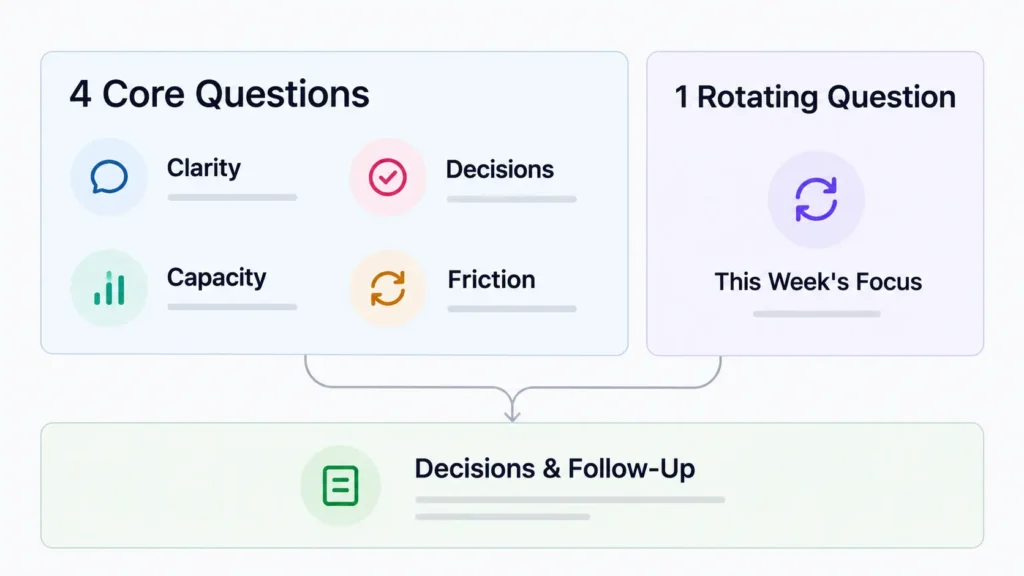
Example: A Five-Question Weekly Check-In
This is a fictional example for a business owner working with one VA on ongoing admin and content tasks.
Core questions
Is there anything in your current work that you’re having to guess about?
Are you waiting on a decision from me?
Does the upcoming workload fit our agreed hours?
What could we change to make one recurring task easier?
Rotating question for this week
Is there an approval or access issue likely to slow down next week’s content publishing?
In another week, the rotating question might focus on quality feedback or a recurring task that consistently exceeds its estimated time.
The goal isn’t to create a perfect permanent questionnaire.
It’s to make the check-in familiar enough to be easy, but flexible enough to catch new problems.
Let the Work Tell You Which Questions to Rotate In
Your existing reports and task records can provide useful clues.
| Signal you notice | Question category to use |
|---|---|
| A task remains Waiting across multiple updates | Decisions and blockers |
| Deliverables repeatedly need clarification or rework | Clarity and priorities |
| Hours regularly exceed estimates | Workload and capacity |
| The same manual step causes repeated delays | Process friction |
| An upcoming project has several dependencies | Looking ahead |
These are conversation triggers, not automatic judgments about performance.
For example, rising task hours could mean the workload has increased, the instructions need improvement, or something outside your VA’s control has changed.
If you’re already tracking VA productivity, use those observations to ask better questions instead of treating one number as the whole explanation.
Revisit your core set occasionally, perhaps after a month or when responsibilities change significantly.
Keep questions that still uncover useful information. Replace ones that have become automatic exchanges with little value.
Questions Your VA May Want to Ask You
A productive check-in isn’t only about the client asking questions.
Your VA may need information about business priorities, the quality of their updates, or changes that affect their responsibilities.
Research-based discussions of one-on-ones, including Rogelberg and colleagues’ work on questions employees can bring to managers, reinforce the value of participation from the person receiving support and feedback.
For a contractor relationship, the questions can stay focused on the agreed work.
Your VA might ask:
“Is there anything about my updates that you’d like handled differently?” This helps establish what information is genuinely useful.
“Are there upcoming changes in the business that could affect my current responsibilities?” This makes planning easier.
“Which decisions would you prefer I handle independently, and which should always come back to you?” This clarifies responsibility without assuming unlimited authority.
These conversations can be especially useful when the relationship is new, the workload is changing, or the same questions keep appearing in chat.
What to Avoid During a Weekly VA Check-In
The right questions can still become unhelpful when the conversation turns into another form of monitoring.
Watch for a few common habits:
Reading the entire task board aloud. Review the update before the meeting and spend your time on what remains unclear.
Asking every question every week. A large question bank is a resource, not a script.
Treating every delay as a performance problem. Check whether the work was waiting on access, decisions, instructions, or other dependencies.
Saving all feedback for a formal review. Small, specific corrections and recognition are usually easier to discuss close to the work.
Cancelling conversations without another way to raise issues. If you skip a call, make sure important decisions and questions still have a route forward.
Your VA also shouldn’t need to wait until the next scheduled meeting to flag something urgent.
A missing permission, conflicting instruction, or high-risk decision may need attention immediately, depending on your agreed communication rules.
Frequently Asked Questions
How long should a weekly check-in with a virtual assistant be?
Around 15–30 minutes is a useful starting point for many ongoing arrangements, particularly when the written report already covers routine progress.
Some weeks may need only a short exchange. Complex changes or unresolved issues may need more time.
Focus on whether the conversation resolves uncertainty, not whether it fills the calendar slot.
Do I need a weekly meeting if my VA already sends a report?
Not necessarily.
A written report may be enough when the work is stable, priorities are clear, and there are no decisions or concerns that would benefit from live discussion.
When problems are recurring or several issues need back-and-forth clarification, a short call can be more useful than another series of messages.
Can weekly VA check-ins happen asynchronously?
Yes.
If your hours barely overlap, you can select a few questions and have your VA answer them in writing or through a short recording. You can then respond with decisions or follow-up questions.
The important part is establishing response expectations and knowing when something needs a live conversation instead. This is especially helpful when working with a virtual assistant in a different time zone.
How often should I change the questions?
Keep a few core questions for consistency, then rotate one or two when the work gives you a reason.
You might review the core set after several weeks or when your VA takes on new responsibilities.
If a question repeatedly produces an automatic answer and no useful discussion, try a more specific version or replace it.
Make the Conversation Worth Having
Your VA’s weekly report should give you visibility into the work.
The check-in should help both of you understand what needs to change, which decisions are missing, and how to prevent the same friction from returning.
Start with four or five questions. Give your VA room to raise their own concerns. Use the remaining questions when something in the work signals that a deeper conversation would help.
At Boost VA, my approach centers on handling agreed responsibilities, keeping clients updated, and flagging issues or blockers that need attention without constant chasing.
If you’re looking for that kind of ongoing support, you can explore my virtual assistant services and see whether they fit your business.