

5 Common Mistakes to Avoid When Hiring a Virtual Assistant
Hiring a virtual assistant should reduce your workload, not create a new layer of confusion. Yet a capable VA can still struggle when the role is vague, onboarding is rushed, or feedback only arrives after something goes wrong.
The most important mistakes to avoid when hiring a virtual assistant usually begin before the first task is assigned. A good working relationship depends on choosing for the right reasons, explaining the work clearly, and allowing the assistant to learn how your business operates.
This guide covers five common client-side mistakes, how each one affects the working relationship, and what to do instead.
Mistake 1: Hiring Before You Define the Work
“Help me with admin” may sound clear in your head, but it can describe dozens of unrelated responsibilities. The same applies to requests such as “manage my social media,” “handle SEO,” or “support the team.”
A broad description makes it harder for a candidate to judge whether they have the right experience. It also creates room for different interpretations after the work begins.
Upwork’s guidance on writing a clear job description recommends stating the project goal, responsibilities, required skills, tools, timeline, budget, and communication preferences. Those details help candidates understand the role and submit more relevant proposals.
Compare these two briefs:
| Vague request | Clearer request |
|---|---|
| Help with our blog | Upload two approved articles per week to WordPress, format headings, add supplied images and links, complete the provided SEO fields, and send the live URLs for review. |
| Manage our leads | Research prospects using the approved criteria, add verified details to the spreadsheet, flag missing information, and update each lead’s status. |
| Support social media | Format approved captions, create graphics from existing Canva templates, schedule posts, and report any publishing errors. |
The clearer versions don’t explain every future task. They define the initial responsibility well enough for both sides to evaluate fit.
What to Do Instead
Before interviewing anyone, write down:
the first one to three responsibilities you want to delegate;
the tools involved;
the expected output;
the deadline or recurring schedule;
what the VA can decide independently;
what still requires your approval;
what “done correctly” looks like.
You can use the task-identification approach in How Smart Business Owners Buy Back Time with a Virtual Assistant to separate work that should be delegated from work that still needs your direct attention.
Mistake 2: Choosing a Virtual Assistant Mainly by Price
Budget matters, but the lowest hourly rate doesn’t automatically produce the lowest total cost.
A candidate may charge less but need more supervision, take longer to complete the work, or lack experience with the tools involved. Another candidate may charge more but complete the task accurately with fewer revisions. The important comparison is the value and reliability you receive for the total time, cost, and management involved.
Price also tells you very little about whether someone can follow your process, communicate clearly, protect sensitive information, or notice when the source data doesn’t match.
A more useful evaluation considers:
| Hiring factor | What to look for |
|---|---|
| Relevant experience | Similar tasks, tools, workflows, or business context |
| Evidence | Work samples, portfolio items, reviews, or a clear explanation of past work |
| Communication | Direct answers, useful questions, and realistic expectations |
| Process fit | Ability to follow instructions, document work, and flag uncertainty |
| Availability | A schedule and response pattern that fit the work |
| Price | A rate or project fee that fits the scope and expected value |
Upwork recommends using a simple candidate scorecard and a small paid test when several candidates appear suitable. A paid trial gives you evidence of quality, communication, and process fit without committing a large workload immediately.
What to Do Instead
Set your evaluation criteria before reviewing candidates. Give the most weight to the factors that can affect the work directly.
For example, if the role involves updating client data, accuracy and instruction-following may matter more than speed. If it involves customer messages, communication and judgment may deserve more weight. If it involves WordPress uploads, relevant platform experience and careful quality checks may be essential.
Choose the best fit for the work, not simply the smallest number in the proposal.
Mistake 3: Expecting Full Productivity Immediately
A VA may already know the tool or task, but they don’t yet know your business.
They still need to learn your priorities, naming conventions, preferred formats, clients, approval rules, communication style, and definition of a good result. Even a strong assistant may ask basic questions during the first few assignments because the missing knowledge is specific to your workflow.
Upwork’s guidance on helping freelancers succeed notes that a learning curve is normal. New freelancers may need to understand your systems and routines, clarify expectations, and make early adjustments based on feedback.
Problems begin when every question is treated as incompetence or when a new VA receives a large collection of unrelated tasks on day one. That pressure can encourage guessing, which is far riskier than asking for clarification.
What to Do Instead
Start with a controlled responsibility that is useful but easy to review.
A practical ramp-up may look like this:
Explain the business context and desired outcome.
Assign one representative task with written instructions.
Ask the VA to raise questions before making uncertain decisions.
Review the first output promptly.
Correct the process, not only the final result.
Add more responsibility after the standard is understood.
Early progress should be measured by learning, accuracy, and improvement, not only by volume. Speed can increase after the process becomes familiar.
Mistake 4: Skipping Onboarding and Training
Hiring someone with experience doesn’t remove the need for onboarding.
A VA may know how to use WordPress, but they won’t automatically know your category rules, image dimensions, internal-linking preferences, review process, or publishing permissions. They may understand lead research but still need your qualification criteria, source hierarchy, spreadsheet format, and duplicate-checking rules.
Experience covers the general skill. Onboarding explains how that skill should be applied inside your business.
Your onboarding material doesn’t need to be a large handbook. It needs to give the assistant enough context to work correctly and know when to stop and ask.
A useful onboarding packet can include:
a short explanation of the business and the task’s purpose;
access to the required tools;
a written SOP or screen-recorded walkthrough;
one strong completed example;
naming, formatting, and file-storage rules;
approval and escalation boundaries;
common mistakes to check before submission;
the person responsible for final review.
The Boost VA guide to remote work and virtual assistance also emphasizes clear expectations and onboarding, including access to tools and an introduction to the business’s working style.
What to Do Instead
Separate three things clearly:
Skill: What the VA should already know.
Process: How your business wants the task completed.
Judgment: Which decisions the VA can make and which ones must be escalated.
This prevents two opposite problems. You won’t waste time teaching a qualified person the basics of their profession, and you also won’t assume they can read your mind.
Mistake 5: Communicating Only When There Is a Problem
Remote work becomes difficult when communication is reactive.
If the client stays silent for several days, the VA may not know whether the work is approved, whether priorities changed, or whether a question is urgent. If the VA only reports at the end, the client may discover too late that access, source information, or instructions were missing.
Good communication doesn’t require constant meetings. It requires a predictable system.
Upwork recommends setting communication expectations and regular check-ins so both sides understand the scope, timeline, response pattern, and next steps.
Agree on:
the main communication channel;
expected response times;
how urgent issues should be marked;
how often progress updates are sent;
where tasks and files are tracked;
who approves completed work;
how feedback should be recorded.
A simple update can answer four questions:
Completed: What was finished?
Next: What will be worked on next?
Blocked: What is preventing progress?
Needed from you: What decision, file, access, or answer is required?
Feedback should also be specific. “This isn’t right” leaves the assistant guessing. “Use the location page as the source for the phone number, and flag any conflict with the business profile” gives a rule that can be applied again.
How to Avoid These Virtual Assistant Hiring Mistakes: A Readiness Scorecard
Before you post the role or contact a candidate, score each statement from 0 to 2:
0: Not prepared
1: Partly prepared
2: Clearly prepared
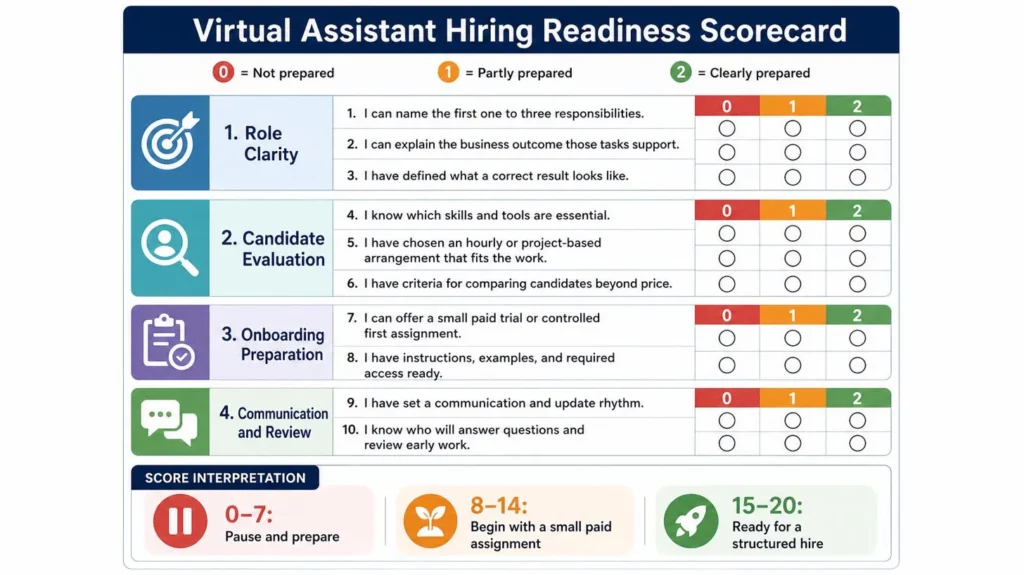
| Readiness area | 0 | 1 | 2 |
|---|---|---|---|
| I can name the first one to three responsibilities. | |||
| I can explain the business outcome those tasks support. | |||
| I have defined what a correct result looks like. | |||
| I know which skills and tools are essential. | |||
| I have chosen an hourly or project-based arrangement that fits the work. | |||
| I have criteria for comparing candidates beyond price. | |||
| I can offer a small paid trial or controlled first assignment. | |||
| I have instructions, examples, and required access ready. | |||
| I have set a communication and update rhythm. | |||
| I know who will answer questions and review early work. |
Interpreting Your Score
0 to 7: Pause before hiring.
The role is likely to create avoidable confusion. Define the work, success standard, and onboarding material first.
8 to 14: Start with a small paid assignment.
You have enough clarity to test the relationship, but some parts of the workflow still need to be documented.
15 to 20: Ready for a structured hire.
You have a clearer role, evaluation method, onboarding plan, and communication system. You can still refine the process after the first assignments.
This scorecard is a planning tool, not a scientific hiring assessment. Its purpose is to expose missing preparation before those gaps affect the working relationship.
A Better VA Relationship Starts With Better Preparation
The quality of a virtual assistant matters, but the client’s setup matters too.
A clear role helps you attract relevant candidates. A balanced evaluation helps you choose for fit rather than price alone. A realistic ramp-up gives the assistant time to learn. Onboarding turns experience into consistent work inside your business. Regular communication prevents small questions from becoming expensive mistakes.
At Boost VA, I provide retained and project-based virtual assistant support for founders, agencies, and online businesses. The strongest working relationships begin with a clear outcome, useful instructions, defined approval boundaries, and honest feedback. From there, I can support recurring work across research, data, content operations, WordPress, outreach preparation, administration, and other structured tasks.
Explore retained and project-based virtual assistant support when you have work that needs reliable execution and a clear process for getting it done.