


Your calendar can be full without containing one dramatic problem.
Fifteen minutes answering routine emails. Twenty minutes updating a spreadsheet. Another half hour finding information for somebody else. A WordPress post needs formatting. A vendor needs following up. A report still has to be prepared.
Each task looks manageable on its own. Together, they can leave very little uninterrupted time for work that actually requires the business owner.
If you want to buy back time with a virtual assistant, the goal is not to hand off the maximum number of tasks. It is to find recurring work that can move safely, determine how much owner involvement will remain after the handoff, and check whether the arrangement genuinely returns useful capacity.
That is a different question from simply asking whether somebody else can do a task more cheaply.
What buying back time actually means
Delegating a two-hour task does not automatically give you two hours back.
You may need to explain the process, provide access, answer questions, review the result, correct mistakes, and handle exceptions.
The useful measure is net time returned.
If a responsibility currently takes you two hours each week but still requires an hour of your attention after delegation, you have not bought back two hours. You have returned roughly one hour of owner capacity.
That remaining hour might still make the handoff worthwhile. The important thing is to measure the real change rather than assuming that outsourced hours and reclaimed hours are identical.
There is also more to the decision than cost.
A task might be inexpensive to outsource but still be a poor delegation candidate because it requires your authority, confidential judgment, specialist expertise, constant explanation, or substantial rework.
Conversely, a recurring responsibility may be worth moving even when the direct hourly cost is not dramatically lower than your own theoretical hourly rate because removing it also removes coordination, reminders, follow-up, and repeated context switching.
Older Gallup research on entrepreneur delegation found differences in business performance among entrepreneurs with different levels of measured “Delegator” talent. However, that research included specific entrepreneur samples, including 143 Inc. 500 CEOs, and does not establish that delegation itself causes business growth.
The more useful lesson is that delegation is a management capability. What you transfer, who receives it, and how clearly the responsibility is defined all matter.
If you are still deciding whether a VA is the appropriate support model in the first place, the broader guide to whether hiring a virtual assistant makes sense for a small business covers that decision separately.
Start with a seven-day time audit
Do not begin by searching for a generic list of things virtual assistants can do.
Start with your own week.
For seven days, record recurring work that consumes your attention. Include small responsibilities, especially the ones you barely notice because they have become routine.
You are looking for patterns rather than trying to account for every minute.
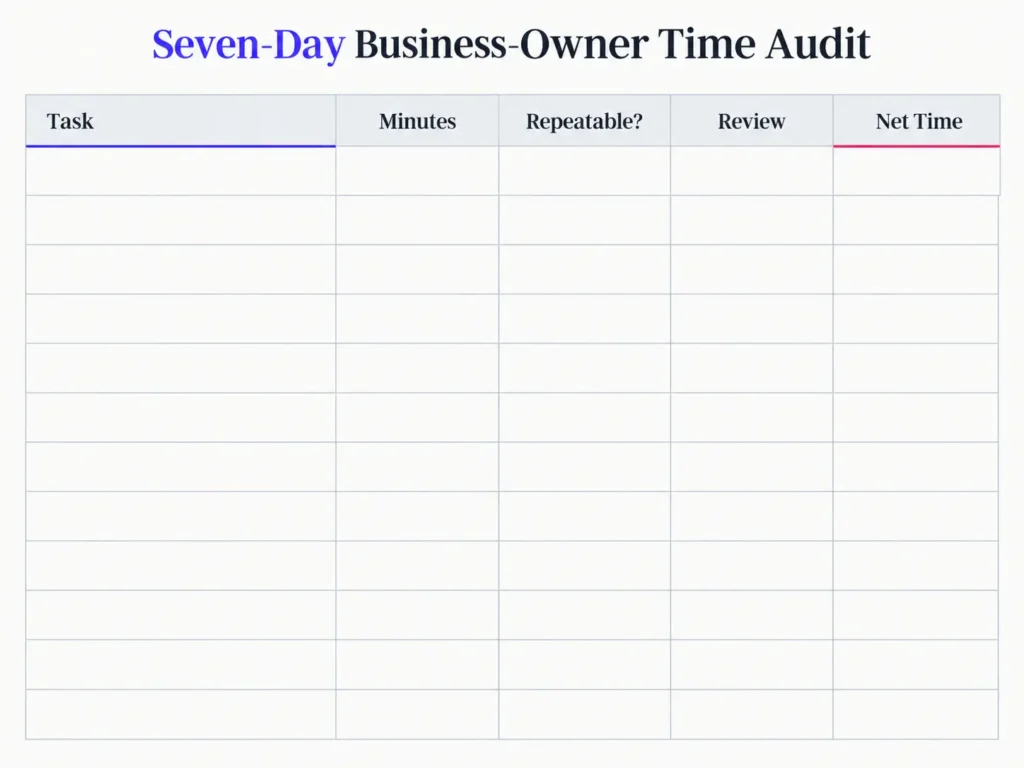
Seven-Day Time Buyback Audit
Create one row for each recurring responsibility and record the following information.
| Audit field | What to record |
|---|---|
| Task | The actual responsibility, not a vague category such as “admin” |
| Frequency | Daily, weekly, monthly, irregular, or project-based |
| Owner minutes per week | Approximate time you personally spend completing or coordinating it |
| Why you currently do it | Habit, authority, expertise, missing owner, lack of documentation, or another reason |
| Owner-only judgment required? | Yes, no, or only for exceptions |
| Repeatable? | Whether the normal process follows a predictable pattern |
| Instructions available? | Existing SOP, example, checklist, notes, or nothing yet |
| Estimated handoff/review minutes | Time you would still expect to spend explaining, checking, approving, or correcting |
| Possible route | VA, specialist, automation, keep with owner, or stop doing |
| Potential net time returned | Current owner time minus expected ongoing owner involvement |
Do not automatically delegate the entry with the highest number of minutes.
A three-hour activity requiring specialist judgment may need to remain with you or another qualified professional.
A sixty-minute recurring process with clear instructions, predictable inputs, and a visible result may be a much stronger first handoff.
Also look for clusters.
Five small spreadsheet updates might belong to one recurring data-maintenance responsibility. Several vendor emails might actually be one vendor-follow-up process. Publishing, formatting, link checking, metadata, and reporting may all be parts of one content-operations workflow.
Grouping related work often creates a cleaner responsibility than handing somebody a collection of unrelated fragments.
Which work is a good first handoff?
The strongest first candidate usually has several characteristics at the same time.
It is repetitive enough to learn
Repeatable work gives both sides a chance to improve the process.
Examples can include inbox and calendar organization, CRM maintenance, spreadsheet updates, structured research, vendor follow-up, approved WordPress publishing, routine reporting, content scheduling, or outreach preparation.
That does not mean every VA is qualified for every example.
Match the responsibility to the person’s demonstrated skills.
Specialist financial, legal, technical, or regulated work may need a qualified professional even when some preparation or administrative support can be delegated.
The result can be checked
“Help with my business” is difficult to review.
“Update these CRM records, check for duplicates, flag records with missing information, and send me the completed sheet every Friday” is much clearer.
A useful handoff normally has:
-
a visible result;
-
a source of truth;
-
a deadline or cadence;
-
a definition of done;
-
a way to identify errors;
-
a clear place for questions or exceptions.
If you cannot explain how you will recognize acceptable work, the process probably needs clarification before it needs delegation.
Normal execution does not require owner authority
Execution and authority are not the same thing.
A VA might gather vendor quotes without choosing the vendor.
They might prepare customer information without approving a high-risk exception.
They might organize invoices without making tax or accounting judgments.
They might prepare a WordPress draft without deciding the company’s editorial strategy.
A good first handoff removes suitable execution while leaving decisions with the person who should actually own them.
Replace the hourly-rate rule with net time returned
A popular delegation shortcut says to calculate your hourly value and outsource anything somebody can do for less.
That can be useful as a rough prompt to think about opportunity cost, but it is too simplistic to be a universal rule.
Consider three things instead:
1. Current owner time
How much time does the responsibility consume now, including the task itself, reminders, coordination, follow-up, and correction?
2. Ongoing owner involvement after delegation
How much of your time will still be needed for routine review, approvals, exceptions, questions, and rework?
3. One-time handoff cost
How much initial time will be required to explain the work, organize access, prepare examples, document the process, and review early output?
A simple working measure is:
Potential weekly net time returned = current weekly owner time − expected ongoing owner review and rework time
Keep initial setup time separate so you can see how long it takes for the handoff to begin returning capacity.
For example, imagine a recurring CRM cleanup takes a business owner around 120 minutes each week.
A first handoff takes 60 minutes to explain and prepare.
After onboarding, the owner spends around 20 minutes each week reviewing exceptions.
The first week may return only about 40 minutes once the setup time is included.
Later weeks may return closer to 100 minutes if the workflow remains stable.
That is a hypothetical example, not a promised result.
If the owner instead spends 70 minutes every week answering questions, correcting records, and repairing the work, the economics look very different.
This is why the cheapest hourly option is not necessarily the best handoff.
Skill fit, accuracy, communication, process clarity, authority boundaries, and review effort all affect the amount of usable time you receive back.
Build one handoff that does not create more management
Once you identify a promising candidate, move one responsibility first.
Do not unload half your workload at once.
Define the handoff clearly enough that both you and the assistant can tell whether it is working.
At minimum, establish:
-
The result. What should exist when the work is complete?
-
The trigger. When or why does the responsibility begin?
-
The inputs. Which files, systems, instructions, or source information should be used?
-
The normal authority. What can the VA complete without asking?
-
The escalation rules. Which exceptions come back to you?
-
The definition of done. How will quality and completion be checked?
-
The update method. Where will progress, blockers, and completion be recorded?
-
The review rhythm. When will you review the work instead of interrupting it continuously?
The last point matters.
If you move execution but still request constant updates, approve every routine step, or answer the same question repeatedly, the responsibility may technically belong to somebody else while the management burden remains with you.
A strong handoff should gradually make normal cases more predictable.
At Boost VA, I support founders, agencies, and online businesses with recurring execution across areas including administration, research, data, WordPress, content operations, outreach, and related backend work. Support can be structured around recurring work or a defined project, depending on what the workload actually requires.
The goal is not to take ownership of decisions that should remain with you or a specialist. It is to make suitable execution stop depending on your direct attention every time it occurs.
Review what actually changed
After the handoff has run through enough real cycles to evaluate it, compare the new process with your original audit.
For a weekly responsibility, two weeks can provide an initial review point, although some workflows need longer.
Ask:
-
How many owner minutes does the responsibility consume now?
-
How much review and correction is still required?
-
Are the same questions appearing repeatedly?
-
Is the output meeting the agreed standard?
-
Is the work being completed more consistently?
-
Are you still chasing status updates?
-
Has the execution backlog changed?
-
Did the reclaimed capacity go to something that actually needed you?
That last question is easy to miss.
Freeing ninety minutes and immediately filling it with another low-priority administrative task does not necessarily solve the original capacity problem.
Decide what the reclaimed time is for.
It might be client conversations, strategic planning, sales, product decisions, creative work, a difficult project, or simply one uninterrupted block for a responsibility that genuinely requires your judgment.
If repeated questions, approvals, and interruptions are the bigger problem rather than the raw number of hours, the separate guide to protecting founder focus through delegation goes deeper into ownership loops and escalation boundaries.
Start with one recurring workload
Buying back time does not mean outsourcing everything that feels inconvenient.
Start with one recurring responsibility that your audit shows is consuming meaningful owner attention.
Confirm that it is repeatable.
Confirm that the result can be reviewed.
Protect decisions that still require your judgment or specialist expertise.
Estimate the handoff and review cost.
Then move the responsibility and measure the actual difference.
The useful question is not simply:
“Can somebody else do this?”
It is:
“Can this responsibility move with a clear result, sensible boundaries, and less ongoing owner involvement than it requires today?”
If you already have one recurring workload that appears to pass that test, you can explore ongoing or project-based virtual assistant support through Boost VA and bring that specific workload for scoping.