
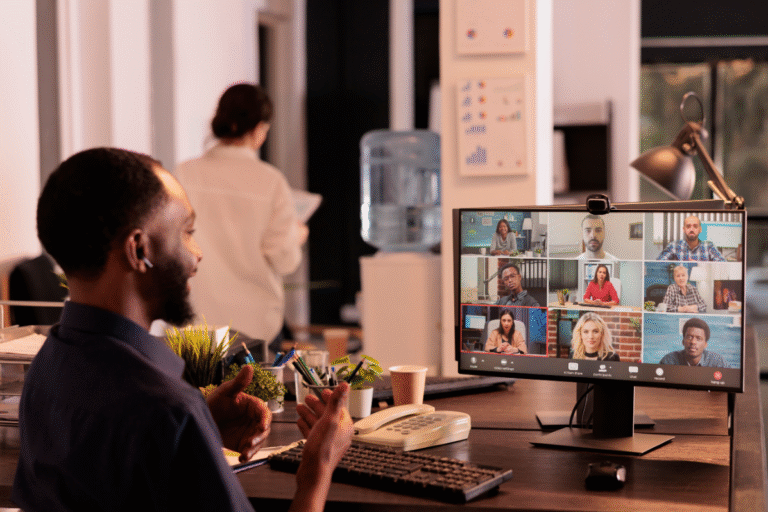
Remote work can widen the pool of people a business is able to work with.
When a role no longer depends on living within commuting distance of an office, an employer may be able to consider capable people in different cities, regions or countries. For a small business, that can create more options when local hiring is limited or when the workload does not require someone to be physically present.
But the relationship between remote work and access to talent is not automatic.
Some jobs cannot realistically be performed away from a workplace. Some people have better digital access than others. Remote arrangements can remove one barrier while introducing another through unreliable connectivity, poor communication, weak security or unclear responsibility.
The useful question for a business is therefore not simply, “Is remote work better?”
It is: Which work can be performed remotely, which people may become more accessible as a result, and what operating conditions are needed to make the arrangement reliable?
Remote work does not benefit everyone equally
Remote work is now an established part of the labor market rather than an emergency arrangement.
The U.S. Bureau of Labor Statistics reported that 35.9 million people teleworked or worked at home for pay in October 2025, representing 22.9% of people who were at work.
That scale matters, but it does not mean every worker or every occupation has equal access to remote work.
Job suitability is the first filter
Before considering where a person lives, how much flexibility they need or how large the potential talent pool might be, the work itself has to pass a basic test:
Can the important parts of this role be completed reliably without physical presence?
Some work transfers naturally to a remote environment.
Examples include:
-
online research;
-
data entry and database maintenance;
-
CRM updates;
-
content preparation;
-
scheduling;
-
email-based outreach;
-
reporting preparation;
-
WordPress content updates;
-
administrative coordination;
-
document organization;
-
many forms of customer or project support.
Other work depends on equipment, a physical site, face-to-face service, manufacturing, transportation or direct handling of products and therefore cannot simply be converted into a remote role.
This distinction prevents a common mistake: treating remote work as a workplace preference before deciding whether it is operationally suitable.
Education and occupation still shape access
Remote work may remove geographic barriers, but it does not remove occupational differences.
The Federal Reserve’s latest household survey shows how uneven access remains. In 2025, 55% of workers with a bachelor’s degree or more worked from home at least some of the time, compared with 32% of workers with some college, technical education or an associate degree, and 21% of workers with a high school degree or less.
Caption: Federal Reserve survey data for 2025 shows substantial differences in working from home by education level.
These figures do not mean education itself makes someone suitable for remote work. They reflect, in part, differences in the kinds of occupations people hold and how easily those jobs can be performed away from a physical workplace.
That is an important limit to broad claims that remote work automatically democratizes access to employment.
It can broaden opportunity, but the opportunity is distributed unevenly.
Where remote work can reduce barriers
Once a role is genuinely location-independent, remote work can remove barriers that have little to do with a person’s ability to perform the job.
Geography and commuting
A traditional office role normally restricts recruitment to people who already live within practical commuting distance or who are willing and able to relocate.
Remote work changes that boundary.
A business that needs reliable online research, administrative support, WordPress updates or recurring data work may not need the person performing those tasks to live in the same city.
That can help the business look beyond a limited local recruitment pool while giving suitable workers access to opportunities that are not available close to home.

This does not mean every company should recruit globally or that location stops mattering entirely.
Time zones, language, legal arrangements, data requirements, availability and communication expectations can still affect whether a working relationship is practical.
The advantage is simply that geography becomes one factor rather than an automatic exclusion.
Disability and workplace barriers
Remote work can also remove particular barriers for some people with disabilities.
The OECD’s work on disability and employment notes several potential advantages of teleworking, including less commuting and greater control over the working environment.
Those advantages can be significant for someone for whom travel, a conventional office environment or rigid scheduling creates unnecessary difficulty.
But the OECD is equally clear that teleworking is not a universal solution.
Some jobs cannot be performed remotely. Some people lack suitable digital access or tools. Remote work can also create risks around visibility, career development, health and workplace support.
For businesses, the practical lesson is to avoid both extremes.
Remote work should not be dismissed simply because someone is not physically present, but it should not be presented as automatically accessible or inclusive either.
The quality of the job design still matters.
Caregiving and scheduling
Location flexibility can also make certain roles more practical for people managing responsibilities outside work.
Removing a commute or allowing agreed flexibility may create more room for medical appointments, family responsibilities or other commitments.
That does not mean remote work removes the need for clear working expectations.
A business still needs to know:
-
when someone will normally be available;
-
whether certain hours require overlap;
-
how urgent requests are handled;
-
when deliverables are due;
-
how absences are communicated;
-
whether the workload is compatible with the agreed schedule.
Flexibility works best when it is designed into the arrangement rather than left undefined.
What current evidence says about flexibility and retention
Remote work is often discussed as though it produces a guaranteed productivity improvement.
The evidence is more useful when interpreted narrowly.
One well-known randomized study of hybrid working involved 1,612 graduate employees at a large technology company. Employees in the treatment group were allowed to work from home two days per week.
The hybrid arrangement reduced attrition by roughly one-third and improved job-satisfaction measures, while the researchers did not find a negative effect on performance reviews or promotion outcomes.
That is useful evidence, but it should not be stretched beyond the study.
It involved hybrid rather than fully remote work, a specific organization and a particular group of knowledge workers.
It does not prove that every remote arrangement improves retention, productivity or employee satisfaction.
What it does show is that well-designed flexibility can work without automatically creating the performance penalty that some managers fear.
For smaller businesses, the same principle applies: judge the arrangement by the requirements of the work and the quality of its operating system, not by assumptions about whether home or office work is inherently superior.
Why remote access still requires infrastructure
Removing a geographic boundary is only useful if the person can actually perform the work reliably.
Remote access therefore depends on more than a laptop.
Connectivity and digital access
A remote worker generally needs dependable internet access, suitable hardware and reliable access to the systems required for the role.
The exact requirement depends on the work.
Someone updating spreadsheets may have different technical needs from someone handling large media files, live customer calls or continuous video meetings.
Businesses should define these requirements before assigning the work rather than discovering them after problems occur.
For critical recurring tasks, it can also be useful to agree on what happens when connectivity or equipment fails.
Communication and management
Remote work makes weak processes easier to notice.
A vague instruction that might be corrected casually across an office can turn into hours of unnecessary work when people are distributed.
The solution is not constant monitoring.
It is clearer execution.
Useful remote-working practices include:
-
defining the expected result rather than assigning a vague task;
-
identifying the person who owns the work;
-
documenting recurring procedures;
-
agreeing on communication channels;
-
setting realistic deadlines;
-
defining what should be escalated;
-
providing progress updates at appropriate intervals;
-
reviewing exceptions instead of expecting people to guess.
This becomes particularly important as the amount of remote support grows.
If your goal is to increase execution capacity rather than simply transfer individual tasks, my guide on scaling a business with virtual assistants explains how clearer ownership, systems and human judgment fit together.
Security, privacy and data access
Remote work can expand the talent pool, but access should still follow the principle of giving people only what they need to perform their responsibilities.
Before remote support begins, consider:
-
which systems the person actually needs;
-
whether separate user accounts can be created;
-
whether sensitive data needs additional restrictions;
-
how passwords and credentials will be shared securely;
-
which tasks require approval before action;
-
how access will be changed or removed when responsibilities change;
-
what information should never leave a controlled system.
The right level of access depends on the work.
A person preparing public research should not automatically receive the same system permissions as someone maintaining internal client data.
Good remote work depends on matching access to responsibility.
What remote work and access to talent mean for businesses
For a small company, one of the most useful effects of remote work is that it separates where a person works from whether the work requires their physical presence.
That creates several possible operating models.
You might need:
-
a full-time employee who happens to work remotely;
-
a specialist contractor for a defined project;
-
a freelancer for occasional work;
-
a virtual assistant for recurring digital execution;
-
a combination of internal staff and external remote support.
Those models are not interchangeable.
The right choice depends on the workload, required control, continuity, expertise, availability and risk involved.
Virtual assistance is particularly relevant when the work is already digital and can be defined through clear outcomes, recurring processes or project deliverables.
Current marketplace evidence also suggests that this remains an active area of demand. In Upwork’s 2026 In-Demand Skills report, general virtual assistance ranked among the marketplace’s most sought-after customer-service and administrative-support skills.
That is Upwork marketplace data, not proof of the entire labor market, but it does show continued client demand for remote administrative and operational support.
At Boost VA, the more useful way to think about remote assistance is not simply as “someone working from home.”
It is remote execution capacity.
That might involve research, WordPress work, data maintenance, administrative tasks, recurring operations or project support that can be performed reliably without requiring another person to be physically present in your business.
Remote-support readiness checklist
Before deciding that a workload should be remote, check whether the operating conditions actually support it.
| Question | Ready when | Warning sign |
|---|---|---|
| Can the work be completed without physical presence? | The important tasks are digital or location-independent. | Core responsibilities require equipment, a site or in-person interaction. |
| Is the expected result clear? | Deliverables, deadlines and quality expectations can be explained. | Instructions depend heavily on assumptions or constant verbal correction. |
| Can necessary systems be accessed remotely? | Required tools have appropriate remote access. | Work depends on devices, files or systems that cannot be accessed safely. |
| Are communication expectations defined? | Channels, response expectations and escalation rules are known. | Everyone assumes the other person will “just know” when to communicate. |
| Is responsibility clear? | One person knows what they own and when it is complete. | Tasks are passed between people without clear ownership. |
| Can access be limited appropriately? | Accounts and permissions match the person’s actual responsibilities. | Broad passwords or unnecessary system access must be shared. |
| Is the work recurring or sufficiently defined? | There is repeatable work or a clear project outcome. | The business cannot yet explain what support it actually needs. |
| Can performance be judged by useful output? | Quality, completion, accuracy or response standards can be reviewed. | Presence or online status is being used as the main measure of productivity. |
| Is there a plan for exceptions? | Problems, missing information and technical issues have an escalation path. | The remote worker is expected to guess when something unexpected happens. |
You do not need every process documented perfectly before remote support begins.
But the more important the work becomes, the more important it is to make ownership, communication, access and quality standards explicit.
Remote work expands the option set, not the guarantee
Remote work can remove barriers created by commuting distance and physical location. For some people, it can also make employment more practical by providing more control over where work happens.
For businesses, that can mean access to capable people who would never have been part of a traditional local hiring pool.
But access alone does not produce a good working relationship.
Job suitability, connectivity, communication, security, management and clear responsibility still determine whether remote work succeeds.
The useful business question is therefore not whether remote work is universally better.
It is whether this particular work can be done remotely, by the right person, within a system that makes reliable execution possible.
If the work you need help with is already digital, recurring or clearly project-based, you can explore the virtual assistant support available through Boost VA and decide whether remote execution is a practical fit for the workload you want to move off your plate.