

How to Build a Marketing Agency Execution Workflow That Protects Strategy
A growing marketing agency rarely suffers from a shortage of ideas. The harder problem is turning strategy into consistent client work without pulling senior specialists into every update, upload, spreadsheet, reminder, and quality check.
That tension becomes more visible as an agency adds services. Paid media, SEO, lifecycle marketing, creative, CRO, analytics, and account management may all contribute to one client outcome. Each discipline needs expertise, but the campaign also depends on routine coordination and accurate execution.
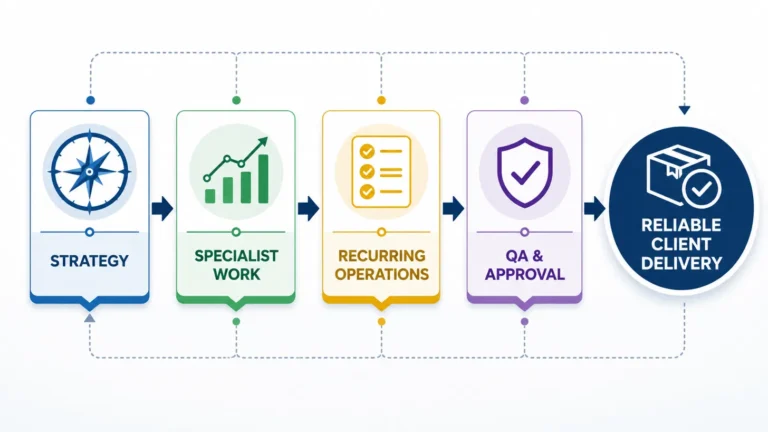
A strong marketing agency execution workflow solves this by defining who decides, who performs specialist work, who keeps recurring tasks moving, and who approves the final output.
Disruptive Advertising provides a useful public example. Its digital marketing services cover multiple channels, while its published team structure includes strategy, account management, onboarding, operations, analytics, paid media, SEO/CRO, creative, and coordination roles.
The company does not publish its confidential internal SOPs, but the visible structure illustrates an important lesson: full-funnel delivery is not one job. It is a connected system of decisions, specialist work, operational support, and quality control.
A Full-Funnel Service Offer Is Also a Coordination System
An agency website may present services as separate items. Clients, however, usually experience them as one relationship.
A paid search campaign may depend on landing-page changes, conversion tracking, creative assets, audience research, offer approval, reporting, and follow-up. An SEO project may involve keyword research, content briefs, publishing, internal links, technical fixes, data validation, and client approvals. Lifecycle marketing can require segmentation, copy, design, platform setup, testing, scheduling, and performance reporting.
The strategy may be strong, but weak coordination can still create delays and errors.
Common workflow risks include:
a specialist waiting for an asset that nobody formally requested;
two people updating different versions of the same document;
a report being prepared with incomplete or inconsistent data;
a task marked complete before the required QA check;
a client request being discussed in messages but never added to the tracker;
an account manager becoming the default owner of every loose end.
These are not necessarily signs of a bad team. They are signs that the workflow needs clearer ownership.
What Disruptive Advertising’s Public Structure Illustrates
Disruptive Advertising describes its offer as a full-funnel approach rather than isolated ad-account management. Its public service list includes paid search, paid social, SEO, Amazon, lifecycle marketing, CRO, creative, data analytics, and lead generation.
Its team page also shows distinct functions and roles across operations, eCommerce, B2B, national and local lead generation, sales and marketing, account management, onboarding, data, creative, and channel strategy.
That does not reveal how every campaign is managed internally. It does show why clear handoffs matter.
When several disciplines contribute to an account, the agency needs a way to move work between them without confusing four different responsibilities:
deciding what should happen;
performing work that requires channel expertise;
keeping repeatable execution organized;
reviewing and approving the result.
Disruptive Advertising also publishes a service process that moves through discovery, solution development, a marketing level-set, strategy optimization, and growth strategy. Those stages reinforce the distinction between understanding the problem, choosing the approach, executing the work, and improving it over time.
The practical lesson for another agency is not to copy those labels. It is to make its own ownership boundaries equally clear.
The Four Layers of Marketing Agency Delivery
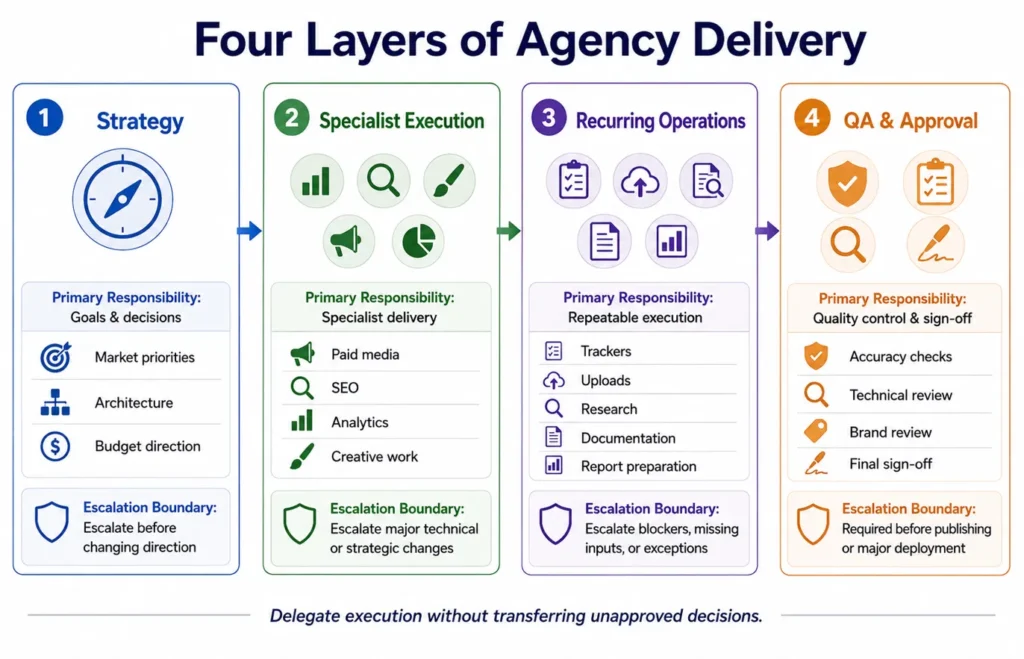
A useful workflow begins by separating agency work into four layers.
1. Strategic work
Strategic work determines direction.
It includes decisions such as:
which audience or market to prioritize;
how budget should be allocated;
which offer should lead a campaign;
which channel should receive more attention;
what success should be measured against;
when the team should change direction.
This work should remain with the people responsible for client outcomes. Depending on the agency, that may include a strategist, account lead, department head, or founder.
2. Specialist work
Specialist work requires channel knowledge, professional judgment, or technical skill.
Examples include:
building and optimizing paid media campaigns;
diagnosing tracking or attribution problems;
developing an SEO strategy;
planning an experiment;
creating conversion-focused copy or design;
interpreting performance data;
deciding whether a recommendation is technically sound.
A general virtual assistant should not replace the qualified person responsible for this layer.
3. Recurring operational execution
Operational execution keeps approved work moving.
It may include:
gathering source information;
organizing campaign assets;
updating project trackers;
formatting briefs;
preparing recurring reports;
uploading approved content;
maintaining status fields;
checking that required files are present;
recording decisions and next actions;
coordinating reminders and deadlines;
completing defined research or data-entry steps.
This layer is often highly delegatable because success can be described through a checklist, example, SOP, or approval rule.
4. Approval and quality control
Quality control confirms that the output meets the agency’s standard before it reaches the client or goes live.
The reviewer may check:
accuracy;
brand alignment;
platform requirements;
tracking;
links;
naming conventions;
data consistency;
final formatting;
required approvals;
evidence that the task was completed.
The person doing the task should perform a self-check, but certain outputs still need approval from a strategist, account owner, editor, or technical specialist.
A Practical Agency Delivery Ownership Matrix
The table below can be adapted to a specific service line or client account.
| Work layer | Typical examples | Primary owner | Delegatable support | Approval gate |
|---|---|---|---|---|
| Strategy | Objectives, positioning, budget, channel priorities, success criteria | Strategist, account lead, department head, or founder | Research preparation, meeting notes, competitor data, brief formatting | Client or senior strategic owner |
| Specialist execution | Campaign builds, technical SEO, CRO analysis, creative direction, analytics interpretation | Qualified channel specialist | Asset gathering, checklist preparation, data organization, implementation support within a defined scope | Channel lead or designated reviewer |
| Recurring operations | Tracker updates, uploads, report preparation, status checks, documentation, scheduling, structured research | Operations coordinator, project coordinator, or trained assistant | Most repeatable tasks with clear instructions | Operations owner or account manager |
| QA and approval | Accuracy checks, brand review, technical review, final sign-off | Assigned reviewer based on risk | Pre-QA checklist, link checks, file validation, discrepancy logging | Final accountable owner |
The matrix becomes more useful when every recurring task has five fields:
Owner: Who is responsible for getting it completed?
Input: What information or asset must exist before work starts?
Definition of done: What must be true before the task can be closed?
Reviewer: Who checks or approves it?
Evidence: What link, screenshot, status, or record proves completion?
A task called “prepare the monthly report” is vague. A task called “update the reporting sheet, verify the date range, flag missing channel data, add the source links, and send it to the account lead for interpretation” is much easier to assign and review.
A Five-Stage Marketing Agency Execution Workflow
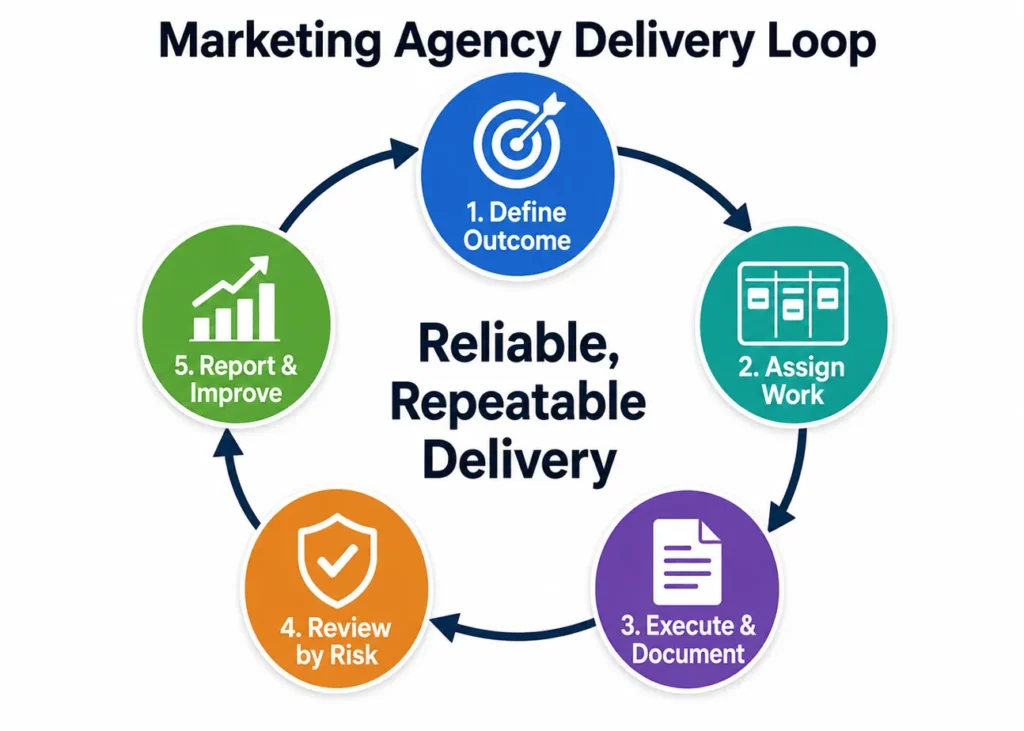
The ownership model can be turned into a simple delivery loop.
Stage 1: Define the outcome
The strategic owner records the objective, scope, success measure, deadline, and constraints.
The team should know whether the work is intended to increase qualified leads, improve conversion, reduce wasted spend, publish an approved content batch, clean reporting data, or complete another specific outcome.
Stage 2: Translate strategy into assigned work
Break the outcome into tasks and assign each task to the correct layer.
This prevents a common mistake: delegating a strategic decision as though it were an administrative task.
For example, an assistant can gather competitor landing pages and record their offers. The strategist should decide what the agency recommends after reviewing that research.
Stage 3: Execute and document
Specialists complete channel work. Operational support keeps the supporting tasks, files, trackers, and approvals moving.
Documentation should happen during execution, not several days later. Statuses, source links, exceptions, and decisions are easiest to capture while the work is fresh.
Stage 4: Review according to risk
Not every task needs the same approval level.
A routine tracker update may need a quick operations check. A live campaign change, technical implementation, client-facing recommendation, or public piece of content may require specialist or account-owner approval.
Stage 5: Report, learn, and update the process
The team records what happened, what remains open, what changed, and what should be improved next time.
This closes the loop. Without it, the agency repeats the same small confusion every month.
What Can Be Delegated Without Diluting Expertise?
The safest tasks to delegate have clear rules and observable outputs.
Good candidates often include:
structured research using an approved source list;
campaign asset collection and organization;
content or landing-page uploads after approval;
report assembly before specialist interpretation;
spreadsheet and CRM updates;
project tracker maintenance;
link, field, naming, and file checks;
recurring content scheduling;
meeting notes and action-item tracking;
competitor or prospect data collection;
documentation and SOP updates;
reminder and follow-up coordination.
Delegation becomes risky when the task description quietly contains an important decision.
“Update the report” can be delegatable.
“Explain why performance dropped and decide what to change” requires specialist judgment.
“Upload the approved article to WordPress” can be delegatable.
“Choose the SEO strategy and rewrite the technical recommendations” may not be.
This is why digital marketing virtual assistant support works best when the agency defines the boundary between execution and expertise. The assistant supports the delivery system instead of being treated as a substitute for every marketing role.
Build Quality Control Into the Handoff
Quality control should not depend on someone remembering to double-check the work.
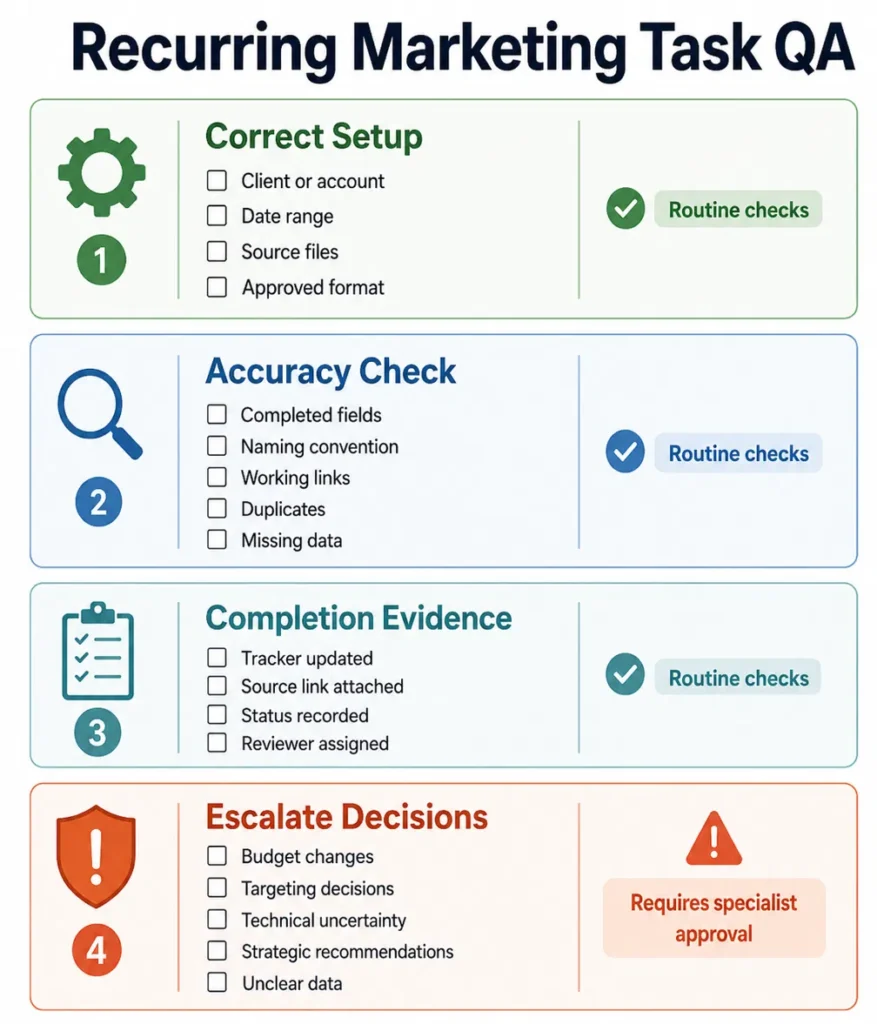
Create a short checklist for each recurring task. The checklist can include:
correct client or account selected;
correct date range used;
required source links added;
fields completed in the approved format;
naming convention followed;
links tested;
duplicate or missing data checked;
exceptions documented;
reviewer assigned;
completion evidence attached.
The checklist should reflect the actual risk of the task. A campaign launch needs more review than a meeting-note upload.
It also helps to separate correction from decision.
An assistant may correct a formatting issue, missing link, duplicate row, or naming error when the rule is clear. A budget change, targeting decision, strategic recommendation, or interpretation of uncertain data should be escalated.
Use One Source of Truth for Status and Evidence
Agency work becomes harder to manage when status lives across email, chat, documents, and memory.
A practical tracker does not need to be complicated. It should show:
client or account;
workstream;
task;
owner;
due date;
current status;
required reviewer;
source or working link;
blocker;
next action;
completion evidence.
The tracker should answer three questions quickly:
What is happening?
Who owns the next action?
What evidence shows the work is complete?
This is where project-management support from a virtual assistant can be valuable. The role is not to take ownership of every strategic decision. It is to keep the agreed workflow visible, current, and properly documented.
Where Boost VA Fits Into This Workflow
At Boost VA, I support agencies and online businesses with the recurring work that sits around strategy and specialist delivery.
Depending on the workflow, that can include research, data collection, spreadsheet updates, content operations, WordPress tasks, report preparation, project tracking, outreach preparation, QA checks, and other SOP-based execution.
The best fit is an agency that already knows what outcome it wants and can define the rules, examples, access, and approval boundaries. From there, I can help keep the work moving, document progress, and flag discrepancies instead of making unsupported decisions.
That gives strategists and channel specialists more room to focus on the work that requires their judgment.
A Better Workflow Protects the Work Only Specialists Can Do
The purpose of an agency workflow is not to add more process. It is to prevent valuable expertise from being consumed by avoidable coordination.
Separate strategic decisions from specialist implementation. Move repeatable support work into clear SOPs. Assign proportionate review. Record evidence. Improve the process after each cycle.
That structure makes delegation safer because everyone knows what they own and when to escalate.
At Boost VA, I provide retained and project-based support for agencies that need reliable help with recurring execution, research, data, content operations, WordPress updates, reporting preparation, and workflow coordination. Contact Boost VA to discuss the part of your delivery process that needs consistent support.
Independent analysis: This article is based on publicly available information reviewed on July 31, 2026. Boost VA is not affiliated with, sponsored by, employed by, or endorsed by Disruptive Advertising.