


AI for business owners is becoming less about knowing which new tool launched this week and more about knowing how to make sensible decisions when AI enters a business process.
You do not need to become a machine-learning engineer. You do need enough understanding to ask practical questions: What problem are we solving? What information goes into the system? How reliable does the output need to be? Who checks it? What happens if it is wrong? And how will we know whether it actually improved the work?
That distinction matters because simply having access to AI does not prove that a business is using it effectively. It is possible to ignore a useful capability, but it is equally possible to automate something too quickly, expose information unnecessarily, trust an inaccurate output or pay for software that does not create a measurable improvement.
If you are still trying to identify where AI already appears in ordinary tools and business activities, this guide to AI in daily life and business provides useful background. Here, the focus is different: what a business owner needs to understand before deciding whether AI belongs in a workflow.
What “learning AI” means for a business owner
For most owners, useful AI literacy is not about understanding neural-network architecture or learning to build models.
It is about understanding the business implications of using an AI system.
At a practical level, you should be able to answer questions such as:
-
What is the system actually being asked to do?
-
What information does it need?
-
What kind of mistakes can it make?
-
Can the result be checked?
-
Who remains responsible for the final decision?
-
Is the consequence of an incorrect answer minor or serious?
-
How will we judge whether using it is better than the current process?
That is a much more useful level of knowledge than trying to follow every model release.
The NIST Generative AI risk guidance provides a useful principle here. Its Generative AI Profile is a voluntary companion to the AI Risk Management Framework and is designed to help organisations consider trustworthiness when AI systems are designed, used and evaluated.
The appropriate level of understanding also depends on how consequential the use is. Asking AI to suggest several headline ideas is not the same as relying on an AI-generated answer to make a financial, employment, legal, health or safety decision.
Higher-consequence use generally deserves stronger controls, more qualified human review and more careful consideration of the data and assumptions behind the output.
There is also a regulatory dimension for some organisations. If your organisation falls within the scope of the EU AI Act as a provider or deployer of AI systems, Article 4 includes AI-literacy obligations. The European Commission’s AI-literacy guidance says those obligations have applied since 2 February 2025 and that organisations should consider people’s existing knowledge, the context in which the AI is used and the risks involved. This is context-dependent rather than a one-size-fits-all training requirement.
That does not mean every small business needs a formal AI department. It means the people responsible for using a system should understand enough to use it appropriately.
What AI can help with, and what it does not remove
AI is useful partly because it can process, transform and generate information quickly.
That makes it relevant to several categories of everyday business work. The important point is to treat these as candidate uses, not guaranteed benefits.
Drafting and synthesis
Generative AI can help produce a first version of material such as:
-
emails;
-
summaries;
-
meeting notes;
-
content outlines;
-
internal documentation;
-
research summaries;
-
product or service descriptions.
That can reduce the amount of blank-page work involved.
But a polished draft is not automatically an accurate or appropriate final document. Names, numbers, claims, tone, context and source information may still need checking.
For more concrete examples of current model-assisted work, see these GPT-5.6 business use cases. That guide looks specifically at research, reporting, content, data and other practical workflows, while this article focuses on the owner’s decision framework.
Classification, analysis and repetitive knowledge work
AI can also help organise information.
Depending on the tool and the data available, that may include:
-
grouping customer feedback;
-
categorising records;
-
summarising long documents;
-
extracting fields from text;
-
identifying obvious patterns;
-
comparing several pieces of information;
-
preparing information for a report.
These tasks can be useful candidates because the result can often be compared with source material.
That last point matters. Speed is useful only when the resulting work is sufficiently reliable for its purpose.
Decisions still need accountable owners
AI can help surface information, alternatives or patterns. That is not the same as transferring accountability for the decision.
An owner may use an AI system to summarise customer complaints, for example. The system could identify recurring themes, but deciding whether to change a product, refund a customer or change company policy remains a business decision.
The same principle becomes more important as consequences increase.
AI can contribute information to a decision. It should not become an excuse for nobody being clearly responsible for that decision.
Five questions to ask before putting AI into a workflow
Before choosing a tool, start with the workflow.
1. What business problem are we actually trying to solve?
“Use more AI” is not a business problem.
A clearer problem might be:
-
weekly reports take too long to prepare;
-
customer enquiries need to be categorised before review;
-
long meeting notes need to become concise action items;
-
large documents need an initial summary before a person reads them;
-
first drafts consume too much preparation time.
If you cannot describe the problem clearly, it will be difficult to decide whether AI has improved it.
2. What information will the AI receive?
Consider the inputs before thinking about the output.
Does the task involve:
-
public information;
-
internal documents;
-
customer information;
-
financial information;
-
employee information;
-
confidential business material;
-
credentials or access information?
Do not assume that information is appropriate to place into a particular AI product simply because the tool accepts it.
Check the product’s terms, data-handling controls and your own business obligations before using sensitive material.
3. What happens if the output is wrong?
An incorrect social-media idea can be discarded quickly.
An incorrect figure in a financial report, wrong information sent to a customer or an unreliable conclusion used in an important decision may have much greater consequences.
Ask what the failure would cost in:
-
time;
-
rework;
-
money;
-
customer trust;
-
operational disruption;
-
legal or regulatory exposure.
The larger the consequence, the less sensible it is to rely on an unchecked result.
4. Who reviews the result and who owns the final decision?
Every meaningful AI-assisted workflow should have clear ownership.
The reviewer might be an assistant, content editor, manager, subject specialist or business owner depending on the task.
What matters is that “the AI did it” does not become the end of the quality-control process.
Define:
-
who checks the output;
-
what they check;
-
what requires escalation;
-
what they may approve independently;
-
what still requires the owner’s decision.
5. How will we know whether it worked?
A successful AI experiment needs a comparison point.
Before using the tool, record how the work operates now.
Then measure what changes.
If you cannot define a meaningful result, you may end up measuring activity rather than improvement.
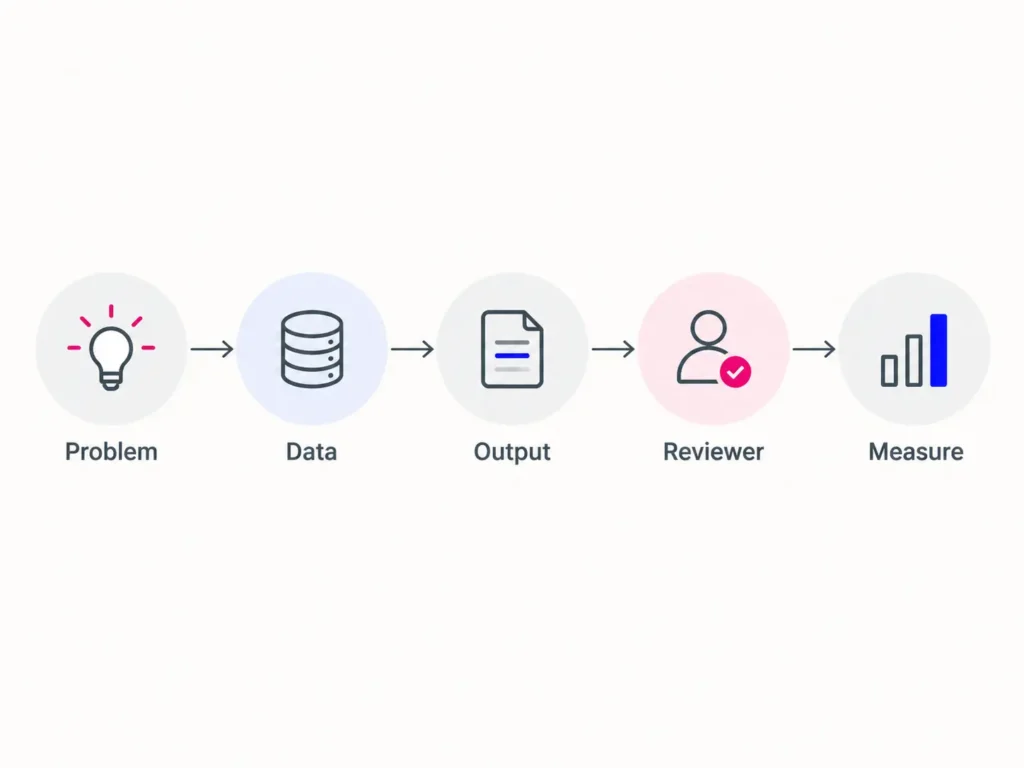
The AI Literacy Decision Card
Use this whenever you are considering a new AI-assisted task.
| Question | Record this before adopting the use case |
|---|---|
| Business problem | What specific problem are we trying to improve? |
| Input and data | What information will the system receive? |
| Output | What exactly should it produce? |
| Consequence if wrong | What happens if the result is inaccurate or inappropriate? |
| Human reviewer | Who checks the result before it is used? |
| Current baseline | How long, costly or difficult is the process now? |
| Success measure | What improvement would make the change worthwhile? |
| Process owner | Who is responsible for the workflow? |
| Stop or escalation condition | What result would make us pause, change or abandon the use case? |
The card is intentionally tool-neutral. A new model may change what is technically possible, but these business questions remain useful.
Why adoption numbers are less useful than your own result
AI statistics can sound impressive until you look at what each survey actually measured.
The U.S. Census Bureau’s 2026 business AI data found that overall AI usage among U.S. businesses hovered between roughly 17% and 20% during its December 2025 to May 2026 Business Trends and Outlook Survey period. The Census also notes that usage varied substantially by company size and sector.
A different picture appears in McKinsey’s 2026 State of AI survey because it surveys a different population and asks different questions.
McKinsey reported that 80% of respondents said AI improved their individual productivity. Yet only 37% said AI contributed positively to their organisation’s EBIT, and only about 6% met McKinsey’s definition of an AI high performer.
Those numbers should not be treated as contradictory measurements of the same population.
They demonstrate something more useful: an adoption percentage does not tell you whether a particular AI use case is right for your business.
Even within McKinsey’s respondent population, individual productivity improvements did not automatically translate into broad financial impact. Its high-performing group was also much more likely to redesign workflows and formally measure results.
So “everyone else is doing it” is a weak reason to automate something.
A better question is: Does this use case improve a real result in our business after we include review, correction, cost and management effort?
What to measure in a first experiment
B1 is not meant to turn every business owner into an AI implementation manager, but understanding measurement is part of AI literacy.
Before changing a workflow, capture a simple baseline.
Depending on the task, useful measures might include:
Time: How long does the work currently take?
Quality: What percentage requires correction or rework?
Cost: What is the current cost, and what does the AI-assisted process cost after software and review time are included?
Throughput: Can the same person complete more useful work without sacrificing quality?
Review effort: Did AI reduce preparation work but create additional checking?
Downstream result: Did the faster output actually improve something meaningful, such as response time, report preparation or task completion?
Do not decide that a system works simply because it produced an impressive demonstration.
Measure the complete workflow.
If you are ready to go beyond these literacy questions and test AI on one specific business task, the guide to using AI wisely in a defined business workflow provides the next step. Its current guidance includes starting with a specific task, retaining human involvement and monitoring the result.
Where human operational support still matters
AI can reduce parts of knowledge work, but businesses still need somebody to provide good inputs, check source material, handle exceptions, organise outputs, maintain records and move approved work through the actual business process.
That distinction is important.
An AI-generated research summary does not update the CRM.
A content draft does not automatically become a correctly formatted WordPress post.
A spreadsheet analysis does not resolve missing data.
A suggested customer response does not decide which unusual case needs escalation.
At Boost VA, I support founders and agencies with defined work across areas such as research, data management, content operations, WordPress and recurring administrative execution. The current Boost VA virtual assistant support options cover both ongoing workloads and clearly scoped projects.
That can include working inside an AI-assisted process when the task, boundaries and review requirements are clear. It does not mean handing strategic ownership or specialist decisions to an assistant or an AI system.
If a recurring research, data, content, WordPress or administrative workflow is consuming time and you want reliable execution around it, you can start by defining the work that needs to move. Then decide which parts belong with software, which need human ownership and which decisions should remain with you.
AI literacy for a business owner is ultimately not about memorising every model or mastering every new feature.
It is about asking better questions.
Know the problem. Understand the input. Consider what can go wrong. Assign a reviewer. Keep accountability clear. Measure the result.
That is enough to move from AI hype to informed business use.