
You block out a day to plan 2027. By the end of the first hour, you’re still trying to establish what happened in Q3, which client renewals are already committed, and whether the pipeline total came from the latest CRM export. The planning conversation has barely started.
Annual planning preparation should settle those factual questions before you sit down. One short, source-linked pre-read can bring together seven things: results against last year’s goals, the financial starting point, existing commitments, customer and pipeline movement, external changes, actual capacity, and decisions still open. Each figure or claim needs a source, a reporting date, and a clear note when something is missing or provisional. The pack contains no recommendations.
In my Q4 planning checklist, I mentioned having an organized planning pack ready for interpretation. This is what that pack should contain. It is particularly useful when you plan alone or with a small team and do not have department leads preparing separate annual reports.
What the evidence pack is, and what it isn’t
The evidence pack is a briefing document you can read before your strategy day. It summarizes relevant facts and points back to their sources; it does not set the strategy, write new goals, or replace your bookkeeping records. For 2027 planning held before the end of 2026, clearly label year-to-date figures instead of presenting them as final annual results.
In guidance on preparing for an annual planning session, EOS Worldwide implementer Debra Chantry-Taylor warns against simply arriving with a stack of reports. Her guidance is written for leadership teams. When you are the only owner in the room, you still need someone to assemble the facts before you review them.
The table below is a copy-ready outline you can send to a virtual assistant, operations colleague, or the person maintaining your records. Add your planning date, reporting cutoff, and approved sources before they begin.
| Pack chapter | Question it answers | Typical source | Leave out |
|---|---|---|---|
| Results vs. goals | What did we achieve against the previous plan? | Original goals, scorecards, dated reports | Unverified explanations for missed targets |
| Financial starting point | What came in, what is owed, and what is already committed? | Approved summaries, receivables and renewal records | Tax judgments or a proposed budget |
| Existing commitments | What work and obligations carry into next year? | Contracts, project calendar, delivery schedule | New promises or renegotiation proposals |
| Customers and pipeline | Who joined, left, renewed, or remains in the pipeline? | CRM and customer records | Invented win probabilities or deal recommendations |
| External changes | What changed among competitors, customers, suppliers or rules? | Dated public sources and verified notices | Suggested strategic responses |
| Capacity | Where did available hours go, and what remains constrained? | Time records, workloads and recurring-work logs | Hiring or automation proposals |
| Open questions | Which decisions genuinely need the owner on strategy day? | Pending issues linked to supporting evidence | Recommended answers |
The recurring rule is simple: record the fact, its source, its date, and any unresolved gap. Keep the underlying files linked rather than pasting every export into the pre-read.
Chapter 1: Last year’s goals against what actually happened
Start with the goals you actually agreed for 2026, not a reconstructed list of what now seems important. Beside each one, show the measure, original target, result to the reporting cutoff, and source date. If a measure changed during the year, preserve that note instead of silently comparing two different definitions.
For example, a line for client retention might show the original target, the current count of retained clients, the CRM report used, and the date it was exported. Where no dependable figure exists, write “not verified.” That gap is more useful than a confident-looking estimate.
The VA’s job is to assemble consistent figures, not to decide whether performance was good. My guide to making client reporting numbers reproducible explains why two reporting surfaces can disagree and how to document which source belongs to which metric. The strategy pack only needs the settled figure and a traceable source line.
Leave out: explanations of why targets were missed, new targets, or a grading method the owner has not approved.
Chapter 2: Money in, money owed, and money already committed
Give the owner a financial starting point that can be understood without opening accounting software during the meeting. Separate amounts earned or received, receivables still outstanding, and recurring payments or other financial commitments already agreed. Label the accounting basis, reporting period, and currency rather than mixing incompatible totals.
For a small agency, this could mean a monthly revenue summary, aged client invoices, recurring software or contractor costs, and renewal dates. Where a bookkeeper or accountant maintains the figures, use their approved summaries. Where the current year is not closed, say which numbers remain provisional and who is responsible for confirming them.
You may already have a budget or forecast prepared, or you may plan the budget after setting priorities. The pack should record its status and version, not prescribe that sequence. It also does not perform a year-end reconciliation or substitute for a qualified accountant’s work.
Leave out: tax treatment, transaction reclassification, fresh budget proposals, and sensitive account details that are unnecessary to the planning question. This article provides general organizational guidance, not financial, tax, or legal advice.
Chapter 3: Commitments you’re already carrying into 2027
The next page should reveal which parts of your calendar are spoken for before you choose new priorities. Include contracted deliverables, promised client work, renewals that require attention, known project deadlines, and significant supplier obligations. Give each item a due date, current owner, evidence link, and an indication of whether a dependency is outstanding.
For client work, distinguish a signed commitment from a tentative request. If an agency needs approved copy or account access before delivery can continue, carry the missing input into the summary rather than treating the project as fully ready. The client dependency tracker covers how to document those missing inputs in detail; the evidence pack only imports the consequential ones.
Leave out: proposed delivery dates, assumptions that a client will renew, or commitments nobody has authorized.
Chapter 4: Pipeline and customer movement
Next, show the movement behind the customer totals. How many customers were gained or lost during the period? Which clients renewed? Which enquiries are still open, and how old are the latest updates? For an agency or service business, a stage-by-stage pipeline snapshot is generally more useful here than an optimistic top-line forecast.
Use a defined CRM export date and note records with missing stages, unclear owners, or stale close dates. If the team uses agreed forecasting rules, the existing forecast can be linked and labelled. The compiler should not change a deal’s probability to make the pipeline look more plausible.
The guide on CRM field ownership explains why stage, value, and close-date edits need controlled responsibility. In this chapter, the VA reports what the approved records say and flags any data-quality limits.
Leave out: new sales forecasts, speculative deal wins, and recommendations about which customers to pursue.
Chapter 5: What changed outside the business
Your numbers describe the business from within. This chapter records dated external changes that may affect the assumptions you bring into planning: a comparable competitor changing a public package, a supplier revising terms, a customer requirement changing, or a confirmed rule that applies to your work.
SCORE mentor Hal Shelton identifies competitor moves, major customer changes, supplier terms, and regulatory changes as reasons to revisit a business plan. Those are prompts for what to look for, not proof that every business faces the same changes.
Keep the scan narrow and evidence-led. For each finding, include what changed, the original source, when the source was checked, and what remains unknown. My guide to writing a competitor research brief covers comparable evidence and collection boundaries. The annual pack should carry forward a concise summary, not the entire research project.
Leave out: competitor rankings based on incomplete information, predictions dressed up as facts, and suggestions about how to respond.
Chapter 6: Capacity and where the hours actually went
Planning another year without understanding existing workload can turn a reasonable target into an impossible delivery promise. This page should summarize actual hours or workloads by major workstream, recurring obligations, bottlenecks, and work that repeatedly needed corrections or follow-ups.
Use time records where they exist. If the business never tracked hours consistently, label the numbers as estimates drawn from schedules, task records, or interviews rather than reporting them as measured totals. Distinguish available capacity from hours already committed to client delivery and maintenance.
The process-debt audit shows how to identify recurring fixes and duplicated work; the guide to estimating virtual assistant hours covers workload-based support estimates. Here, include the relevant summaries and their limits, not another audit or staffing plan.
Leave out: unapproved hiring plans, automation recommendations, or claims that a recorded bottleneck has an obvious solution.
Chapter 7: Decisions still open, written as questions
Finish with the issues you want available for discussion on the day. Each entry should be a neutral question, a short explanation of why it matters, the evidence already in the pack, and any missing information that could change the answer.
For instance: “Do our current delivery commitments leave enough room for an additional service line?” belongs here if the capacity and customer chapters provide the facts needed to discuss it. The pre-read does not answer that question. It makes sure the relevant evidence is easy to find.
My founder decision queue is designed for ongoing operational decisions and can include a VA recommendation. This chapter is different: it brings unresolved strategic questions into one planning session without suggesting the decision.
Leave out: recommendations, draft 2027 priorities, or a decision presented as settled when the owner has not made it.
What stays out of the pack
Treat the pre-read as evidence, not a hidden draft strategy. Recommendations, proposed goals, personnel assessments, sensitive payroll detail, raw system exports, and unreviewed accounting judgments should stay outside it. If one of those items matters to the conversation, the owner or an authorized specialist can bring it separately under the appropriate permissions.
The same goes for unclear data. Do not bury a discrepancy inside a polished chart. Mark it as provisional, explain what differs, name who can resolve it, and keep the source links intact. An honest gap gives the owner something concrete to check before relying on the number.
Who sees what: access for the person compiling it
The easiest route is often the least intrusive. The VA does not need full financial-system access to prepare a planning summary, especially when the owner or bookkeeper can supply the relevant figures. Match the method to the sensitivity of the source:
- Owner-supplied summaries: Start with approved revenue, receivables, and cost summaries. The compiler only organizes what has already been cleared for sharing.
- Limited exports: If summaries are insufficient, provide dated extracts with unnecessary personal, banking, or payroll information removed.
- Reports-level access: Where necessary and supported by the software, consider a named role with appropriate viewing permissions after inspecting exactly what that role exposes.
- No elevated access for this task: Administrator control, bank payment capability, payroll administration, and shared master credentials are not required merely to compile a pre-read.
The NIST principle of least privilege means granting only the access needed for the assigned work. That is important even for read-only access: a report viewer may still see information the compiler does not need.
For example, Intuit’s QuickBooks Online user-role documentation describes a reports-only user who can see most reports, excluding those containing payroll or contact details, but cannot view underlying transactions or the audit log. Subscription availability and the actual permission scope must be checked before access is granted. For a broader discussion, see how to give a VA access to QuickBooks or Xero and share access without exchanging passwords.
A reverse calendar to your strategy day
The timetable below is a suggested planning window, not a mandatory deadline system. Shift it to fit the size of the business, how quickly records can be prepared, and whether your fiscal year ends in December. Ninety, an EOS software provider, advises updating measurable results at least a week before annual planning; the earlier milestones here are practical allowances for collecting and checking data.
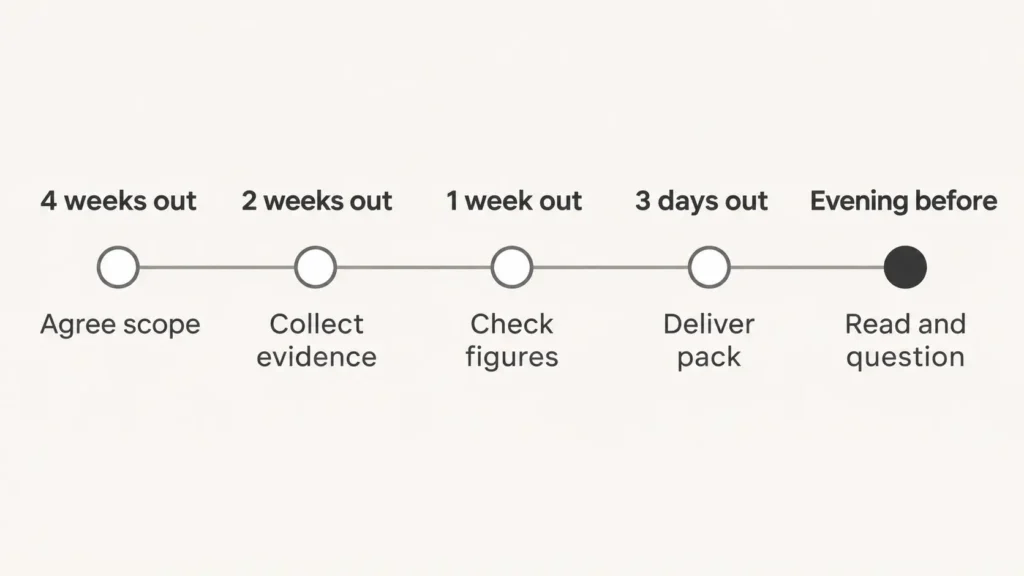
- Four weeks out: Set the planning date, reporting cutoff, seven chapter owners, permitted sources, and the document’s delivery date.
- Two weeks out: Gather contract commitments, customer movement, dated external changes, and capacity evidence. Request missing source records early.
- One week out: Bring goals and financial figures into a consistent reporting period. Obtain approved summaries or label figures that are not final.
- Three days out: Deliver the complete pre-read, with source links and unresolved gaps visible. Do not wait for every nonessential number to become perfect.
- The evening before: Read it, highlight anything that does not make sense, and write your own questions for the session.
If you plan 2027 before December 2026 is complete, the reporting cutoff matters more than the calendar label. For a business with another fiscal year-end, use the same sequence relative to its own planning day.
On the day, and the day after
Open the session with the pack already read. If you are meeting with two or three colleagues, reserve a short shared reading period for anyone who could not review it in advance. Clarify remaining factual discrepancies before treating the figures as the starting point for decisions.
Your work on the day is to judge trade-offs, choose priorities, and authorize changes. The pack’s job ends when its evidence has helped you ask better questions. Afterward, turn the decisions into named tasks, owners, and due dates. The separate guide to turning meeting notes into action items covers that next stage.
At Boost VA, I can help compile a strategy-day evidence pack as a defined project, using agreed sources and access limits while leaving business decisions with you. If you have a planning date in mind, get in touch with the date, the records you already have, and the chapters that need preparing.