
“Upload the blog post.” Your virtual assistant returns with “done.” The copy is in WordPress, but the article went live instead of staying in draft, the featured image is missing, and there is no preview link for the editor.
The problem is not necessarily poor execution. The instruction described an action without defining the finish line.
Acceptance criteria for delegated tasks are agreed conditions that someone else can check against the completed result. Write them before work begins so both you and your VA know what must be true, what evidence will show it, and what happens if part of the task cannot be completed.
This guide focuses on that finish line. For the broader handoff, see how to give clear instructions to a virtual assistant. For checking the result after it comes back, use the separate guide to reviewing finished VA work.
What “done” should mean for a delegated task
“Done” should mean that a short, agreed set of observable completion conditions has been met. Someone other than the person who performed the work should be able to inspect the deliverable and its evidence and reach the same basic conclusion.
That is more useful than deciding whether the result simply looks finished.
Atlassian defines acceptance criteria as conditions work must satisfy to be considered complete. Its guidance emphasizes clear, testable, outcome-focused requirements rather than vague instructions.
For ordinary virtual assistant work, the conditions might concern the required deliverable, the records included, the destination, supporting evidence, or what should happen when information is unavailable.
Consider the difference:
- Activity: Update the CRM.
- Completion condition: All records assigned for this batch have the required contact fields updated in the agreed CRM, with unresolved entries identified in the change log.
The second statement gives the person doing the work something to check before returning it.
It also gives the reviewer a basis for deciding whether the assignment is complete.
Done is not the same as excellent. Acceptance criteria establish the agreed minimum for a handoff, not a guarantee that the work exceeds expectations or needs no human judgment. Where the business owner must approve a final publication, payment, or sensitive change, that approval remains a separate decision.
Three layers of “done” that often get mixed up
The phrase “definition of done” comes from established project-management and software-development practices, but it is sometimes used to describe different things.
For delegated business tasks, separating three layers makes the language more useful.
| Layer | What it answers | Illustrative example |
|---|---|---|
| Standing done standard | What must be true for this type of work every time? | Research claims include source references, and missing information is identified rather than guessed. |
| Task-specific acceptance criteria | What must be true for this particular assignment? | This research summary covers the three requested questions and is saved in the specified folder. |
| Review checklist | What will the reviewer inspect after the work is returned? | Confirm that the summary covers all three questions and that each factual claim has supporting evidence. |
These layers serve different purposes. The first establishes a repeatable baseline, the second defines the particular finish line, and the third helps someone inspect the work against what was already agreed.
Your standing done standard
Standing standards apply across repeated assignments.
For example, research tasks may require source references, spreadsheet updates may need consistent date formats, and customer-facing content may need an approved review before publication.
The 2020 Scrum Guide, written by Ken Schwaber and Jeff Sutherland, uses the Definition of Done as a shared quality standard for a completed product increment. That is a software and product-development concept, not a rule every virtual assistant assignment must follow.
Borrowing the distinction, a small business can maintain its own standing rules for recurring work.
These standards belong in the relevant instructions or documented process. When a requirement applies repeatedly, it may be worth incorporating it into an existing procedure rather than rewriting it for every assignment. My guide to writing SOPs for virtual assistant tasks covers that documentation.
Acceptance criteria for this task
Task-specific criteria describe the conditions unique to the current assignment.
For instance, a standing research standard may require source URLs. This week’s research assignment might additionally require a comparison of three suppliers, a specific delivery format, and a clearly stated cutoff date for the information.
Those additional requirements belong to the task, not necessarily to every future research assignment.
Atlassian’s Definition of Done guidance makes a similar distinction between a broader done standard and acceptance criteria for particular work items.
Terminology is not always consistent across sources. What matters here is using the distinction consistently so people know which rules apply.
The review checklist comes after
The review checklist is the inspection tool.
It should test whether the work meets the existing standards and task-specific criteria, rather than introduce new expectations after the deliverable arrives.
If you ask for a summary containing three specified sections, the reviewer checks those sections. The reviewer should not suddenly reject the result because it lacks a fourth section that was never requested.
That does not prevent you from requesting an improvement. It means distinguishing a missed requirement from a new or changed requirement.
The separate guide on how to review virtual assistant work explains how to check finished deliverables and decide which tasks need closer inspection.
A simple pattern for writing acceptance criteria
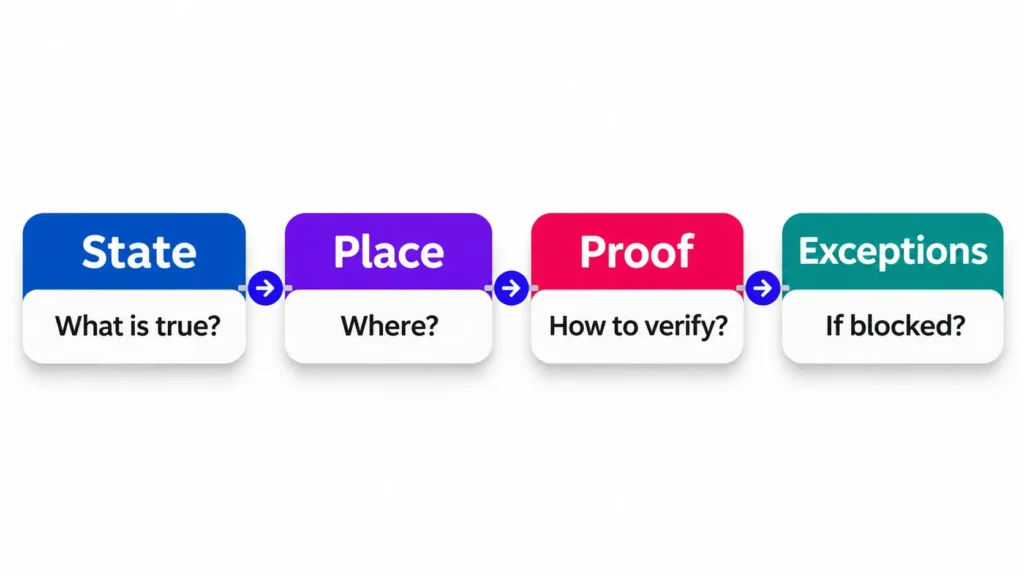
Use four questions to turn a vague instruction into a checkable completion condition:
- State: What must exist or be true when the work is finished?
- Place: Where must the result be saved, recorded, or made available?
- Proof: What can another person inspect to confirm completion?
- Exceptions: What should happen if the condition cannot be met?
Together, these form a practical State–Place–Proof–Exceptions pattern.
This is a simple writing technique for delegated work, not a formal industry standard. It draws on the principles of outcome-focused and verifiable acceptance criteria.
Here is a reusable sentence:
Done when [observable result] is [saved or completed in the agreed place], confirmed by [specific evidence]. If [defined exception occurs], [report it or stop at the agreed boundary].
For example, consider an instruction to update a group of website links:
“Done when the agreed page links point to the approved destinations, the updated page is saved in Draft, and a preview URL is provided for checking. If a destination cannot be confirmed, leave that link unchanged and flag it.”
The result, location, evidence, and exception are all visible.
Not every assignment needs all four parts written out. Sometimes the location is already obvious from the task card, or the standing procedure already explains exception handling.
For a small assignment, one clear sentence may be enough. For unfamiliar or higher-risk work, two to five separate conditions may be easier to verify than one overloaded statement.
Keep each criterion focused on the result. Detailed instructions for performing every action belong in the task brief or SOP, not inside the acceptance criteria.
The second-person test: Can someone else check it?
The simplest way to test an acceptance criterion is to imagine handing the completed work to someone who did not write the instructions or perform the task.
Could that person inspect the result and mark the condition as met or not met without asking what you secretly intended?
If the answer is no, the criterion probably needs another detail.
This is the second-person test. It is a practical way to apply the idea of objective verification.
The Agile Alliance’s explanation of acceptance testing describes tests that generally have pass-or-fail results. Although that discussion concerns software, the verification principle is useful when defining ordinary business deliverables.
Suppose your instruction says:
“Make sure the spreadsheet is clean.”
Someone else cannot reliably tell what “clean” means here. It could refer to missing values, duplicates, formatting, incorrect dates, or unwanted records.
Instead, identify the conditions that matter.
Words that usually hide an unwritten standard
These illustrative replacements make vague instructions easier to check:
- “Clean” becomes “No blank values remain in the required fields for records 20–80; unresolved entries are listed separately.”
- “Professional” becomes “The email uses the approved greeting and signature, contains the agreed information, and has no placeholder text.”
- “Properly updated” becomes “The approved changes appear in the saved draft, with the affected URLs recorded in the change log.”
- “As usual” becomes “Follow the current linked SOP and use its stated completion requirements.”
- “ASAP” becomes a specific deadline with a date, time, and time zone.
The last example concerns timing rather than the deliverable itself, but it illustrates the same problem: two people can interpret an unstated expectation differently.
Some work also involves judgment that cannot be reduced to a pass-or-fail test. Brand tone, creative quality, and whether a recommendation is persuasive may still need an owner’s review.
In those cases, make the deliverable’s form and evidence checkable, while keeping the subjective approval where it belongs.
Four rewrites: From “do this” to “done when”
The following examples are illustrative, not descriptions of client projects or measured outcomes. Each demonstrates how a short instruction can become a clearer handoff without turning into a lengthy procedure.
1. Blog post upload
Before: “Upload the article to WordPress.”
Done when: “The supplied article is saved as a draft in the agreed WordPress site, and the editor has a working preview link plus a screenshot showing the saved draft status. If any required image is missing, leave the article in Draft and report the missing asset. Do not publish without approval.”
Here, the completion evidence is especially important. The VA does not need to guess whether saving a draft also means making the article public.
The broader blog publishing workflow addresses the surrounding production stages, while these conditions apply to this particular handoff.
2. Inbox triage
Before: “Sort the inbox before lunch.”
Done when: “Every message received before the agreed cutoff is assigned one of the approved labels. Messages meeting the escalation rules are also placed in the designated review folder, and the handoff summary reports the number processed and any unresolved messages.”
The cutoff, label set, folder, and count summary make the result inspectable.
The task still needs an agreed rule for unusual messages. Without one, a VA may classify an unfamiliar request differently from the business owner.
3. Research summary
Before: “Research the suppliers and send me your findings.”
Done when: “The research summary is saved in the assigned document, answers the three questions in the brief, and provides a source URL for each factual finding. Information that could not be confirmed is marked ‘Not found’ rather than estimated.”
This does not guarantee that the available information will support a business decision. It establishes what constitutes a complete research return.
For larger comparison assignments, the guide to writing a competitor research brief explains how to connect research questions to the decision the owner needs to make.
4. CRM cleanup batch
Before: “Clean up the duplicate contacts.”
Done when: “The agreed record range has been reviewed, duplicates meeting the approved matching rules have been merged, protected fields remain unchanged, and the change log identifies completed merges and unresolved matches. Any uncertain match is left untouched for approval.”
The critical condition is not that every suspected duplicate disappears.
It is that the assigned range has been handled under the agreed rules, with uncertain records preserved rather than merged by guesswork.
The separate guides to CRM cleanup rules and CRM field ownership cover those task-specific safeguards in more detail.
When lighter or no new acceptance criteria make sense
Not every task needs a fresh list of completion conditions.
Routine, low-risk work may already have a sufficient standing standard or SOP. Repeating those rules in every task card can create more text without adding clarity.
For example, if a recurring file update has a stable procedure and an established deliverable format, a clear reference to the current SOP may be enough.
Exploratory work needs a different approach. When the outcome is uncertain, define what the person should return rather than demanding a discovery that may not exist.
Instead of “Find the best solution,” you might request “Return three feasible options, the reason for each recommendation, and the important information still missing.”
Creative tasks can work similarly. You can specify three draft concepts, an approved format, the required source materials, and a short rationale while retaining final judgment about which concept is strongest.
Meeting the acceptance criteria does not automatically mean the work is outstanding or finally approved. It means the agreed completion conditions have been met, subject to any required review or authorization.
If you want additional work that was not part of the original conditions, describe it as a new requirement or revision. Do not treat every new preference as evidence that the original task was incomplete.
Be equally careful about over-specifying the task.
If the criteria need several pages of instructions or depend on multiple separate deliverables, consider splitting the assignment into smaller pieces. Acceptance criteria should make the finish line easier to see, not conceal it inside another complicated document.
Agree on “done” before the work starts
Write the completion conditions while the task is still being assigned, not after the VA submits the result.
For a new or unfamiliar task, ask the person doing the work to confirm that the conditions are understandable and that the required proof can actually be provided.
If a source is inaccessible, an approval is missing, or a requirement cannot be verified, settle the exception before the work proceeds beyond the agreed boundary.
When the same completion rule appears repeatedly, move it into the relevant standing instructions or SOP. Keep the task card focused on what is different this time.
The next time you delegate something, start with a simple sentence:
“Done when…”
Then check whether you have described an observable result, identified where it belongs, explained how someone can verify it, and covered any important exception.
If you cannot explain how you will check the result, narrow the assignment until you can.
Clear completion conditions give your VA a better basis for returning the work and give you a fairer basis for reviewing it. If recurring WordPress, research, data, or administrative tasks need that kind of structured execution, you can contact me to discuss the work and its requirements.