


A founder can stop doing a task and still remain responsible for it.
That is one reason delegation does not automatically create focus.
You might hand routine execution to someone else but still receive every question, approve every exception, chase every status update and step back into the work whenever something is unclear. The task moved, but the ownership loop did not.
Founder focus through delegation improves only when suitable work can move far enough away from you that routine execution no longer depends on your constant attention.
The goal is not to remove yourself from every detail. It is to decide which recurring loops genuinely require your judgment and which can run with clearer ownership, review points and escalation rules.
Founder focus is an ownership problem, not only a time problem
A founder’s calendar can look relatively open while the day still feels fragmented.
The problem may be the number of unfinished decisions and transitions you remain responsible for.
A customer question appears.
Someone needs approval.
A spreadsheet needs checking.
A contractor asks what to do next.
A recurring report is late.
A WordPress update needs review.
You deal with one issue, return to the work you planned to do, and then another small responsibility pulls you away again.
Research on attention residue helps explain why those transitions matter. Sophie Leroy’s experiments found that shifting away from an unfinished task can leave some attention on the previous task, making it harder to fully transition into the next one.
That does not prove hiring a virtual assistant will make a founder more productive. It does show why repeatedly moving between unfinished responsibilities can make sustained attention difficult.
Modern digital work can add even more interruption.
A 2025 Microsoft WorkLab analysis of work fragmentation reported that, among the top 20% of users by ping volume in its Microsoft 365 telemetry, meetings, emails and chats produced a ping at an average interval of about two minutes during an eight-hour workday.
That figure is not an average for every worker. It describes Microsoft’s highest-ping group. But it illustrates how quickly a working day can become dominated by incoming coordination.
For a founder, the useful question is therefore not only:
How many hours am I working?
It is also:
How many times does the business require me to stop, decide, clarify, approve or restart something?
Identify execution loops that keep pulling you back in
A task becomes especially disruptive when it is not a single action but a recurring loop.
Consider a weekly content-publishing process.
You may think the task is:
Publish the article.
But your actual loop might be:
-
check whether the article is ready;
-
locate the final file;
-
find the image;
-
upload everything;
-
fix formatting;
-
add metadata;
-
check links;
-
publish;
-
send the URL to someone;
-
respond to questions if anything is missing.
The visible task takes only part of the time. The founder also owns the reminders, coordination, checking and exception handling around it.
Similar loops can appear in:
-
inbox triage;
-
scheduling;
-
CRM maintenance;
-
research;
-
vendor follow-up;
-
WordPress publishing;
-
content scheduling;
-
outreach preparation;
-
spreadsheet updates;
-
routine reporting;
-
account administration;
-
recurring project coordination.
A useful way to find them is to look for work that repeatedly comes back to you.
Ask:
-
What keeps reopening after I thought it was finished?
-
Which routine questions require my answer every week?
-
What am I repeatedly reminding people to do?
-
Which updates do I chase?
-
What work waits simply because I have not reviewed it?
-
Which processes stop when I am unavailable?
-
Which notifications make me abandon planned work?
If recurring admin and coordination are displacing responsibilities that genuinely need you, the guide to signs you may need virtual assistant support can help diagnose the underlying capacity problem.
Once you have identified the work, the delegation matrix can help decide whether it should be kept, delegated, automated or handled by a specialist.
B4’s focus is the next question:
How do you move suitable work without keeping yourself inside every loop?
Decide what can leave the founder and what cannot
Protecting focus does not mean delegating every interruption.
Some interruptions exist because the founder genuinely needs to make the decision.
Examples may include:
-
major strategic choices;
-
final pricing or commercial commitments;
-
high-risk financial approvals;
-
legal or compliance decisions;
-
significant hiring or firing decisions;
-
sensitive client decisions;
-
specialist judgments that require expertise the VA does not have.
Those responsibilities may still need supporting work.
A VA can gather information, prepare a comparison, organize documents or execute an approved step without becoming the final decision-maker.
For example:
Keep with founder: decide whether to enter a new market.
Possible delegated support: research competitors, collect pricing information and organize market data.
Keep with founder: authorize a major payment.
Possible delegated support: prepare approved invoices and flag missing information.
Keep with founder: decide a sensitive client response.
Possible delegated support: organize the conversation history and prepare the relevant information.
This distinction is covered in more detail in the guide to tasks that should not be delegated to a virtual assistant alone.
The goal is not to eliminate founder involvement where it is necessary.
The goal is to stop requiring founder involvement where it is not.
Design delegation that reduces interruptions
Poor delegation can create a second source of distraction.
Instead of doing the task yourself, you spend the day answering questions about the task.
That usually happens when ownership is incomplete.
A useful handoff should make at least five things clear:
-
What result is expected?
-
Where does the required information come from?
-
What can the VA decide without asking?
-
What requires approval or escalation?
-
When will you review the work?
A task-management system can help because it keeps the assignment, status, deadline and review stage in one place rather than distributing them across unrelated messages.
The practical guide to delegating tasks with Trello or Notion shows how delegated work can move through a simple backlog, ready, in-progress, review and done workflow.
The software is less important than the principle.
A founder should not need to reconstruct the status of a delegated responsibility from several messages.
Batch reviews rather than constant approvals
If a delegated workflow sends an approval request every twenty minutes, you may have moved execution but not protected attention.
Where the risk level allows it, group routine review work into defined checkpoints.
For example:
Instead of reviewing individual research entries throughout the day, review the completed research sheet at 4 PM.
Instead of approving every routine content upload separately, review the week’s prepared drafts together.
Instead of asking for a live update whenever you remember the project, use a scheduled status update.
This does not mean delaying genuinely urgent decisions.
It means separating routine review from exceptions.
A useful review schedule might be:
-
immediate for genuine blockers;
-
one scheduled daily review for active work;
-
one weekly review for recurring low-risk operations;
-
milestone-based review for projects.
The right cadence depends on the responsibility and risk.
The important part is that routine execution should not produce random founder interruptions simply because no review rhythm exists.
Define escalation thresholds
“Ask me if you are unsure” sounds responsible, but it can create constant interruptions because almost every new situation contains some uncertainty.
A better escalation rule describes the situations that should come back to you.
For example:
Continue with the documented process unless a source is missing, two records conflict, the requested action would change an approved budget, or the customer asks for an exception.
Now the VA knows the difference between normal execution and a genuine escalation.
Other useful escalation triggers might include:
-
missing information that cannot be verified;
-
a request outside agreed scope;
-
a payment or commitment above an approved threshold;
-
a customer complaint requiring judgment;
-
conflicting instructions;
-
an access problem;
-
a result that falls outside defined quality standards;
-
a deadline at risk.
The clearer these thresholds become, the less often routine uncertainty needs to return to the founder.
If you are bringing someone new into the business, a structured virtual assistant onboarding process can help establish responsibilities, access and early review before the workload expands.
Give access without giving unnecessary authority
Removing yourself from routine execution often means giving someone else access to tools.
That access should match the responsibility.
The NIST principle of least privilege provides a useful security standard: a person or process should have only the minimum access necessary to perform the assigned function.
For founder delegation, this can mean:
-
create a separate account instead of sharing your own login;
-
share the required folder instead of the complete drive;
-
give appropriate WordPress publishing permissions instead of server-level access;
-
provide CRM access relevant to the records being managed;
-
separate information preparation from final financial authorization;
-
review access when responsibilities change;
-
remove access that is no longer needed.
There is an operational benefit as well as a security benefit.
Clear permissions define the boundary of the role.
If someone can prepare the payment information but cannot authorize the payment, there is less ambiguity about when the founder needs to become involved.
If someone can publish approved WordPress content but cannot change hosting or billing settings, normal publishing can proceed without exposing unrelated systems.
Good delegation reduces unnecessary founder involvement without creating unnecessary authority.
Measure whether your focus actually improved
The fact that a VA completed more tasks does not necessarily mean the founder gained useful focus.
You need to measure the founder side of the workflow too.
Useful questions include:
Are fewer routine issues reaching you?
Count recurring questions and approvals before and after the handoff.
If the number stays the same, the ownership boundary may still be unclear.
Has review become more predictable?
Can you review work at planned times, or are you still reacting to random notifications?
Is the execution backlog smaller?
Recurring tasks should move more reliably if ownership is working.
Are fewer tasks bouncing back?
Track how often delegated work returns because instructions, inputs, permissions or standards were unclear.
Can the process continue without you for normal cases?
You do not need a completely autonomous system.
But ordinary cases should increasingly follow the agreed process without requiring the founder to re-enter every step.
Did the time you protected stay protected?
Delegation can create open space that is immediately consumed by new low-priority work.
Decide what the protected time is for.
That could be:
-
strategy;
-
client relationships;
-
product decisions;
-
creative work;
-
sales conversations;
-
deep project work;
-
simply finishing one important responsibility without repeated switching.
Do not measure success by a promise that delegation will increase revenue or productivity.
Measure the operational change you can actually observe.
Seven-Day Founder Focus Leak Log
Before making another delegation decision, track the interruptions that actually reach you for seven days.
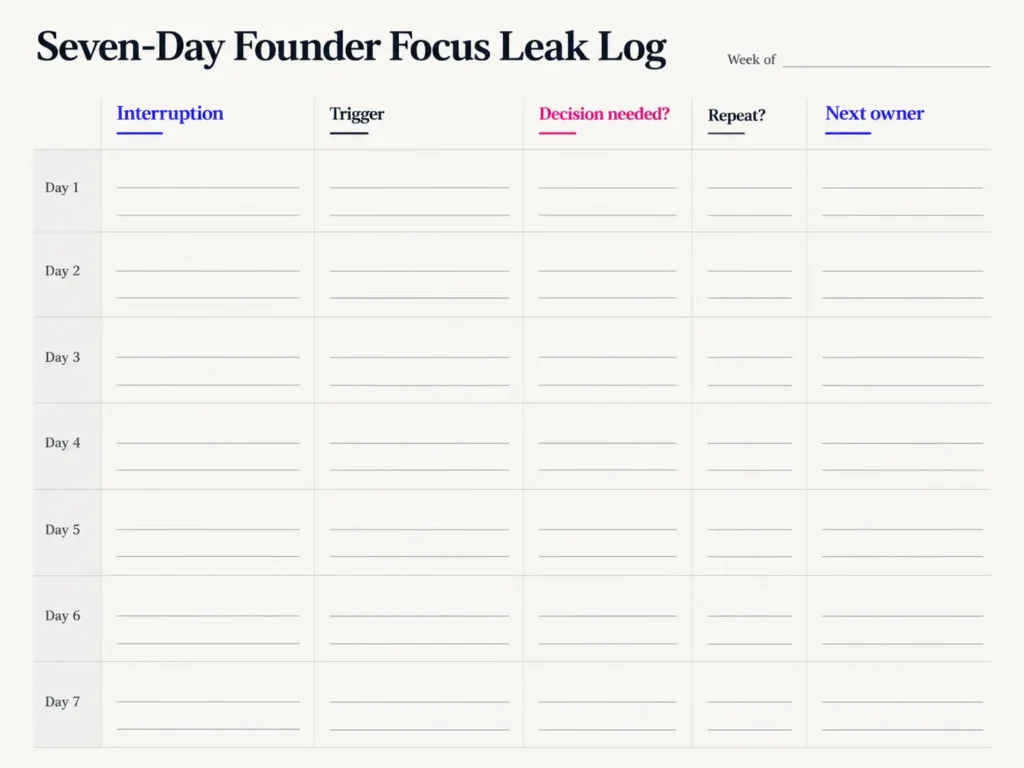
Record each meaningful interruption, task switch or repeated ownership request.
| Field | What to record |
|---|---|
| Interruption or task | What pulled you away from the work you intended to do? |
| Trigger | Person, notification, system, deadline or your own reminder |
| Planned or unplanned | Was this expected at this time? |
| Founder decision actually required? | Yes, no or partly |
| Recurrence | One-off, daily, weekly, monthly or unpredictable |
| Minutes consumed | Approximate time spent handling and returning from it |
| Source system | Email, chat, CRM, WordPress, spreadsheet, calendar or another tool |
| Could a rule, process or VA handle the next occurrence? | Identify whether the founder is genuinely necessary |
| Escalation condition | What exceptional situation should still come back to you? |
| Proposed owner | Founder, VA, employee, specialist, automation or another team member |
At the end of the seven days, do not simply rank entries by minutes.
Look for repeated loops.
Five ten-minute interruptions from the same process may deserve more attention than one fifty-minute task that genuinely required your expertise.
Look especially for patterns such as:
-
the same question appearing several times;
-
work waiting for your routine approval;
-
status requests you could receive in one scheduled update;
-
repeated information gathering before a decision;
-
tasks you complete because no owner has been defined;
-
notifications that could be handled through a rule;
-
routine execution that stops whenever you are unavailable.
Then choose one recurring loop to redesign.
Define the owner.
Define the normal process.
Define what does not need approval.
Define what should be escalated.
Define when you will review it.
Run the new arrangement and track whether that type of interruption becomes less frequent.
That is a more useful test of delegation than simply counting how many tasks you handed off.
Move one recurring loop, then measure the difference
Founder focus is difficult to protect when the founder remains the default routing point for routine execution.
Delegation can help, but only when the ownership moves with the work.
Start with one recurring loop.
Choose something that is process-based, reviewable and appropriate to hand off.
Give it a clear owner.
Set the normal decision boundary.
Create specific escalation rules.
Batch routine reviews where the risk level allows it.
Limit access to what the responsibility actually requires.
Then measure whether fewer questions, approvals and unfinished loops return to you.
At Boost VA, I support founders, agencies and online businesses with recurring execution across areas such as admin, research, data, WordPress, outreach and other process-based operational work.
If you can identify a recurring execution loop that keeps returning to you and want to see whether it can be handed off with clearer ownership, you can discuss the workload with me through Boost VA.