


How to Work With a Marketing Virtual Assistant Without Micromanaging
A marketing task can look fully delegated and still create constant back-and-forth.
You ask a virtual assistant to prepare next week’s campaign posts. The task sounds clear. But which audience is the priority? Which offer is current? Which creative has been approved? Can the copy be changed? Who approves the final version? What happens if the information in the brief conflicts with an older document?
The task is clear. The operating context is not.
Knowing how to work with a marketing virtual assistant starts after you decide what to hand over. If you are still choosing the right work, start with these marketing tasks to outsource to a virtual assistant.
Once the task has been selected, the goal is different. Your VA needs enough context, access, and authority to execute reliably without being expected to own your marketing strategy or ask for permission at every small step.
Give Your VA the Marketing Context, Not Just the Task
“Schedule these posts” tells someone what action to take.
It does not explain what the marketing is trying to achieve.
A useful handoff should connect the task to the campaign or business context behind it. Asana’s guidance on creating a project brief includes elements such as objectives, scope, timeline, and target audience. Those ideas adapt well to recurring marketing work.
Before handing over a marketing responsibility, make six things clear:
| Context | What the VA needs to know |
|---|---|
| Goal | What the work is meant to support |
| Audience | Who the message or campaign is for |
| Offer or message | What has already been approved |
| Channel | Where the work will be used |
| Assets | Which copy, creative, brand files, data, or links are current |
| Constraints | Deadlines, approval requirements, things that must not be changed |
The difference can be small in writing but large in execution.
Weak handoff:
“Schedule three LinkedIn posts for next week.”
Stronger handoff:
“Schedule these three approved founder posts for next week. They support the current consultation offer for agency owners. Use the graphics in the linked folder. You can adjust formatting, but don’t rewrite the offer. Send the final previews for approval by Thursday.”
The second version gives the VA something to work from without turning the assignment into a long instruction manual.
Turn Strategy Into a Reviewable Marketing Brief
A VA does not need a 20-page strategy document for every recurring task.
The brief only needs to contain enough information for the work to be executed and reviewed correctly.
For a simple recurring workstream, that may mean:
- the expected deliverable;
- the objective behind it;
- the deadline or review date;
- the approved source material;
- what the VA can change;
- what must be approved;
- what counts as complete.
Define “done” before work starts
A surprising amount of rework comes from two people having different definitions of finished.
“Upload the article” might mean publishing the supplied text exactly as received.
Or it might include formatting headings, checking links, adding metadata, compressing images, assigning a category, previewing mobile layout, and returning the final URL.
Those are different assignments.
Instead of discovering the difference at review time, define it in the brief.
For example:
Done means: Article is formatted in WordPress, links are checked, supplied metadata is entered, the post remains in draft, and the preview URL is returned for approval.
Now both sides can evaluate the same outcome.
Keep the current instructions and assets in one obvious place
Marketing work becomes harder when the latest brief is in email, the revised copy is in chat, the approved image is in another folder, and an old campaign document still looks current.
You don’t need a particular project-management tool. You do need an obvious source of truth.
If assets live in Google Drive, for example, its folder-sharing controls allow different people to receive different levels of access.
Whatever system you use, the VA should know:
- where the current version lives;
- which document takes priority;
- who can approve a change;
- what to do when two instructions conflict.
That last point matters. A good operating rule is to flag a meaningful conflict rather than silently guess which instruction should win.
Decide What the VA Can Do, What Needs Approval, and What Must Be Escalated
“Ask me if you’re unsure” sounds reasonable, but it doesn’t define authority.
If every decision requires a message, delegation becomes another form of supervision.
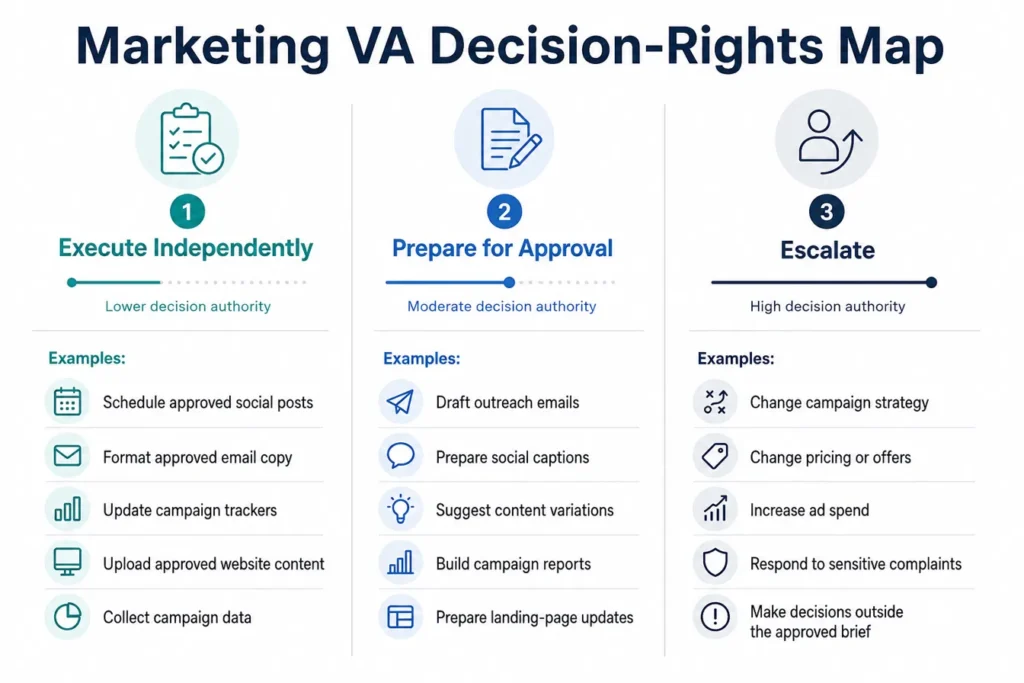
A more useful system is to divide decisions into three levels.
| Execute independently | Prepare for approval | Escalate |
|---|---|---|
| Schedule already approved content | Draft copy from an approved campaign direction | Change the target audience or core offer |
| Format supplied copy and creative | Prepare outreach prospects using agreed criteria | Make an exception to the agreed qualification rules |
| Update a reporting sheet from defined sources | Prepare a campaign or CMS change as a draft | Change an advertising budget, bidding approach, or targeting strategy |
| Upload approved assets to the agreed location | Assemble materials for a launch | Respond to a sensitive reputation or customer issue |
| Record results or evidence | Suggest a possible process improvement | Make a strategic decision outside the agreed scope |
These examples are not universal rules. The point is to define the boundary for your own workstream.
If you are still deciding which responsibilities should stay with you, the delegation matrix can help separate repeatable execution from work that depends heavily on judgment.
Clear boundaries also protect the VA from being held responsible for decisions they were never supposed to make.
Giving someone access to an advertising account, for example, does not automatically make them responsible for bidding strategy, audience decisions, budget allocation, or campaign optimization.
Access and authority are different things.
Give Access by Role, Not by Convenience
Marketing support often requires access to real business systems: advertising accounts, analytics, shared drives, social platforms, WordPress, CRM data, or reporting tools.
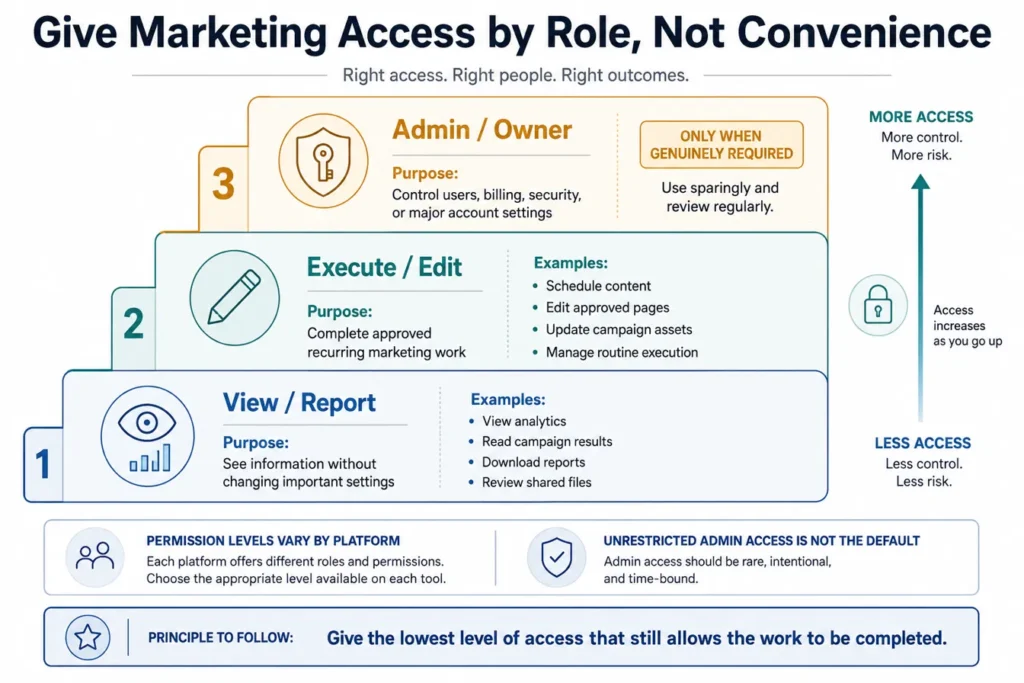
Where the platform supports separate users or permission levels, use them.
Google Ads, for example, provides different account access levels rather than requiring every collaborator to receive the same permissions.
The practical principle is simple:
Give enough access to complete the agreed responsibility, but don’t treat maximum access as the default.
A reporting task may only need visibility.
A content-execution role may need editing or publishing permissions.
Administrative ownership may need to stay with the business owner or the person accountable for the account.
Review permissions when responsibility changes
Access should follow the job.
If the VA takes on more responsibility, the current permission level may become too restrictive. If a workstream ends, old access may no longer be necessary.
So whenever you materially change the role, ask a simple question:
Does the current access still match the current responsibility?
This is easier than allowing permissions and responsibilities to drift apart over time.
Build a Review Rhythm Around Risk and Campaign Pace
There is no reason every marketing VA relationship needs the same weekly meeting.
A new campaign may need close review.
A mature recurring reporting task may need little live discussion.
A same-day promotion may require faster approval than evergreen content.
Asana’s guidance on project status reporting notes that reporting frequency can vary according to factors such as the project timeline, complexity, and stakeholder needs.
The same principle is useful here.
| Situation | Practical review approach |
|---|---|
| New workstream | Review the first few outputs more closely |
| Routine, repeatable work | Use concise asynchronous updates where practical |
| Material change requiring judgment | Review before the change goes live |
| Established recurring work | Reduce unnecessary meetings while keeping progress visible |
| Blocker or conflicting instruction | Escalate rather than waiting for the next routine review |
The objective is not to minimize communication at all costs.
It is to use communication for the things that need it.
Routine status does not always need a meeting. Decisions, exceptions, unclear results, and meaningful changes often deserve more attention.
If a weekly cadence fits the work, the existing virtual assistant weekly report template provides a structured way to capture status, blockers, evidence, and next actions without rebuilding that reporting system from scratch.
Review Outcomes and Evidence, Not Busyness
Marketing support creates two different kinds of results, and mixing them together can cause problems.
The first is execution quality.
Did the VA complete the work that was agreed?
The second is marketing performance.
Did the campaign produce the business result you wanted?
Those questions are related, but they are not identical.
| Execution evidence | Marketing-performance context |
|---|---|
| Deliverable completed | Leads or enquiries generated |
| Correct assets used | Conversion performance |
| Agreed deadline met | Engagement or response rate |
| Links or records supplied | Cost or efficiency metrics |
| Instructions followed | Revenue or pipeline impact |
| Exceptions flagged | Whether the campaign strategy should change |
For advertising, Google describes conversion goals as a way to organize conversion actions around advertising objectives.
That illustrates an important distinction.
Your marketing owner or specialist may be watching conversions, leads, cost, or another campaign KPI. A VA can help collect data, prepare reports, update systems, and execute approved work around those goals.
That does not automatically make the VA solely responsible for campaign performance.
Performance can also depend on the offer, audience, creative direction, budget, targeting, market conditions, and strategic decisions outside the VA’s control.
So define both:
What execution is the VA accountable for?
and
What marketing outcome is the owner or specialist evaluating?
Hours can still matter for capacity, planning, or billing, but they should not replace evidence that the agreed work was actually completed.
Expand the Role Only After the Handoff Works
The fastest way to make delegation messy is to expand responsibility before the original handoff works reliably.
Start with a defined workstream.
Then look for evidence that the relationship is functioning:
- instructions are understood;
- outputs are accurate;
- important exceptions are flagged;
- approvals happen at the right points;
- progress remains visible;
- the VA respects the agreed decision boundaries.
Once that becomes consistent, you can decide whether more responsibility makes sense.
That expansion should also match competence.
A VA who reliably prepares campaign assets, reporting, research, outreach, or content operations should not automatically become responsible for specialist strategy simply because they already work inside the marketing systems.
At Boost VA, I support recurring and project-based execution across areas such as outreach, lead sourcing, keyword research, link and citation work, social content operations, WordPress support, research, and structured reporting. The exact responsibility still needs to be defined around the work rather than assumed from the job title.
If you are still establishing the relationship itself, use the virtual assistant onboarding guide first. This article is most useful once the basic setup is complete and real marketing work is moving.
Use a Marketing VA Collaboration Card for Each Workstream
You can bring the principles above together in one small working document.
The Marketing VA Collaboration Card is not another task tracker. It defines how one marketing responsibility should operate.
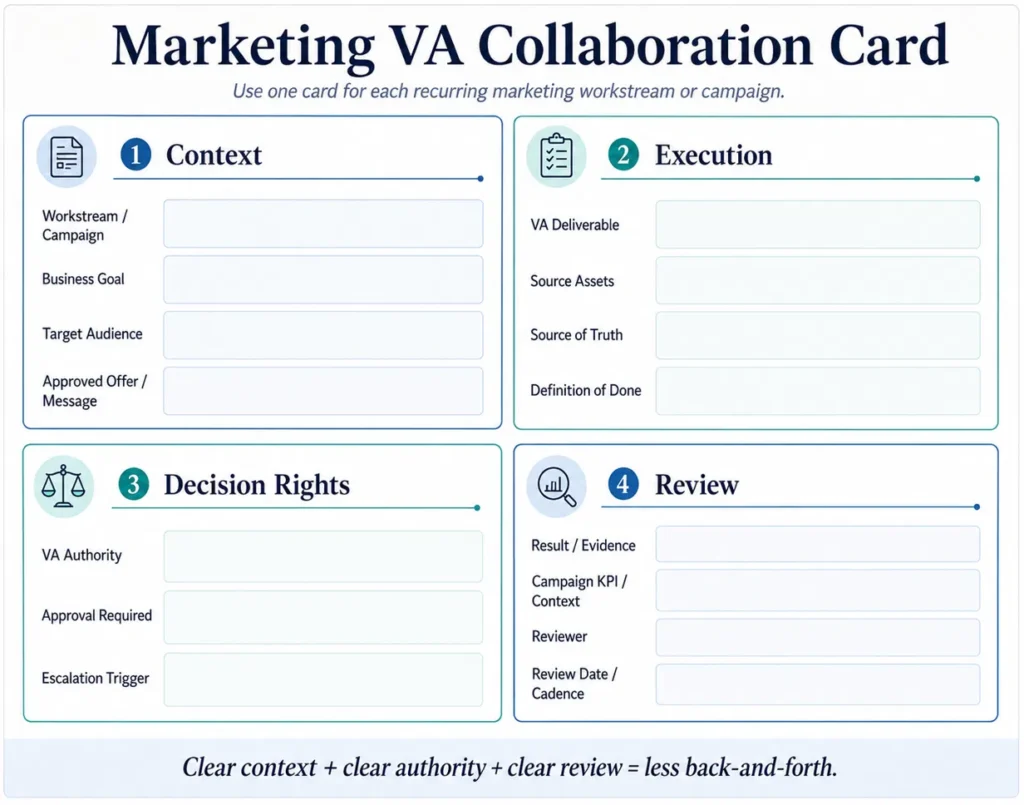
| Field | What to record |
|---|---|
| Workstream / campaign | The recurring responsibility or specific campaign |
| Business goal | What the work ultimately supports |
| Target audience | Who the marketing is for |
| Approved offer / message | The proposition or message already decided |
| VA deliverable | What the VA must produce, update, or maintain |
| Source assets | Current brief, brand guide, creative, copy, data, and links |
| Source of truth | Where the current approved version lives |
| VA authority | What can be executed without another approval |
| Approval required | What must be reviewed before publishing or changing |
| Escalation trigger | Situations that should stop the work and prompt a question |
| Definition of done | What must be true before the task can be closed |
| Result / evidence | URL, document, screenshot, status, dataset, or other proof |
| Campaign KPI / context | The outcome measure the marketing owner is watching |
| Reviewer | Person responsible for approval or strategic judgment |
| Review date / cadence | When the work should be reviewed again |
Keep the card short enough that people will actually use it.
Its value is not in documenting every possible situation. It is in removing the repeated questions that should already have an agreed answer.
Update it when the campaign changes, the VA’s authority expands, the source assets move, or the review requirements change.
The Goal Is Clearer Execution, Not More Supervision
A good marketing VA relationship does not require constant meetings or unrestricted authority.
It requires enough context for the VA to understand the work, a brief that defines what good looks like, clear decision boundaries, access that matches the responsibility, visible evidence, and review that fits the pace and importance of the work.
That gives both sides something more useful than “just handle the marketing.”
It gives them an operating agreement.
Choose one recurring marketing workstream you would like to delegate. Define the expected result and the decisions you want to retain. If you want help handling the execution layer, you can explore ongoing and project-based virtual assistant support and bring that defined workstream into the conversation.