
“Research five competitors and send me a presentation by tomorrow.”
That might sound like a reasonable assignment for a shortlisted virtual assistant. But what happens when one candidate spends hours designing slides, another submits a spreadsheet, and a third asks which competitors you actually mean?
The results may be impossible to compare. You never explained what the task should measure, how much time it should take, or what successful work would look like.
The purpose of a virtual assistant trial task is to observe how someone performs a small, representative piece of the work you intend to delegate. Pay for the assignment, give candidates comparable instructions, limit unnecessary access, and decide how you will evaluate the submissions before anyone begins.
This approach follows the logic of work-sample assessments described by the U.S. Office of Personnel Management (OPM): candidates perform activities that closely resemble the job, rather than relying entirely on what they say they can do.
The challenge is designing a trial that tests something worth knowing without making the assignment unnecessarily complicated.
Start With the Work You Will Actually Delegate
Choose one responsibility the virtual assistant would genuinely perform in the role.
If you need help with research, test research. If the role involves maintaining spreadsheets, use a small data-management assignment. If the main responsibility is WordPress publishing, assess the ability to prepare and check a draft rather than asking for an unrelated graphic design project.
Your virtual assistant job description should already identify the core responsibilities. Select a task from those responsibilities rather than inventing something that seems challenging.
OPM also makes an important distinction: work samples are most appropriate when candidates are expected to possess the relevant skills when they join. Testing someone on a specialized process you intend to teach during onboarding may tell you more about their unfamiliarity with your particular system than their suitability for the role.
Shrink the volume, not the judgment
The trial does not need to reproduce an entire working day.
Suppose the VA’s normal responsibility will be researching and qualifying dozens of businesses for an agency.
Instead of assigning the complete list, create a smaller sample that still requires the candidate to:
- Apply the correct qualification criteria.
- Check information against appropriate sources.
- Record useful evidence.
- Recognize missing or conflicting details.
- Present the findings in the format the agency actually uses.
Reducing the number of records makes the assignment manageable without removing the decisions that make the work meaningful.
The same principle applies elsewhere. Someone responsible for content publishing might prepare one draft in a staging environment. An administrative VA might categorize a small set of fictional customer requests and prepare draft responses.
The important question is whether the smaller assignment preserves the actual skill or judgment you need to observe.
Turn One Real Responsibility Into a Paid Trial Brief
Consider a fictional marketing agency preparing to hire a research virtual assistant.
The agency regularly researches potential ecommerce development partners for client projects. The VA will identify suitable businesses, verify service information, organize findings, and flag uncertainties for review.
An unstructured test might simply ask candidates to find five ecommerce agencies.
That leaves important questions unanswered. Which countries qualify? What services count? How should claims be verified? What does the agency expect when information is missing?
Here is how the same responsibility can become a more useful paid work sample.
Worked example: ecommerce partner research
| Brief element | Instructions given to the candidate |
|---|---|
| Business context | The agency needs research support identifying potential ecommerce development partners serving U.S. clients. |
| Assignment | Review six preselected company websites and determine which meet the supplied qualification criteria. |
| Qualification criteria | Look for evidence of Shopify development or migration services and evidence that the business serves U.S. clients. |
| Deliverable | Complete a six-row spreadsheet with company name, website, qualification status, supporting source links, reason for the decision, and unresolved questions. |
| Classification | Use Fits, Does Not Fit, or Unclear. Do not guess when evidence is insufficient. |
| Source material | The same six public company websites and written qualification criteria are provided to every finalist. |
| Permitted tools | Web browser and spreadsheet software. AI assistance is permitted for organizing notes, but factual claims must be checked against original sources. |
| Expected effort | The agency states an active-work estimate after testing the sample internally. |
| Submission deadline | Within two business days of accepting the assignment, for this illustrative example. |
| Restrictions | No contact with the companies, no access to the agency’s CRM, and no collection of unnecessary personal information. |
| Questions | Use the agreed message channel to raise missing instructions or conflicting evidence. |
| Payment | The agreed fee is confirmed before work begins and paid according to the trial agreement, regardless of the final hiring decision. |
This is an illustrative assignment, not a real hiring test or a validated assessment instrument. The agency must select and check its own source websites before using it.
Notice what changed.
The original responsibility remains recognizable, but the deliverable and evaluation conditions are now defined. The candidate knows what to investigate, where to record findings, and when to flag uncertainty.
For example, suppose a fictional company clearly advertises ecommerce design but provides no reliable indication that it works with Shopify.
The candidate should not automatically mark it as qualified because ecommerce and Shopify are related concepts.
Marking the company as Unclear, linking to the relevant services page, and explaining the missing evidence may be the more useful response.
The agency can evaluate that decision against a standard established before receiving any submissions.
This example primarily tests qualification research, source verification, documentation, and judgment. It does not independently prove that someone can manage an entire outreach campaign or maintain the agency’s CRM.
Agree on Payment and Realistic Time Expectations
When a trial requires substantive work and produces a deliverable, treat it as paid work.
For freelance hiring, this is both a practical and a professional consideration. Upwork’s freelancer-vetting guidance recommends using a short paid test project as one way to evaluate a freelancer.
On Upwork specifically, the platform’s Terms prohibit asking freelancers for free work as part of proposal bids or competitions.
That is an Upwork platform rule, not a universal statement about employment or contractor law in every country.
Before the candidate starts, agree on the assignment scope, fee, payment method, permitted expenses, and when payment will be made.
Expected effort and submission deadline are different
“Submit by Friday” tells the candidate when the work is due. It does not explain whether the assignment should require 30 minutes or most of a working day.
State both:
- Expected active effort: Your reasonable estimate of the time needed to complete the defined work.
- Submission deadline: The date and time by which the deliverable must be returned.
The expected effort should reflect the actual task. Test the brief yourself where practical, account for the context a new candidate needs to read, and revise an unrealistic estimate before sending it.
There is no evidence-based universal rule that every VA trial should last exactly one hour or any other fixed duration.
Similarly, if the real role allows reasonable research time, do not introduce an artificial speed contest unless working under a particular time constraint is genuinely part of the responsibility.
Keep the Trial Realistic Without Exposing Production Systems
Realistic work does not always require live business access.
Most short research assessments can use public information. Data-entry trials can use synthetic customer records. Inbox assessments can use fictional messages, while WordPress candidates can prepare content in a staging site with restricted permissions.
The National Institute of Standards and Technology’s principle of least privilege supports granting only the access necessary to perform an assigned task.
For a VA trial, that usually means choosing the lowest-risk environment that still allows the relevant skill to be observed.
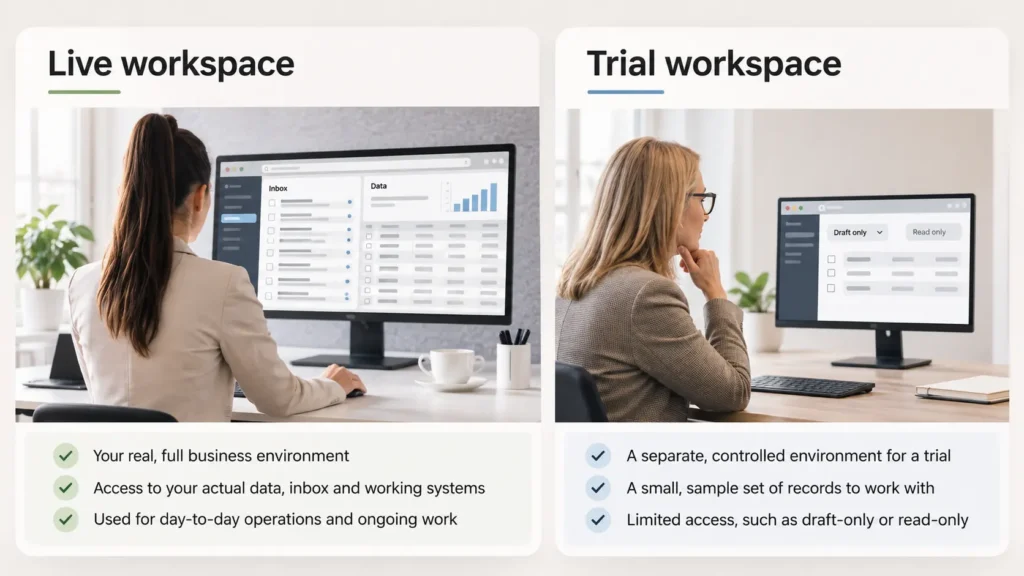
Consider these boundaries:
| Real responsibility | Safer trial equivalent |
|---|---|
| Responding to customer emails | Categorize fictional messages and prepare drafts without sending |
| Updating live CRM records | Clean a copied dataset with synthetic or redacted information |
| Publishing WordPress content | Format an approved sample in a staging or draft-only environment |
| Researching prospects | Evaluate a limited set of public sources without contacting anyone |
| Managing social content | Prepare a sample schedule without publishing or connecting live accounts |
Sometimes a particular skill genuinely requires working inside an application. In that case, use a suitable test workspace or narrowly restricted account where feasible.
Avoid granting full administrator privileges, sharing passwords unnecessarily, exposing customer records, or allowing irreversible changes simply to make the assignment resemble production work.
The trial can also assess approval judgment.
For example, an inbox candidate might identify a refund request that requires owner approval. The correct response could be to prepare a draft and flag the approval requirement, not issue the refund.
The objective is to observe whether the candidate handles the boundary appropriately, not to expose a real customer to an unnecessary hiring experiment.
Write the Scoring Rubric Before Reviewing Submissions
Good candidates can approach the same task differently. The scoring standard should help you distinguish acceptable variations from actual performance problems.
The OPM’s guidance on writing assessments emphasizes linking assessments to critical job competencies and applying standardized review and scoring procedures.
For a virtual assistant trial, translate that principle into observable outcomes.
In the ecommerce research example, useful dimensions include accurate qualification, evidence quality, adherence to instructions, and handling uncertain information.
Those dimensions are more relevant than vague judgments such as whether the candidate seems naturally talented, enthusiastic, or professional.
Example scoring criteria
The following illustrative rubric uses three rating levels for each criterion.
| Criterion | 0: Significant issue | 1: Partially meets expectation | 2: Meets expectation |
|---|---|---|---|
| Qualification accuracy | Decisions repeatedly conflict with the supplied criteria | Most decisions follow the criteria, but some errors remain | Decisions correctly apply the criteria, including appropriate Unclear classifications |
| Source evidence | Required evidence is absent or unreliable | Some evidence is present but incomplete | Important findings are supported by relevant, traceable sources |
| Instruction compliance | Material requirements or restrictions are missed | Deliverable is usable but needs minor corrections | Required fields, format, tools, and restrictions are followed |
| Uncertainty handling | Missing facts are guessed or presented as verified | Uncertainty is identified but poorly explained | Missing or conflicting evidence is clearly flagged with a useful next question |
For this example, the four criteria could be scored equally, giving an illustrative maximum of eight points.
Eight points is not a scientifically validated hiring threshold. The scale is simply a way to document observations for this particular assignment.
If one dimension genuinely matters more than another, document the weighting and reason before the trial starts. Do not alter the weights after seeing which candidate performs best.
When comparing finalists, use the same essential task, information, permitted tools, scoring rules, and opportunity to ask questions.
Different candidates may need reasonable accommodations or adjustments to access the assessment fairly. Consistency should not mean ignoring legitimate accessibility needs.
Also avoid scoring skills the assignment does not actually observe. The research trial above cannot reliably measure WordPress administration, design ability, or long-term attendance.
For broader guidance on which behaviors matter, see the qualities worth observing in a virtual assistant. The trial itself should focus on the subset relevant to the responsibility being tested.
Treat Useful Questions as Evidence of Judgment
An unanswered question is not automatically a weakness.
Suppose the trial brief requires U.S. service coverage, but one company lists a U.S. office without explaining whether its delivery team supports U.S. customers.
The candidate might ask whether an office address is sufficient evidence or classify the record as Unclear and explain why.
Either response may show appropriate judgment, depending on the instructions.
What matters is whether the person recognizes a meaningful uncertainty and handles it within the agreed boundaries.
Compare three possible responses:
- Guessing: Mark the company as qualified without sufficient evidence.
- Unhelpful escalation: Ask the client to decide every routine detail without attempting the assigned research.
- Useful judgment: Record available evidence, identify the specific missing information, and ask for clarification only when necessary.
When candidate questions reveal a genuine ambiguity in the task brief, provide equivalent clarification to everyone affected by that ambiguity. Otherwise, the assessment conditions may become different without you intending them to.
The goal is not to reward the person who asks the fewest questions. It is to observe whether they know when to proceed and when to stop.
Debrief the Submission Before Making a Hiring Decision
Once the work has been returned and scored, a short debrief can help explain decisions that are not obvious from the final spreadsheet or document.
Keep the questions consistent across comparable candidates. For example:
- Which part of the assignment required the most judgment?
- Which source or instruction was unclear, and how did you handle it?
- What would you verify before this work was used in a real client project?
- What would you improve if you repeated the assignment with more context?
The candidate may explain a reasonable interpretation you had not considered. That can reveal a weakness in the brief, not necessarily a weakness in their work.
Record the explanation, but do not invent a new scoring criterion simply because one candidate gives an impressive answer.
If the original task was materially flawed, document the problem and treat affected submissions consistently rather than making candidate-specific exceptions.
What one trial cannot prove
Even a strong submission represents performance on one assignment under one set of conditions.
It does not establish how someone will perform across months of work, manage every unfamiliar situation, or respond to shifting priorities.
Nor does it independently prove who completed the work. Identity and access verification addresses a different hiring question.
Use the trial alongside relevant work history, interviews, references where appropriate, and clear agreements about who will perform the work.
The result should increase your understanding of the candidate’s job-relevant performance, not create false certainty.
Copy the Paid VA Trial Task Design Rubric
Use the following worksheet before inviting shortlisted candidates to complete an assignment.
It combines task design, assessment conditions, access boundaries, payment, and scoring into one practical planning tool.
| Trial design field | What to write before sending the assignment |
|---|---|
| 1. Actual responsibility | Which recurring VA responsibility or defined project task does this represent? |
| 2. Work sample and deliverable | What smaller version of the work will the candidate complete, and what should they submit? |
| 3. Context and source material | What instructions, examples, source files, qualification rules, or reference materials will everyone receive? |
| 4. Tools and AI rules | Which tools may be used? Is AI assistance permitted, restricted, or subject to disclosure? |
| 5. Expected effort and deadline | What is the reasonable active-work estimate, and when must the submission arrive? |
| 6. Payment agreement | What fee, payment terms, and expense limits have been agreed? |
| 7. Access and approval boundary | Which test accounts or materials are available? What must not be sent, published, changed, or accessed? |
| 8. Questions and escalation | Where should candidates ask questions? What conditions require them to stop and request clarification? |
| 9. Scoring criteria | Which observable outcomes will be scored, what rating anchors apply, and are any weights justified? |
| 10. Candidate debrief | Which consistent follow-up questions will help explain the work? |
| 11. Interpretation limits | Which abilities does this task genuinely assess, and which important hiring questions remain unanswered? |
Complete the worksheet before inviting candidates rather than filling it in after the results arrive.
For example, if you cannot explain what counts as a correct research record, the qualification criteria probably need more work.
If the candidate cannot complete the sample without receiving full access to your live customer database, reconsider the test environment.
If your scoring plan depends heavily on whether you personally like the submission, replace that preference with observable standards wherever practical.
This rubric is a practical planning resource informed by work-sample, standardization, payment, and access-control principles. It is not a validated psychometric assessment, and it does not establish a universal hiring pass mark.
Choose the Smallest Trial That Gives You Useful Evidence
The strongest trial is not necessarily the most difficult assignment.
It is the smallest credible sample of the work you need completed, with enough context for the candidate to succeed and enough structure for you to evaluate the result.
Pay for substantive work, apply relevant standards consistently, and recognize what the result does and does not demonstrate.
After selecting someone, the next step is to onboard the virtual assistant for the real working relationship. That involves introducing actual systems, permissions, processes, and expectations rather than extending the hiring test indefinitely.
If you already know which responsibilities need support but would rather discuss a defined project or ongoing assistance, you can review my virtual assistant services.
Clear responsibilities make both candidate assessments and future working arrangements easier to manage.