


Hiring a digital marketing virtual assistant does not automatically create more marketing capacity.
If the assistant receives vague instructions, scattered source material, excessive access, unclear approval rules, and no definition of what finished work should look like, you may simply replace one workload problem with another.
The more useful question is how to work with a digital marketing virtual assistant so repeatable marketing work can move forward while the right strategic and specialist decisions stay with the people responsible for them.
A good setup does not require an elaborate management system. It requires clear ownership, usable briefs, sensible access, defined review points, and a practical way to measure whether the working relationship is actually improving execution.
Start with the work, not the job title
“Digital marketing virtual assistant” can describe many different kinds of support.
That does not mean every marketing VA should handle every marketing activity.
Start by identifying the work that actually needs an owner.
At Boost VA, my current marketing-related support includes areas such as SEO and outreach execution, keyword and company research, backlink prospecting, social and content operations, WordPress publishing and maintenance, data work, and reporting preparation. You can see the broader virtual assistant support available through Boost VA.
The important part is matching the responsibility to the person’s actual skills and the amount of judgment the work requires.
Good execution candidates
Recurring marketing work is usually easier to delegate when it has four characteristics:
-
the expected output can be described;
-
the source information can be identified;
-
the work follows reasonably repeatable rules;
-
somebody can review the result.
Examples might include preparing a WordPress draft from approved content, scheduling approved social posts, updating an outreach sheet, collecting competitor information from defined sources, checking required fields in a marketing database, or preparing a recurring report from agreed metrics.
These responsibilities are different from saying, “Handle our marketing.”
A broad instruction transfers uncertainty rather than ownership.
A narrower responsibility such as “Publish each approved article in WordPress using this checklist and move it to review when the SEO fields, links, formatting, and supplied images are complete” gives the assistant something observable to own.
Decisions that should stay with you or a specialist
Execution support should not quietly turn into authority over decisions the assistant was never hired or qualified to make.
Your business may already have a digital marketing strategy covering goals, audience, positioning, priorities, channels, resources, and measurement.
A marketing VA can help execute parts of that strategy without becoming the person accountable for setting it.
For example:
-
A VA can gather competitor information. A strategist should interpret what that information means for positioning.
-
A VA can prepare an SEO content draft or update approved on-page elements. The appropriate SEO or content owner should make specialist decisions outside the agreed scope.
-
A VA can organize campaign data. The responsible marketing owner should decide whether that data justifies changing strategy or budget.
-
A VA can prepare content for publishing. Final brand, compliance, or high-risk approval can stay with the relevant decision-maker.
This follows the same broader principle covered in my guide to tasks that should not be delegated to a virtual assistant alone: preparation and execution can move without automatically transferring final authority.
Build a usable marketing brief
Many delegation problems begin before the VA touches the task.
“Please schedule our marketing.”
“Do some competitor research.”
“Update the website.”
“Handle outreach.”
Each instruction points toward an activity, but leaves several important questions unanswered.
A useful brief should tell the assistant what outcome is expected, where the current source material lives, what actions are permitted, what finished work looks like, and when a decision needs to return to you.
For an agency environment, this same principle appears throughout a good marketing agency VA workflow. The specialist or strategist supplies direction, while repeatable preparation, execution, coordination, and follow-through can move through a defined handoff.
Define the goal, source, output, and definition of done
Suppose you need four approved blog posts prepared in WordPress this month.
A weak brief says:
“Upload these to WordPress.”
A stronger brief defines:
Outcome: Four complete WordPress drafts ready for editorial review.
Source: Approved Google Docs and supplied image folder.
Permitted actions: Format content, add approved internal links, upload supplied images, complete specified SEO fields, preview the page, and save as draft.
Definition of done: Formatting is complete, links work, supplied images are placed correctly, SEO fields are populated, desktop and mobile previews have been checked, and the article is waiting in the agreed review status.
Decision boundary: Do not substantially rewrite approved copy or publish the post without approval.
Blocker rule: Flag missing images, conflicting instructions, broken destinations, or unclear SEO information instead of guessing.
That level of detail makes the responsibility much easier to execute and review.
If you use a project-management tool, my Trello and Notion delegation tutorial shows how fields such as owner, outcome, source, due date, definition of done, review status, and blocker rules can stay with the task itself.
Define approval and escalation rules
A VA should know when independent action is appropriate and when the work should come back to you.
Good escalation rules are specific.
For example:
-
If an approved social post simply needs scheduling, proceed.
-
If the source document contains conflicting publication dates, stop and flag it.
-
If an outreach prospect fails the agreed qualification criteria, exclude or flag it according to the SOP.
-
If a WordPress update would require administrator-level changes outside the assigned responsibility, escalate it.
-
If campaign data looks unusual, record the issue and send it to the responsible marketing owner rather than independently changing strategy.
The goal is not to make the assistant ask permission for every small action.
It is to make the boundary between normal execution and decision-making visible.
Set up access and communication safely
A marketing VA may need access to WordPress, shared documents, project-management tools, spreadsheets, analytics, social platforms, or other systems.
That does not mean every system needs to be opened completely.
The NIST principle of least privilege says access should be limited to the minimum necessary to perform an assigned function.
Applied to virtual assistance, that means giving access according to the actual responsibility.
Someone preparing WordPress drafts, for example, does not automatically need hosting, billing, domain-management, or unrestricted administrator access.
Where the platform allows it:
-
create a separate user account;
-
grant the appropriate role rather than the highest role;
-
share only relevant folders or projects;
-
enable suitable account-security controls;
-
record what access was granted;
-
review permissions when responsibilities change;
-
remove access when it is no longer required.
My broader guide on how to onboard a virtual assistant goes further into preparing accounts, instructions, SOPs, access, first assignments, and review points.
Communication should be equally deliberate.
Choose one reliable place for assigned work. Chat can still be useful for questions, but the final task, source material, deadline, current owner, and review status should not live across several disconnected conversations.
This becomes especially important as the number of recurring marketing responsibilities increases.
Review channel-specific work without micromanaging
Review does not mean checking every click an assistant makes.
It means deciding what needs inspection before the work moves forward.
The right review point depends on the work.
SEO and outreach support
For research, prospecting, citations, or outreach preparation, review may focus on:
-
whether qualification rules were followed;
-
source accuracy;
-
missing or duplicate records;
-
relevance;
-
required fields;
-
issues that were correctly escalated.
The reviewer does not necessarily need to reproduce the research. They need enough visibility to judge whether the agreed rules were applied properly.
Content and social operations
For approved content, review might cover:
-
correct copy;
-
correct destination or account;
-
formatting;
-
links;
-
supplied creative;
-
scheduling date and time;
-
required metadata;
-
whether publication still requires approval.
If the assistant is preparing rather than approving content, make that distinction explicit.
WordPress work
For publishing support, use a consistent completion checklist.
Depending on the assignment, this could include:
-
heading structure;
-
links;
-
images and alt text;
-
SEO fields;
-
formatting;
-
desktop preview;
-
mobile preview;
-
correct status;
-
final reviewer.
A repeated checklist is often more useful than repeatedly explaining the same standard.
Research and reporting
For research or reporting work, agree on the data source, required fields, reporting period, treatment of missing data, and how unusual results should be flagged.
A marketing VA can prepare reliable information for decision-makers without being made responsible for every conclusion drawn from it.
Measure the workflow, not just marketing outcomes
One of the easiest mistakes is judging a marketing VA only against outcomes they do not completely control.
Traffic, leads, rankings, conversion rates, revenue, and campaign performance can depend on strategy, market conditions, creative, pricing, website quality, specialist decisions, budget, competition, and many other factors.
Those measures can still matter.
For example, Google Analytics provides traffic-source dimensions that help businesses understand where visitors came from and how marketing channels contribute to acquisition.
But a useful VA review should separate marketing outcomes from execution quality.
Depending on the responsibility, consider operational measures such as:
-
percentage of assigned work completed on time;
-
task cycle time;
-
age of the recurring backlog;
-
number of avoidable corrections;
-
completeness of required fields;
-
accuracy against the supplied source;
-
whether blockers were escalated at the right time;
-
reporting freshness;
-
whether review queues are becoming easier or harder to manage.
Then add the marketing metrics relevant to the workstream.
For example, an assistant responsible for maintaining an outreach database might be reviewed on qualification accuracy, completeness, duplicate control, and turnaround. Outreach response or link-acquisition results can also be monitored, but those results should not erase the distinction between execution quality and the wider factors affecting campaign performance.
Measurement becomes more useful when it answers two separate questions:
-
Is the marketing work itself producing the desired outcome?
-
Is this delegated workflow executing the agreed responsibility reliably?
Do not assume those are the same question.
Common reasons marketing VA handoffs fail
Most problems are not caused by one dramatic mistake. They usually begin with small ambiguities.
The responsibility is too broad
“Manage our digital marketing” does not identify what the VA owns.
Reduce it to specific responsibilities with observable outputs.
Strategy is being disguised as a task
Researching competitors and deciding how to reposition the company are different responsibilities.
Collecting campaign data and deciding how to allocate a major budget are different responsibilities.
Keep those boundaries visible.
The source material is unclear
If the assistant does not know which document, spreadsheet, product information, or approved copy is current, the risk of rework increases.
Link the current source directly inside the task.
Access is broader than the responsibility
Convenient access is not automatically appropriate access.
Give the permissions required for the work and review them as the role changes.
Everything requires constant chat approval
A relationship can become difficult to scale when every minor decision creates another message.
Define what can proceed automatically, what waits for scheduled review, and what requires immediate escalation.
There is no definition of done
“Complete the research” may mean ten different things.
Specify the required fields, quantity or coverage, quality rules, output location, and review status.
The wrong outcome is being measured
A VA should not receive automatic credit or blame for an entire marketing result that depends on several owners.
Match performance measures to the responsibility the person actually controls.
Marketing VA Handoff Card
Use this compact card before transferring a recurring marketing responsibility.
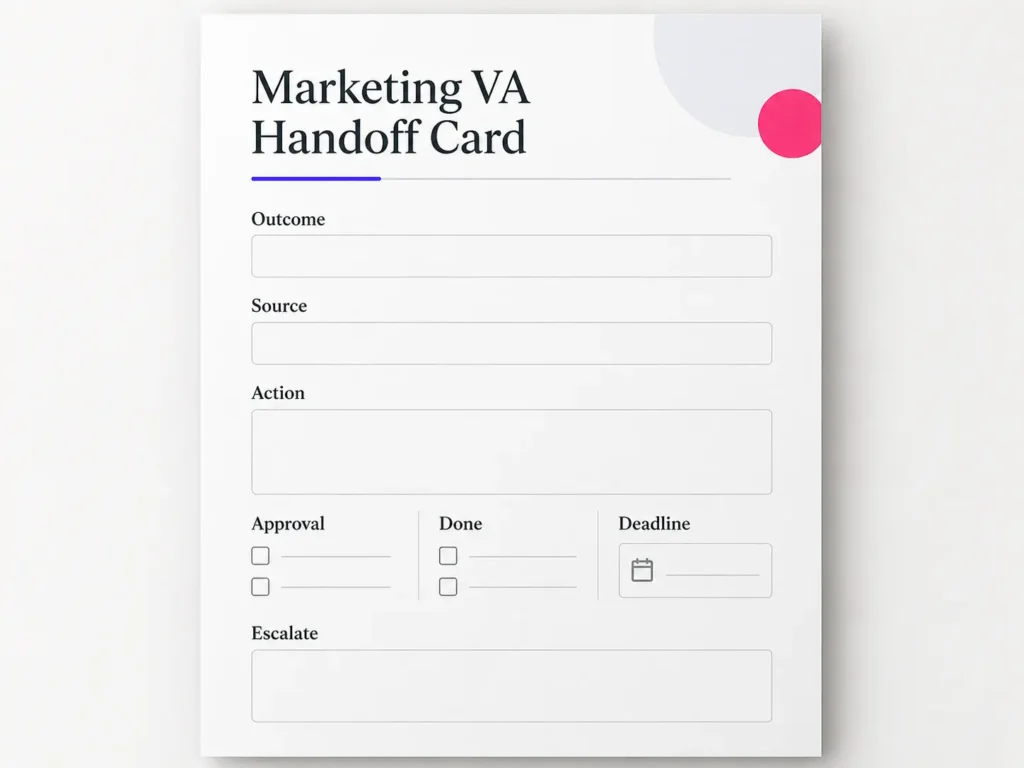
| Field | What to define |
|---|---|
| Responsibility | The recurring task or workstream being transferred |
| Intended outcome | What should exist when the work is complete |
| Source | Where the current approved information lives |
| Permitted action | What the VA can do without further approval |
| Decision boundary | What must remain with you or a specialist |
| Definition of done | The conditions that make the task ready for review or completion |
| Cadence/deadline | When and how often the work should happen |
| Access required | The minimum tools, folders, accounts, or permissions required |
| Measurement | Which operational or marketing fields should be recorded |
| Escalation condition | Which uncertainty, exception, risk, or blocker should be raised |
| Reviewer | Who approves the final output when approval is required |
For example, a recurring social-content responsibility might look like this:
Responsibility: Schedule approved weekly social content.
Outcome: All supplied posts scheduled on the approved accounts for the correct dates.
Source: Final approved content calendar and creative folder.
Permitted action: Schedule approved copy and supplied creative.
Decision boundary: Do not rewrite offers, create unapproved claims, change campaign direction, or publish additional content without approval.
Definition of done: Posts are scheduled correctly, links are checked, dates match the calendar, and the schedule is recorded in the project system.
Escalation: Missing creative, conflicting dates, unclear links, rejected uploads, or a requested change outside the approved content.
Once this information is stable, save it as a reusable template rather than rebuilding the handoff every week.
A digital marketing VA is most useful when the working relationship gives them enough clarity to execute without forcing them to guess.
Start with one recurring responsibility. Define the source, output, decision boundary, access, completion standard, review rule, and reporting requirement. Run the workflow, inspect where questions or rework appear, and improve the handoff before expanding the scope.
At Boost VA, I support founders, agencies, and online businesses with clearly scoped execution across areas such as SEO and outreach, content operations, WordPress, research, data, and recurring backend marketing work. If you have a defined marketing workload that needs reliable execution, you can discuss the work with me through Boost VA.