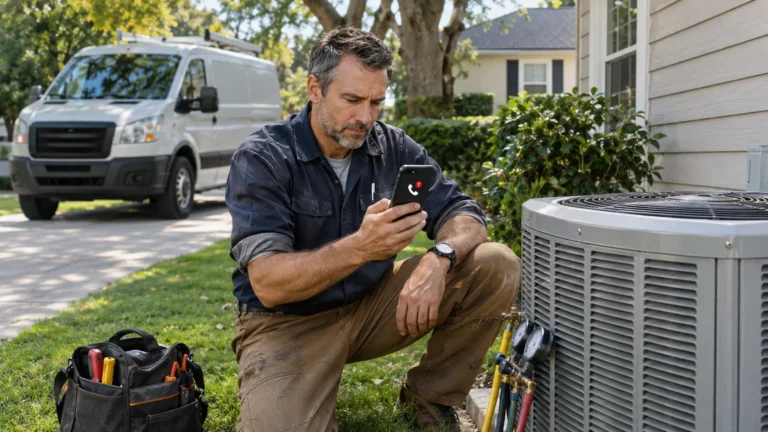
Your HVAC company has a missed call while the technician is working at another home. The voicemail says, “My AC is making a strange noise. How much will it cost to look at it, and can somebody come today?”
Three replies might sound helpful: “It’s probably an $89 visit,” “That sounds like a bad capacitor,” and “We’ll be there by 3.” None is safe unless the business has verified the relevant facts and authorized that promise. This is a fictional example, not a Boost VA client case.
Missed call follow-up for home service businesses should give the caller a useful next step without turning an assistant into a technician or dispatcher. Always acknowledge the enquiry, capture the details, route it to the right person, and log the outcome. Never invent a quote, diagnose equipment, promise an unconfirmed arrival time, or improvise safety instructions. This US-focused guide shows how to put those boundaries into a callback card.
Why missed calls are about boundaries as well as speed
Returning a call promptly matters, but a quick, incorrect commitment can cause more trouble than a careful callback. The person responding needs to know which answers are already approved and which require the estimator, technician, owner, or dispatcher.
There’s a financial reason to pay attention, too. Google’s Local Services Ads guidance says an unanswered call during business hours can count as a valid paid lead when the caller remains on the line for more than 20 seconds. Voicemail calls may also qualify, even if no message is left. The conditions depend on the active ad schedule, Business Profile hours, and call-routing setup. Google also says missed calls may hurt advertiser responsiveness, a factor in ad ranking. These rules apply to Local Services Ads, not every incoming business call.
How quickly should you call back?
Use the earliest practical callback window within the hours your business has approved. Keep the queue visible so missed calls are not forgotten, but don’t turn “five minutes” into an unsupported rule. Harvard Business Review’s 2011 research concerned online sales leads, not missed HVAC or plumbing calls. It suggests delay can matter; it does not establish a universal response deadline for home-service businesses.
Four promises a non-technical assistant should not make
The callback person’s authority stops where a statement would require an inspection, a qualified judgement, or an unavailable schedule.
- No unapproved price: don’t offer a diagnostic fee, estimate, discount, or “usual price” unless the owner has approved precise wording and any conditions.
- No diagnosis: don’t name a failed component or tell a caller that an issue is harmless. Capture the symptoms in their words instead.
- No invented arrival time: don’t promise “today,” “within an hour,” or an exact time unless the booking and dispatch rules genuinely authorize it.
- No improvised safety advice: don’t troubleshoot gas, wiring, or dangerous water situations. Use only the approved emergency instructions and referral route.
This is an applied example of decisions that should not be delegated without clear authority. Written approval levels matter more than how confident someone sounds on the phone.
The callback authority card
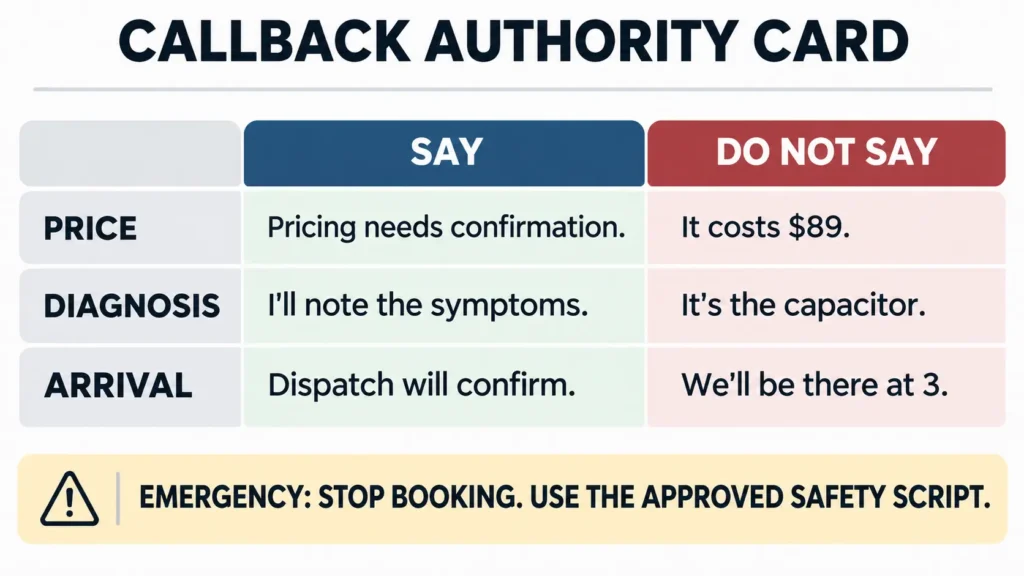
Keep this one-page card where the person managing the queue can see it. The owner should replace every bracketed field, check every statement against actual policy, and approve the final wording. The pairs below are examples, not quotations from real customer calls.
1. “How much will it cost?”
Say: “I can take the details and ask [estimator or owner] to confirm the pricing. Our approved [diagnostic fee], if applicable, is [amount and conditions].” Remove the second sentence unless the fee and its conditions have been verified and approved.
Don’t say: “It’s usually $89, and the repair shouldn’t be expensive.”
2. “What’s wrong with my unit?”
Say: “I’ll record the noise you’re hearing and when it started so the technician can review it.”
Don’t say: “That sounds like a capacitor. You can keep running it until we arrive.”
3. “Can someone be here today?”
Say: “I can request [an approved appointment window], but [dispatcher] will confirm availability before it’s booked.” If the assistant has access to a genuinely approved, live booking calendar, they may offer only the slots the owner has authorized.
Don’t say: “Someone will be at your house by 3.”
4. “Is this under warranty?”
Say: “I can record the job date, invoice reference, and equipment details for the person who handles warranty checks.”
Don’t say: “Yes, we’ll fix it free of charge.”
5. “Are you licensed and insured?”
Say: “I can share the verified license or insurance information we’ve approved for this question, or have [responsible contact] confirm the details.”
Don’t say: “We’re fully licensed and insured for any job you need,” unless the business has verified that exact scope and authorized the statement.
If the caller is unhappy about previous work, treat it as an existing-customer issue rather than a fresh lead. Use a separate customer complaint escalation process for refunds, allegations, and disputed promises. The goal of the card is to give precise language, not a new decision-owner matrix.
Hard stops: emergencies are not ordinary booking requests
When someone reports a suspected gas leak, an assistant must switch from scheduling to the approved emergency message immediately. The US Pipeline and Hazardous Materials Safety Administration (PHMSA) tells people who suspect a natural gas leak to leave the area and call 911 from a location well away from the leak. It also warns against using a phone near the leak or operating electrical switches that could create sparks.
An owner-approved line might be: “If you suspect a gas leak, leave the area now. Once you are safely away, call 911 or your gas utility’s emergency line. Please don’t use your phone or electrical switches near the suspected leak.” The assistant should not continue troubleshooting or promise a visit instead of emergency help. After giving the instruction, alert the business’s designated on-call contact under its internal procedure.
Active flooding, exposed or sparking wiring, and other immediate hazards also require a stop to ordinary booking. Use safety instructions approved from appropriate emergency or utility guidance; when there is immediate danger, direct the caller to local emergency services. Do not invent technical instructions during the conversation.
Businesses advertising 24/7 emergency response need an actual after-hours coverage arrangement, such as an on-call qualified technician or suitable live answering service. An assistant who only checks a queue during office hours is not emergency coverage.
What to record when a caller cannot book yet
The follow-up record should let the next person continue without asking the customer to repeat the whole story. Keep only the information necessary for the job and the contact method the caller has permitted.
- Caller name and verified callback number
- Service address and ZIP code, if needed to check coverage
- Requested service and symptoms in the caller’s own words
- New customer or existing customer, plus any known job reference
- Urgency flag, including the exact words that triggered any emergency routing
- Preferred callback time and whether texting is permitted, with the basis or record for that permission
- Lead source, when known, such as a Local Services Ad or website contact
- Attempt time, result, assigned next contact, and next action
Logging is an appropriate administrative task when access and data rules are agreed. Protect important CRM fields using clear field-ownership rules so an assistant’s call note does not accidentally rewrite lead attribution or the pipeline stage.
Three text-back messages to approve before using
These are examples for a business with a verified lawful basis to send the message, an appropriate texting service, and an owner-approved response policy. A missed call alone is not blanket permission to send automated or marketing texts. When permission is uncertain, use an appropriate callback or voicemail instead of assuming the first text is allowed.
First response to a missed call
“Hi [Name], this is [Business]. We noticed your call about [service, if known]. If you would like to continue by text, reply YES, or call us at [number]. [Approved opt-out wording, if applicable.]”
After an unanswered callback
“Hi [Name], this is [Business]. We tried returning your enquiry. You can call [number] during [approved hours], or reply with a suitable time if you’ve agreed to texts. [Approved opt-out wording, if applicable.]”
When someone asks for a price by text
“Thanks for the details. [Estimator or technician] needs to confirm the pricing for [service]. I can pass along your request and the best time to reach you. [Approved opt-out wording, if applicable.]”
Texting rules depend on the message, technology, consent, and jurisdiction. For example, Twilio’s error 30034 documentation says it blocks US-bound messages from unregistered +1 ten-digit long-code numbers that are not linked to an approved A2P 10DLC campaign. That platform requirement is not, by itself, proof that the recipient consented.
The FCC’s October 2026 consent-revocation rule, effective November 25, 2026, changes how consent can be revoked for certain covered automated calls and texts. Where the rule applies, senders must properly handle recognized opt-out words such as STOP, QUIT, END, REVOKE, OPT OUT, CANCEL, and UNSUBSCRIBE. Informational messages and marketing messages are not treated identically. The federal 8 a.m. to 9 p.m. rule specifically addresses residential telephone solicitations; it is not universal permission to contact a missed caller at any time. State rules may be stricter.
This is practical US-oriented operational guidance, not legal advice. Before putting templates into automated use, confirm consent, message type, opt-out handling, local calling hours, and carrier requirements with the business’s messaging provider or qualified adviser. Keep promotional offers out of routine service replies unless the marketing permissions and rules have been separately checked.
Does an AI receptionist remove the need for a callback card?
Not entirely. Automatic text-back can acknowledge a contact, an AI receptionist can gather information, and a person can follow up when a decision is outside the system’s limits. Those are different functions, not interchangeable guarantees.
Jobber’s Receptionist documentation says the product creates follow-up tasks when a caller is not ready to book or submit a request. Someone still needs to own those tasks. The same price, scheduling, safety, and approval boundaries should govern automated messages and human follow-up. For broader decisions about automation limits, see when not to use AI for business tasks.
Write the five decisions only the owner can approve
Before handing over a missed-call queue, write down five decisions:
- Price language: Which verified fees can be stated, with which conditions?
- Booking permission: Which appointment windows may be offered, and who confirms dispatch?
- Coverage and handoff: Which service areas qualify, and who receives undecided or after-hours requests?
- Safety stops: Which scripts are approved for gas, water, electrical, and other urgent reports, and who provides live emergency coverage?
- Texting and records: Which contact permissions, sender setup, opt-out route, and CRM fields have been approved, and who reviews exceptions?
Turn these answers into a short, maintained standard operating procedure and review any unclear callback before widening the assistant’s authority. You don’t need to turn every missed call into a full intake interview; you need a next step that is accurate and can be acted on.
At Boost VA, my administrative and CRM support can help keep follow-up lists, records, and approved templates organized, without implying live phone-answering or emergency dispatch coverage. If that behind-the-scenes workload is what you want to hand off, get in touch to discuss the scope.